

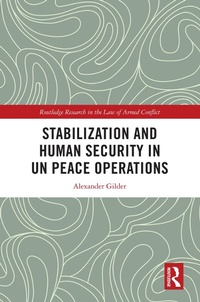
Stabilization and Human Security in UN Peace Operations
1st Edition
Published on 29. November 2021
210 pages
978-1-000-50408-8 (ISBN)
Description

UN peace operations are increasingly asked to pursue stabilization mandates with lofty expectations of being able to stabilize conflict zones, achieve national reconciliation, and rebuild state legitimacy. This book investigates the relationship between UN stabilization mandates and the concept of 'human security'.
The book is divided into three parts. Part I outlines the emergence of stabilization and other trends in peacekeeping practice and outlines an analytical framework of human security. Part II applies the analytical framework to case studies of MINUSMA, MINUSCA, and UNMISS examining issues, such as human rights, empowerment, protection, and vulnerability. In Part III the book draws out several concerns that arise from stabilization mandates, including the militarisation of UN peace operations and the consequences under international humanitarian law, the risks of close cooperation with the host state and engagement in counter-terror activities, and the potential clash between peacebuilding activities and militarisation.
The book will be a valuable resource for academics, policymakers and practitioners working on UN peacekeeping generally, and those specifically looking at stabilization, from the perspective of international relations, international law, peace and conflict studies, security studies and human rights.
The book is divided into three parts. Part I outlines the emergence of stabilization and other trends in peacekeeping practice and outlines an analytical framework of human security. Part II applies the analytical framework to case studies of MINUSMA, MINUSCA, and UNMISS examining issues, such as human rights, empowerment, protection, and vulnerability. In Part III the book draws out several concerns that arise from stabilization mandates, including the militarisation of UN peace operations and the consequences under international humanitarian law, the risks of close cooperation with the host state and engagement in counter-terror activities, and the potential clash between peacebuilding activities and militarisation.
The book will be a valuable resource for academics, policymakers and practitioners working on UN peacekeeping generally, and those specifically looking at stabilization, from the perspective of international relations, international law, peace and conflict studies, security studies and human rights.
Reviews / Votes
'...this book should be read by any legal or non-legal scholar interested in recent trends in peacekeeping operations...in the framework of an impressive knowledge of legal issues pertaining to peacekeeping missions...the content of each chapter is carefully researched, well-presented and full of interesting analysis...this concise and clever book deserves to be read widely, is going to be read widely and probably will spark more debate among peacekeeping experts and stakeholders from legal and non-legal fields alike.'Dr Marco Longobardo, Westminster Law School, UK; book review in Journal of Conflict & Security Law
'His book serves as a primer on U.N. peacekeeping operations and what makes a mission a stabilization mission, and on the concept of human security and how it continues to change over time. His findings can help defense planners move beyond a focus on physical protection and civilian harm mitigation to a broader understanding of bottom-up and localized approaches that shift "the objective of security from the state to the individual." Gilder understands the strategic implications of force and cooperation with bad actors, and how such approaches delegitimize military intervention and fail to protect individuals or achieve long-term peace.'
Dr Karen Finkenbinder, deputy associate dean, the Marshall Center; book review in per Concordiam, Journal of European Security and Defense Issues
More details
Series
Edition
1. Auflage
Language
English
Place of publication
London
United Kingdom
Publishing group
Taylor & Francis Ltd
Target group
College/higher education
Product notice
Reflowable
ISBN-13
978-1-000-50408-8 (9781000504088)
Copyright in bibliographic data and cover images is held by Nielsen Book Services Limited or by the publishers or by their respective licensors: all rights reserved.
Schweitzer Classification
Other editions
Additional editions
Alexander Gilder
Stabilization and Human Security in UN Peace Operations
Book
05/2023
1st Edition
Routledge
€64.80
Shipment within 15-20 days
Alexander Gilder
Stabilization and Human Security in UN Peace Operations
Book
11/2021
1st Edition
Routledge
€206.20
Shipment within 15-20 days
Person
Alexander Gilder is a Lecturer in Law at Royal Holloway, University of London.
Content
1 Introduction
Part I Context and conceptual framework
2 The many faces of UN intervention
3 The concept of human security
Part II Case studies
4 United Nations Multidimensional Integrated Stabilization Mission in Mali (MINUSMA)
5 United Nations Multidimensional Integrated Stabilization Mission in the Central African Republic (MINUSCA)
6 United Nations Mission in the Republic of South Sudan (UNMISS)
Part III Human security's place in international peace and security
7 The (in)compatibility of stabilization and human security
8 Making use of human security
Part I Context and conceptual framework
2 The many faces of UN intervention
3 The concept of human security
Part II Case studies
4 United Nations Multidimensional Integrated Stabilization Mission in Mali (MINUSMA)
5 United Nations Multidimensional Integrated Stabilization Mission in the Central African Republic (MINUSCA)
6 United Nations Mission in the Republic of South Sudan (UNMISS)
Part III Human security's place in international peace and security
7 The (in)compatibility of stabilization and human security
8 Making use of human security
