

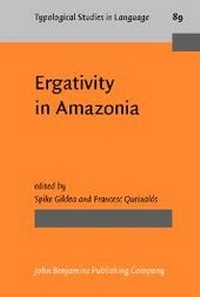
Ergativity in Amazonia
1st Edition
Published on 19. May 2010
V, 319 pages
978-90-272-8850-9 (ISBN)
Description

This volume presents a typological/theoretical introduction plus eight papers about ergative alignment in 16 Amazonian languages. All are written by linguists with years of fieldwork and comparative experience in the region, all describe details of the synchronic systems, and several also provide diachronic insight into the evolution of these systems. The five papers in Part I focus on languages from four larger families with ergative patterns primarily in morphology. The typological contribution is in detailed consideration of unusual splits, changes in ergative patterns, and parallels between ergative main clauses and nominalizations. The three papers in Part II discuss genetically isolated languages. Two present dominant ergative patterns in both morphology and syntax, the other a syntactic inverse system that is predominantly ergative in discourse. In each, the authors demonstrate that identification of traditional grammatical relations is problematic. These data will figure in all future typological and theoretical debates about grammatical relations.
More details
Other editions
Additional editions
Spike Gildea | Francesc Queixalos
Ergativity in Amazonia
Book
05/2010
John Benjamins Publishing Co
€111.30
Shipment within 10-15 days
Persons
Content
- Ergativity in Amazonia
- Editorial page
- Title page
- LCC data
- Table of contents
- Manifestations of ergativity in Amazonia
- 1. Distribution of ergative patterns in Amazonia
- 2. Theoretical issues of ergativity
- 2.1 Definition of ergativity
- 2.2 Ergativity and grammatical relations
- 2.3 Ergativity and diachrony
- 3. Overview of this volume
- Part 1. Well-Established Systems: Morphological Ergativity
- Part II. Recent Diachronic Innovations: Syntactic Ergativity
- References
- Part I. Well-established systems
- Ergativity in the Mayoruna branch of the Panoan family
- 1. Introduction
- 1.1 The Mayoruna branch
- 1.2 Data and methodology for grammatical comparisons
- 1.3 Brief typological overview of the Mayoruna languages
- 2. Dependent marking
- 2.1 Nominal case marking: Ergative-absolutive
- 2.2 Pronominal paradigms: Split
- 3. Head marking
- 3.1 Verb agreement suffixes: Nominative-accusative
- 3.2 Pronominal enclitics: Ergative-absolutive
- 4. Extended intransitive verbs and other special verb types
- 5. Transitivity agreement
- 6. Reanalysis of biclausal constructions
- 6.1 Negative clauses
- 6.2 Abilitative constructions
- 7. Conclusions
- References
- Morpheme gloss abbreviations
- Ergativity in Shipibo-Konibo, a Panoan language of the Ucayali
- 1. Introduction
- 1.1 Conceptual and terminological issues
- 1.2 Grammatical features of Panoan and Shipibo-Konibo
- 2. Ergative alignment
- 2.1 Case-marking
- 2.2 Internally-headed relative clauses and syntactic ergativity
- 3. Non-ergative alignments
- 3.1 Case-marking in progressive clauses
- 3.2 Case-marking and distribution of emphatic pronouns
- 3.3 Distribution of doubled pronouns
- 3.4 Plural marking on the verb
- 3.5 Different-subject marking
- 3.6 Participant agreement
- 4. Summary and final remarks
- References
- How ergative is Cavineña?
- 1. Introduction
- 2. Cavineña morphological ergativity
- 2.1 NPs and independent pronouns
- 2.2 Bound pronouns
- 2.3 Restrictions on the co-occurrence of NPs/independent pronouns and bound pronouns
- 2.4 Conclusions
- 3. Searching for syntactic ergativity in Cavineña
- 3.1 Dependent clauses in Cavineña: An introduction
- 3.2 Non-finite temporal same subject clause
- 3.3 Finite temporal different subject clause
- 3.4. Conclusions
- 4. Conclusions
- References
- The ergativity effect in Kuikuro (Southern Carib, Brazil)
- Introduction
- 1. Kuikuro as an ergative language: An overview of its morphology and syntax
- 1.1 Morphology
- 1.2 Syntax
- 2. Kuikuro as an ergative language: Perspective and ergative (case)
- 2.1 hekeP as perspective
- 2.2 Yheke as an external cause
- 2.3 Causative constructions
- 2.4 Yheke is not agent
- 2.5 Syntactic ergativity?
- 3. Looking for an understanding behind the ergative screen
- 3.1 Some steps forward: Nominalizations and ergativity
- 3.2 Nominalizations and ergativity: The Kuikuro way
- Some final remarks
- References
- Interlinear glosses
- Nominative-absolutive
- 1. Introduction: Split ergativity and the nominative-absolutive
- 2. Nominative-absolutive in Cariban languages
- 2.1 The nominative absolutive clause type in Panare
- 2.2 The grammar of nominative-absolutive in Katxuyana
- 3. Nominative-absolutive in Jê languages
- 3.1 Nominative-absolutive in Canela
- 3.2 Nominative-absolutive in Apinajé
- 3.4 Nominative-absolutive in Suyá
- 4. Discussion
- 4.1 Nominative-absolutive and counter-universal splits
- 4.2 Nominative-absolutive as less or non-ergative
- References
- Part II: Recent diachronic innovations
- Ergativity in Trumai
- 1. Introduction
- 2. The case system and the ergative alignments found in the language
- 2.1 Case system
- 2.2 Verbs
- 2.3 Further alignments in syntax
- 3. Ergativity and grammatical relations
- 3.1 Subject as the grouping {S, P}
- 3.2 Subject as the grouping {S, A}
- 3.3 No grammatical relations
- 4. Conclusion
- Abbreviations used in glosses
- Acknowledgments
- References
- Grammatical relations in Katukina-Kanamari
- Introduction
- 1. Coding
- 2. Behaviour
- 2.1 Order and Movement
- 2.2 Elision
- 2.3 Ostension
- 2.4 Coordination
- 2.5 Focalization
- 2.6 Interrogation
- 2.7 Relativization
- 3. Coreference
- 4. Other ergative-oriented phenomena
- 4.1 Split transitivity
- 4.2 Antipassive
- 5. Grammatical relations: A first synthesis
- 6. Argument structure variations
- 6.1 Reflexive
- 6.2 Applicative
- 6.3 Noun incorporation
- 6.4 Causation
- 7. Grammatical relations and the diachrony of ergativity
- 8. Conclusion
- References
- The intransitive basis of Movima clause structure
- 1. Introduction
- 2. The structure of simple clauses
- 2.1 Argument encoding in intransitive clauses
- 2.2 Argument encoding in transitive clauses
- 2.3 The salience hierarchy
- 2.4 Direct/inverse marking
- 3. The privileged syntactic status of OBV
- 3.1 Relative clauses and the marked-topic construction
- 3.2 The voice particle kaw
- 4. Analyzing Movima in terms of SAO
- 4.1 The split-alignment pattern
- 4.2 The unmarked status of the direct construction
- 5. Towards an explanation
- 5.1 Possessed nouns
- 5.2 The syntactic distribution of nouns and verbs
- 5.3 The equational hypothesis
- 6. Conclusion
- References
- Symbols and abbreviations
- Index
- The series Typological Studies in Language
