

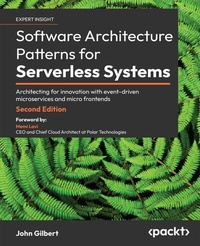
Software Architecture Patterns for Serverless Systems
Architecting for innovation with event-driven microservices and micro frontends
2nd Edition
Published on 23. September 2024
488 pages
978-1-80324-443-3 (ISBN)
Description

Delve into the second edition to master serverless proficiency and explore new chapters on security techniques, multi-regional deployment, and optimizing observability.
Key Features
Gain insights from a seasoned CTO on best practices for designing enterprise-grade software systems
Deepen your understanding of system reliability, maintainability, observability, and scalability with real-world examples
Elevate your skills with software design patterns and architectural concepts, including securing in-depth and running in multiple regions
Book DescriptionOrganizations undergoing digital transformation rely on IT professionals to design systems to keep up with the rate of change while maintaining stability. With this edition, enriched with more real-world examples, you'll be perfectly equipped to architect the future for unparalleled innovation. This book guides through the architectural patterns that power enterprise-grade software systems while exploring key architectural elements (such as events-driven microservices, and micro frontends) and learning how to implement anti-fragile systems. First, you'll divide up a system and define boundaries so that your teams can work autonomously and accelerate innovation. You'll cover the low-level event and data patterns that support the entire architecture while getting up and running with the different autonomous service design patterns. This edition is tailored with several new topics on security, observability, and multi-regional deployment. It focuses on best practices for security, reliability, testability, observability, and performance. You'll be exploring the methodologies of continuous experimentation, deployment, and delivery before delving into some final thoughts on how to start making progress. By the end of this book, you'll be able to architect your own event-driven, serverless systems that are ready to adapt and change.What you will learn
Explore architectural patterns to create anti-fragile systems
Focus on DevSecOps practices that empower self-sufficient, full-stack teams
Apply microservices principles to the frontend
Discover how SOLID principles apply to software and database architecture
Gain practical skills in deploying, securing, and optimizing serverless architectures
Deploy a multi-regional system and explore the strangler pattern for migrating legacy systems
Master techniques for collecting and utilizing metrics, including RUM, Synthetics, and Anomaly detection
Who this book is forThis book is for software architects who want to learn more about different software design patterns and best practices. This isn't a beginner's manual - you'll need an intermediate level of programming proficiency and software design experience to get started.You'll get the most out of this software design book if you already know the basics of the cloud, but it isn't a prerequisite.
Key Features
Gain insights from a seasoned CTO on best practices for designing enterprise-grade software systems
Deepen your understanding of system reliability, maintainability, observability, and scalability with real-world examples
Elevate your skills with software design patterns and architectural concepts, including securing in-depth and running in multiple regions
Book DescriptionOrganizations undergoing digital transformation rely on IT professionals to design systems to keep up with the rate of change while maintaining stability. With this edition, enriched with more real-world examples, you'll be perfectly equipped to architect the future for unparalleled innovation. This book guides through the architectural patterns that power enterprise-grade software systems while exploring key architectural elements (such as events-driven microservices, and micro frontends) and learning how to implement anti-fragile systems. First, you'll divide up a system and define boundaries so that your teams can work autonomously and accelerate innovation. You'll cover the low-level event and data patterns that support the entire architecture while getting up and running with the different autonomous service design patterns. This edition is tailored with several new topics on security, observability, and multi-regional deployment. It focuses on best practices for security, reliability, testability, observability, and performance. You'll be exploring the methodologies of continuous experimentation, deployment, and delivery before delving into some final thoughts on how to start making progress. By the end of this book, you'll be able to architect your own event-driven, serverless systems that are ready to adapt and change.What you will learn
Explore architectural patterns to create anti-fragile systems
Focus on DevSecOps practices that empower self-sufficient, full-stack teams
Apply microservices principles to the frontend
Discover how SOLID principles apply to software and database architecture
Gain practical skills in deploying, securing, and optimizing serverless architectures
Deploy a multi-regional system and explore the strangler pattern for migrating legacy systems
Master techniques for collecting and utilizing metrics, including RUM, Synthetics, and Anomaly detection
Who this book is forThis book is for software architects who want to learn more about different software design patterns and best practices. This isn't a beginner's manual - you'll need an intermediate level of programming proficiency and software design experience to get started.You'll get the most out of this software design book if you already know the basics of the cloud, but it isn't a prerequisite.
More details
Edition
2nd Revised edition
Language
English
Place of publication
Birmingham
United Kingdom
Target group
Professional and scholarly
US School Grade: College Graduate Student
Edition type
Revised edition
File size
9,41 MB
ISBN-13
978-1-80324-443-3 (9781803244433)
Copyright in bibliographic data and cover images is held by Nielsen Book Services Limited or by the publishers or by their respective licensors: all rights reserved.
Schweitzer Classification
Other editions
Additional editions
John Gilbert | Memi Lavi
Software Architecture Patterns for Serverless Systems
Architecting for innovation with event-driven microservices and micro frontends
Book
02/2024
2nd Edition
Packt Publishing
€67.40
Shipment within 3-4 weeks
Previous edition
John Gilbert
Software Architecture Patterns for Serverless Systems
Architecting for innovation with events, autonomous services, and micro frontends
E-Book
06/2024
1st Edition
Packt Publishing Limited
from
€44.39
Available for download
Persons
Gilbert John :
John Gilbert is a CTO with over 30 years of experience in architecting and delivering software systems across many industries. His cloud journey has spanned all the levels of cloud maturity, from lift and shift and software-defined infrastructure to microservices and continuous deployment. He was an early serverless adopter and put his first serverless workloads into production just months after AWS Lambda's introduction. He has also authored Cloud Native Development Patterns and Best Practices and JavaScript Cloud Native Development Cookbook. He finds delivering serverless solutions to be, by far, the most fun and satisfying, as they force us to rewire how we reason about systems and enable us to accomplish far more with much less effort and risk.
John Gilbert is a CTO with over 30 years of experience in architecting and delivering software systems across many industries. His cloud journey has spanned all the levels of cloud maturity, from lift and shift and software-defined infrastructure to microservices and continuous deployment. He was an early serverless adopter and put his first serverless workloads into production just months after AWS Lambda's introduction. He has also authored Cloud Native Development Patterns and Best Practices and JavaScript Cloud Native Development Cookbook. He finds delivering serverless solutions to be, by far, the most fun and satisfying, as they force us to rewire how we reason about systems and enable us to accomplish far more with much less effort and risk.
Content
Table of Contents
Architecting for Innovations
Defining Boundaries and Letting Go
Taming the Presentation Tier
Trusting Facts and Eventual Consistency
Turning the Cloud into the Database
A Best Friend for the Frontend
Bridging Intersystem Gaps
Reacting to Events with More Events
Running in Multiple Regions
Securing Autonomous Subsystems in Depth
Choreographing Deployment and Delivery
Optimizing Observability
Don't Delay, Start Experimenting
Architecting for Innovations
Defining Boundaries and Letting Go
Taming the Presentation Tier
Trusting Facts and Eventual Consistency
Turning the Cloud into the Database
A Best Friend for the Frontend
Bridging Intersystem Gaps
Reacting to Events with More Events
Running in Multiple Regions
Securing Autonomous Subsystems in Depth
Choreographing Deployment and Delivery
Optimizing Observability
Don't Delay, Start Experimenting
