

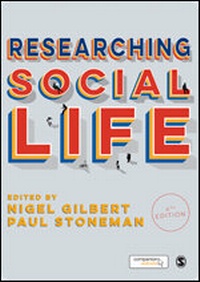
Researching Social Life
4th Edition
Published on 15. December 2015
624 pages
978-1-4739-4423-7 (ISBN)
Description

Paul Stoneman and Nigel Gilbert breathe new energy into this classic bestselling textbook providing clear, relevant advice and extensive coverage of all the research methods you need to understand today's society.
Packed full of examples from across the social sciences, Researching Social Life sets out all of the challenges and opportunities of interpreting and conducting research with qualitative, quantitative and mixed methods.
The book follows the chronology of a typical research project, from initial conception through to the collection, management and analysis of data; it also includes material on how best to write up and disseminate your research. This pragmatic approach mirrors the reality of conducting research and allows the handpicked, internationally renowned contributors to embed real case studies from their own research in each chapter.
The student-oriented pedagogy is carefully woven throughout the book and further supported by a cutting-edge website. Key tools include:
In-depth worked examples
Case studies
Discussion questions
Checklists
Annotated further reading
Practical top tips for doing research.
With unparalleled breadth and depth this trusted and respected textbook is an essential guide for anyone engaging with social research.
Packed full of examples from across the social sciences, Researching Social Life sets out all of the challenges and opportunities of interpreting and conducting research with qualitative, quantitative and mixed methods.
The book follows the chronology of a typical research project, from initial conception through to the collection, management and analysis of data; it also includes material on how best to write up and disseminate your research. This pragmatic approach mirrors the reality of conducting research and allows the handpicked, internationally renowned contributors to embed real case studies from their own research in each chapter.
The student-oriented pedagogy is carefully woven throughout the book and further supported by a cutting-edge website. Key tools include:
In-depth worked examples
Case studies
Discussion questions
Checklists
Annotated further reading
Practical top tips for doing research.
With unparalleled breadth and depth this trusted and respected textbook is an essential guide for anyone engaging with social research.
Reviews / Votes
'Researching Social Life remains the classic, essential guide to social research methods with updated and innovative chapters brought together by a superb team of editors and contributors'. Lisa Dikomitis, Department of Social Sciences, University of Hull, UK. -- Lisa Dikomitis 'This is an excellent and easily accessible compendium of essential research techniques in the social sciences. It is a comprehensive introduction to the field of qualitative social research and a faithful companion during the first steps into empirical research'. Tino Mietz, Faculty of Humanities, Eberhard Karls Universitat Tubingen, Germany. -- Tino Mietz 'Unlike other method texts, this one tells students in clear, readable language how to conduct research in the real world. Students will appreciate the global perspective and the intuitive organization of the book'. Leeda Copley, Department of Sociology, Gerontology and Substance Abuse Studies, University of Central Oklahoma, US. -- Leeda CopleyMore details
Edition
Fourth Edition
Language
English
Place of publication
London
United Kingdom
Target group
College/higher education
ISBN-13
978-1-4739-4423-7 (9781473944237)
Copyright in bibliographic data and cover images is held by Nielsen Book Services Limited or by the publishers or by their respective licensors: all rights reserved.
Schweitzer Classification
Other editions
Additional editions
Nigel Gilbert | Paul Stoneman
Researching Social Life
Book
12/2015
4th Edition
SAGE Publications Ltd
€276.50
Shipment within 15-20 days
Persons
Nigel Gilbert is Professor of Sociology at the University of Surrey, Guildford, England. He is the author or editor of 34 books and many academic papers and was the founding editor of the Journal of Artificial Societies and Social Simulation. His current research focuses on the application of agent-based models to understanding social and economic phenomena, especially the emergence of norms, culture, and innovation. He obtained a doctorate in the sociology of scientific knowledge in 1974 from the University of Cambridge and has subsequently taught at the universities of York and Surrey in England. He is one of the pioneers in the field of social simulation and is past president of the European Social Simulation Association. He is a Fellow of the UK Academy of Social Sciences and of the Royal Academy of Engineering.
Paul Stoneman is Lecturer in Sociology, University of Surrey.
Paul Stoneman is Lecturer in Sociology, University of Surrey.
Content
FOUNDATIONS AND FIRST STEPS
Conceptualising Social Life - Geoff Cooper and Robert Meadows
Research, Theory and Method - Nigel Gilbert
Formulating and Refining a Research Question - Nicola Green and Paul Stoneman
Conducting Systematic Reviews in the Social Sciences - Karen Bullock and Daniel McCarthy
CHOOSING YOUR RESEARCH STRATEGY
Quantitative Research - Paul Stoneman and Ian Brunton-Smith
Grounded Theory and Inductive Research - Paul Hodkinson
Mixed Methods - Victoria D. Alexander, Hilary Thomas, Ann Cronin, Jane Fielding and Jo Moran-Ellis
Participatory Approaches to Social Research - Christina Silver
Evaluation Research - Mike McGuire
International Comparative Research - Linda Hantrais
The Ethics of Social Research - Janet Boddy
COLLECTING DATA
Designing and Collecting Survey Samples - Patrick Sturgis
Questionnaire Design - Charles Leddy-Owen
Measuring Attitudes - Thomas J. Scotto
Qualitative Interviewing - Nigel Fielding and Hilary Thomas
Focus Groups - Ann Cronin
Ethnography - Nigel Fielding
The Internet and Research Methods - Christine Hine
ANALYSING DATA
Coding and Managing Data - Jane Fielding
Analysing Survey Data - Paul Stoneman
Computer Assisted Qualitative Data Analysis (CAQDAS) - Ann Lewins
Thematic Analysis - Alexander Seal
Narrative Analysis - Sarah Earthy, Alexandra Cuncev and Ann Cronin
Applying Conversation Analysis and Membership Categorisation Analysis to Qualitative Data - Andrew King and Lorraine Locke
Analysing Visual Materials - Victoria D. Alexander
Digital Social Research - Christine Hine
WRITING ABOUT SOCIAL RESEARCH AND ITS IMPACT
Writing about Social Research - Nigel Gilbert
The Impact of Social Research - Paul Stoneman and Nigel Gilbert
Conceptualising Social Life - Geoff Cooper and Robert Meadows
Research, Theory and Method - Nigel Gilbert
Formulating and Refining a Research Question - Nicola Green and Paul Stoneman
Conducting Systematic Reviews in the Social Sciences - Karen Bullock and Daniel McCarthy
CHOOSING YOUR RESEARCH STRATEGY
Quantitative Research - Paul Stoneman and Ian Brunton-Smith
Grounded Theory and Inductive Research - Paul Hodkinson
Mixed Methods - Victoria D. Alexander, Hilary Thomas, Ann Cronin, Jane Fielding and Jo Moran-Ellis
Participatory Approaches to Social Research - Christina Silver
Evaluation Research - Mike McGuire
International Comparative Research - Linda Hantrais
The Ethics of Social Research - Janet Boddy
COLLECTING DATA
Designing and Collecting Survey Samples - Patrick Sturgis
Questionnaire Design - Charles Leddy-Owen
Measuring Attitudes - Thomas J. Scotto
Qualitative Interviewing - Nigel Fielding and Hilary Thomas
Focus Groups - Ann Cronin
Ethnography - Nigel Fielding
The Internet and Research Methods - Christine Hine
ANALYSING DATA
Coding and Managing Data - Jane Fielding
Analysing Survey Data - Paul Stoneman
Computer Assisted Qualitative Data Analysis (CAQDAS) - Ann Lewins
Thematic Analysis - Alexander Seal
Narrative Analysis - Sarah Earthy, Alexandra Cuncev and Ann Cronin
Applying Conversation Analysis and Membership Categorisation Analysis to Qualitative Data - Andrew King and Lorraine Locke
Analysing Visual Materials - Victoria D. Alexander
Digital Social Research - Christine Hine
WRITING ABOUT SOCIAL RESEARCH AND ITS IMPACT
Writing about Social Research - Nigel Gilbert
The Impact of Social Research - Paul Stoneman and Nigel Gilbert
