

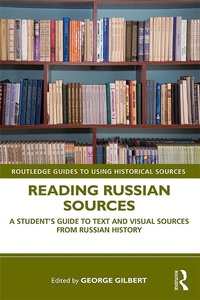
Reading Russian Sources
A Student's Guide to Text and Visual Sources from Russian History
1st Edition
Published on 20. January 2020
284 pages
978-1-351-18416-8 (ISBN)
Description

Reading Russian Sources is an accessible and comprehensive guide that introduces students to the wide range of sources that can be used to engage with Russian history from the early medieval to the late Soviet periods.
Divided into two parts, the book begins by considering approaches that can be taken towards the study of Russian history using primary sources. It then moves on to assess both textual and visual sources, including memoirs, autobiographies, journals, newspapers, art, maps, film and TV, enabling the reader to engage with and make sense of the burgeoning number of different sources and the ways they are used. Contributors illuminate key issues in the study of different areas of Russia's history through their analysis of source materials, exploring some of the major issues in using different source types and reflecting recent discoveries that are changing the field. In so doing, the book orientates students within the broader methodological and conceptual debates that are defining the field and shaping the way Russian history is studied.
Chronologically wide-ranging and supported by further reading, along with suggestions to help students guide their own enquiries, Reading Russian Sources is the ideal resource for any student undertaking research on Russian history.
Divided into two parts, the book begins by considering approaches that can be taken towards the study of Russian history using primary sources. It then moves on to assess both textual and visual sources, including memoirs, autobiographies, journals, newspapers, art, maps, film and TV, enabling the reader to engage with and make sense of the burgeoning number of different sources and the ways they are used. Contributors illuminate key issues in the study of different areas of Russia's history through their analysis of source materials, exploring some of the major issues in using different source types and reflecting recent discoveries that are changing the field. In so doing, the book orientates students within the broader methodological and conceptual debates that are defining the field and shaping the way Russian history is studied.
Chronologically wide-ranging and supported by further reading, along with suggestions to help students guide their own enquiries, Reading Russian Sources is the ideal resource for any student undertaking research on Russian history.
Reviews / Votes
'This collection helps to fill a huge gap in the literature. In the last 30 years, the sources available for the study of Russia and the Soviet Union have multiplied tremendously, and the opportunities and challenges of working with them have expanded alongside. No single volume could provide an exhaustive guide, but George Gilbert has brought together a superb collection of thought-provoking essays that will be indispensable to the teachers and students of the Russian and Soviet past who want a sense of the kinds of sources out there, and how to approach them in a sophisticated and nuanced way.'Professor James Harris, University of Leeds, UK
'George Gilbert has assembled fifteen first-rate and thought-provoking essays about the challenges and rewards of using primary sources to interpret Russian history over the past millennium. The contributors analyze how a variety of sources, ranging from diaries, police reports, and personal correspondence to maps, cinema, and television, have been used by scholars to shed light on critical aspects of Russian history. The essays serve as an excellent introduction to historical research as a methodology, and both undergraduate and graduate students will benefit from reading them before embarking on their own research.'
Professor Bob Weinberg, Swarthmore College, USA
More details
Series
Edition
1. Auflage
Language
English
Place of publication
London
United Kingdom
Publishing group
Taylor & Francis Ltd
Target group
College/higher education
Illustrations
8 Illustrations, black and white
ISBN-13
978-1-351-18416-8 (9781351184168)
Copyright in bibliographic data and cover images is held by Nielsen Book Services Limited or by the publishers or by their respective licensors: all rights reserved.
Schweitzer Classification
Other editions
Additional editions
Reading Russian Sources
A Student's Guide to Text and Visual Sources from Russian History
Book
03/2020
Routledge
Unfortunately, price unknown
Available (delivery time upon request)
George Gilbert
Reading Russian Sources
A Student's Guide to Text and Visual Sources from Russian History
Book
02/2020
1st Edition
Routledge
€215.41
Shipment within 15-20 days
George Gilbert
Reading Russian Sources
A Student's Guide to Text and Visual Sources from Russian History
Book
01/2020
1st Edition
Routledge
€60.50
Shipment within 15-20 days
Person
George Gilbert is lecturer in modern Russian history at the University of Southampton, UK. As well as editing the present volume, his publications include The Radical Right in late Imperial Russia (2016), and he has published in English and Russian on a variety of articles on different aspects of the social, cultural and political history of the late Imperial period.
Content
Introduction: Reading Russian Sources George Gilbert Part 1: Contexts and Approaches 1 Early Medieval Sources Monica White 2 Primary Sources and the History of Modern Russia Peter Waldron 3 The Power of Positionality? Researching Russian History from the Margins Pavel Vasilyev Part 2: Varieties of Sources and their Interpretation 4 Imperial Maps Jennifer Keating 5 "It's Only a Story": What Value are Novels as a Historical Source? Sarah Hudspith 6 The Late Imperial Press George Gilbert 7 Surveillance Reports Dakota Irvin 8 Soviet Autobiographies Katy Turton 9 "Read All About It!": Soviet Press and Periodicals Andy Willimott 10 Visual Culture as Evidence of the Soviet Past Claire Le Foll 11 Film and TV as a Source in Soviet History: Challenges and Possibilities Jeremy Hicks 12 The Diary as Source in Russian and Soviet History Dan Healey 13 Soviet Memoir Literature: Personal Narratives of a Historical Epoch Claire Shaw 14 Prisoner Memoirs as a Source in Russian and Soviet History Mark Vincent 15 Soviet Letters Courtney Doucette
