

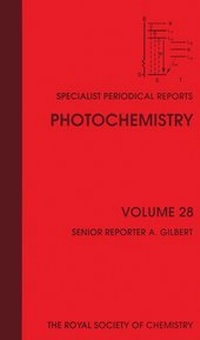
Photochemistry
Volume 28
1st Edition
Published on 31. October 2007
550 pages
978-1-84755-477-2 (ISBN)
Description

The breadth of scientific and technological interests in the general topic of photochemistry is truly enormous and includes, for example, such diverse areas as microelectronics, atmospheric chemistry, organic synthesis, non-conventional photoimaging, photosynthesis, solar energy conversion, polymer technologies, and spectroscopy. This Specialist Periodical Report on Photochemistry aims to provide an annual review of photo-induced processes that have relevance to the above wide-ranging academic and commercial disciplines, and interests in chemistry, physics, biology and technology. In order to provide easy access to this vast and varied literature, each volume of Photochemistry comprises sections concerned with photophysical processes in condensed phases, organic aspects which are sub-divided by chromophore type, polymer photochemistry, and photochemical aspects of solar energy conversion. Volume 34 covers literature published from July 2001 to June 2002. Specialist Periodical Reports provide systematic and detailed review coverage in major areas of chemical research. Compiled by teams of leading authorities in the relevant subject areas, the series creates a unique service for the active research chemist, with regular, in-depth accounts of progress in particular fields of chemistry. Subject coverage within different volumes of a given title is similar and publication is on an annual or biennial basis.
More details
Series
Edition
1. Auflage
Language
English
Place of publication
Cambridge
United Kingdom
Target group
Professional and scholarly
ISBN-13
978-1-84755-477-2 (9781847554772)
DOI
10.1039/9781847554772
Copyright in bibliographic data and cover images is held by Nielsen Book Services Limited or by the publishers or by their respective licensors: all rights reserved.
Schweitzer Classification
Other editions
Additional editions
Book
11/1997
Royal Society of Chemistry
€337.50
Shipment within 3-4 weeks
Persons
Content
- Photochemistry
- Contents
- Introduction and Review of the Year
- Part I Physical Aspects of Photochemistry
- Photophysical Processes in Condensed Phases
- 1 General
- 2 Singlet State Processes
- 2.1 Electron and Proton Transfer Reactions and Exciplexes
- 2.2 Dyes
- 2.3 Photoisomerization and Related Processes
- 2.4 Electronic Excitation Energy Transfer
- 2.5 Polymeric Systems
- 2.6 Colloidal and Heterogeneous Systems
- 2.7 Biological Systems
- 3 Triplet State Processes
- 4 Other Processes
- 4.1 Chemiluminescence
- 4.2 Photochromism
- 4.3 Photochemical Reactions
- References
- Part II Organic Aspects of Photochemistry
- Chapter 1 Photolysis of Carbonyl Compounds
- 1 Norrish Type I Reactions
- 2 Norrish Type II Reactions
- 2.1 1,5-Hydrogen Transfer
- 2.2 Other Hydrogen Transfers
- 3 Oxetane Formation
- 4 Miscellaneous Reactions
- 4.1 SET Processes
- 4.2 Decarbonylation and Decarboxylation
- 4.3 Reaction of Miscellaneous Haloketones
- 4.4 Other Fission Processes
- References
- Chapter 2 Enone Cycloadditions and Rearrangements: Photoreactions of Dienones and Quinones
- 1 Cycloaddition Reactions
- 1.1 Intermolecular Cycloaddition
- 1.1.1 Open-chain Systems
- 1.1.2 Additions to Cyclopentenones and Related Systems
- 1.1.3 Additions to Cyclohexenones and Related Systems
- 1.2 Intramolecular Additions
- 1.2.1 Intramolecular Additions to Cyclopentenones
- 1.2.2 Additions to Cyclohexenones and Related Systems
- 2 Rearrangement Reactions
- 2.1 a,ß-Unsaturated Systems
- 2.1.1 Isomerization
- 2.1.2 Hydrogen Abstraction Reactions
- 2.1.3 Rearrangement Reactions
- 2.2 ß,?-Unsaturated Systems
- 2.2.1 The Oxa-di-p-methane Reaction and Related Processes
- 3 Photoreactions of Thymines and Related Compounds
- 3.1 Photoreactions of Pyridones
- 3.2 Photoreactions of Thymines etc.
- 3.3 Miscellaneous Processes
- 4 Photochemistry of Dienones
- 4.1 Cross-conjugated Dienones
- 4.2 Linearly Conjugated Dienones
- 5 1,2-, 1,3- and 1,4-Diketones
- 5.1 Reactions of 1,2-Diketones
- 5.2 Reactions of 1,3-Diketones
- 5.3 Reactions of 1,4-Diketones
- 5.3.1 Phthalimides and Related Compounds
- 5.3.2 Fulgides and Fulgimides
- 5.3.3 Other Dicarbonyl Compounds
- 6 Quinones
- 6.1 o-Quinones
- 6.2 p-Quinones
- References
- Chapter 3 Photochemistry of Alkenes, Alkynes and Related Compounds
- 1 Reactions of Alkenes
- 1.1 cis,trans-Isomerization
- 1.1.1 Stilbenes and Related Compounds
- 1.2 Miscellaneous Reactions
- 1.2.1 Addition Reactions
- 1.2.2 Electron Transfer Processes
- 1.2.3 Other Processes
- 2 Reactions involving Cyclopropane Rings
- 2.1 The Di-p-methane Rearrangement and Related Processes
- 2.1.1 The Aza-di-p-methane Rearrangement and Related Processes
- 2.2 SET Induced Reactions
- 2.3 Miscellaneous Reactions involving Three-membered Ring Compounds
- 3 Reactions of Dienes and Trienes
- 3.1 Vitamin D Analogues
- 4 (2 + 2)-Intramolecular Additions
- 5 Dimerization and Intermolecular Additions
- 5.1 Dimerization
- 5.2 (2 + 2)-Cycloaddition Reactions
- 6 Miscellaneous Reactions
- 6.1 Reactions involving Cations and Radicals
- 6.2 Miscellaneous Rearrangements and Bond Fission Processes
- References
- Chapter 4 Photochemistry of Aromatic Compounds
- 1 Introduction
- 2 Isomerisation Reactions
- 3 Addition Reactions
- 4 Substitution Reactions
- 5 Cyclisation Reactions
- 6 Dimerisation
- 7 Lateral Nuclear Shifts
- 8 Peripheral Photochemistry
- References
- Chapter 5 Photo-reduction and -oxidation
- 1 Introduction
- 2 Reduction of the Carbonyl Group
- 3 Reduction of Nitrogen-containing Compounds
- 4 Miscellaneous Reductions
- 5 Singlet Oxygen
- 6 Oxidation of Aliphatic Compounds
- 7 Oxidation of Aromatic Compounds
- 8 Oxidation of Nitrogen-containing Compounds
- 9 Miscellaneous Oxidations
- References
- Chapter 6 Photoreactions of Compounds containing Heteroatoms other than Oxygen
- 1 Introduction
- 2 Nitrogen-containing Compounds
- 2.1 Rearrangements
- 2.2 Addition Reactions
- 2.3 Miscellaneous Reactions
- 3 Sulfur-containing Compounds
- 4 Compounds containing other Heteroatoms
- References
- Chapter 7 Photoelimination
- 1 Elimination of Nitrogen from Azo Compounds
- 2 Elimination of Nitrogen from Diazo Compounds
- 3 Elimination of Nitrogen from Azides
- 4 Decarboxylation Reactions
- 5 Reactions of Sulfur Compounds
- 6 Reactions of Halo Compounds
- 7 Miscellaneous Fragmentation Processes
- 7.1 Reactions with Tetranitromethane
- 7.2 Miscellaneous Fragmentations
- 7.3 Ester Fragmentation
- References
- Part III Polymer Photochemistry
- 1 Introduction
- 2 Photopolymerisation
- 2.1 Photoinitiated Addition Polymerisation
- 2.2 Photografting
- 2.3 Photocrosslinking
- 3 Luminescence and Optical Properties
- 4 Photdegradation and Photooxidation Processes in Polymers
- 4.1 Polyolefins
- 4.2 Poly(vinyl halides)
- 4.3 Poly(acrylates) and (alkyl acrylates)
- 4.4 Polyamides and Polyimides
- 4.5 Polycarbonates
- 4.6 Poly(alkyl and aromatic ethers)
- 4.7 Polyesters
- 4.8 Silicone Polymers
- 4.9 Polystyrenes and Copolymers
- 4.10 Polyurethanes
- 4.11 Polyketones
- 4.12 Photoablation of Polymers
- 4.13 Natural Polymers
- 4.14 Miscellaneous Polymers
- 5 Photostabilisation of Polymers
- 6 Photochemistry of Dyed and Pigmented Polymers
- References
- Part IV Photochemical Aspects of Solar Energy Conversion
- 1 Introduction
- 2 Homogeneous Photosystems
- 3 Heterogeneous Photosystems
- 4 Photoelectrochemical Cells
- 5 Biological Systems
- 6 Luminescent Solar Concentrators
- References
- Part V Adsorbate Photochemistry
- 1 Introduction
- 1.1 Metal Substrates
- 1.2 Insulator Substrates
- 2 Theoretical Aspects
- 2.1 Metallic Substrates
- 2.2 Insulator Substrates
- 3 Apparatus and Experiments
- 4 Specific Systems
- 4.1 Metallic Substrates
- 4.1.1 Nitric Oxide
- 4.1.2 Alkyl Halides
- 4.1.3 Dioxygen
- 4.1.4 Ammonia
- 4.1.5 Other Adsorbates
- 4.1.6 Desorption Induced by Multiple Electronic Transitions (DIMET): Femtosecond Laser Induced Adsorbate Photochemistry
- 4.2 Semiconductor Substrates
- 4.3 Insulator Substrates
- 4.3.1 Hydrogen Halides
- 4.3.2 Methyl Bromide on LiF(001)
- 4.3.3 Other Systems
- 5 Summary
- References
- Author Index
