

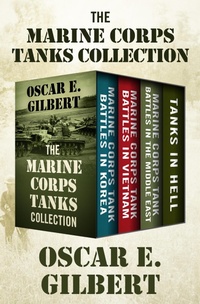
The Marine Corps Tanks Collection
Published on 18. September 2018
2390 pages
978-1-5040-5595-6 (ISBN)
Description

"Together these books provide the definitive history of the USMC's tank forces... Very highly recommended" (
Military Modelcraft International).
Marine Corps Tank Battles in Korea: A detailed and gripping account of the little-known Marine tank engagements during the Korean War, from the valiant defense at Pusan and the bitter battles of the Chosin Reservoir to the bloody stalemate along the Jamestown Line. Oscar E. Gilbert unfolds the unique role played by tanks in the destruction of the ill-fated Task Force Drysdale, how Marine armor was a key factor in the defense of Hagaru, and how a lone tank made it to Yudamni and then led the breakout across the high Toktong Pass.
Marine Corps Tank Battles in Vietnam: In 1965 the large, loud, and highly visible tanks of 3rd Platoon, B Company, 3rd Tank Battalion landed across a beach near Da Nang, drawing unwelcome attention to America's first, almost covert, commitment of ground troops in South Vietnam. Marine Corps tankers sought out the enemy in the sand dunes, jungles, mountains, paddy fields, tiny villages, and ancient cities of Vietnam, dealing with guerrilla ambushes from the Viet Cong and the long-range artillery capability of the North Vietnamese Army.
Marine Corps Tank Battles in the Middle East: In America's longest continual conflict, armored Marines became entangled in guerrilla war amid the broiling deserts, ancient cities, and rich farmlands of Iraq, and in the high, bleak wastes of Afghanistan. Fighting a fanatical foe who brutalized civilians, planted sophisticated roadside bombs, and seized control of entire cities, the Marine Corps tankers cleared roads, escorted convoys, conducted endless sweep operations to locate and destroy insurgent strongholds, protected voting sites for free elections, and recaptured and rebuilt urban centers, even adding a new trick to their repertoire: long-range surveillance.
Tanks in Hell: On November 20, 1943, the 2nd Marine Division launched the first amphibious assault of the Pacific War, directly into the teeth of powerful Japanese defenses on Tarawa. In that blood-soaked invasion, a single company of Sherman tanks, of which only two survived, played a pivotal role in turning the tide from looming disaster to legendary victory.
Marine Corps Tank Battles in Korea: A detailed and gripping account of the little-known Marine tank engagements during the Korean War, from the valiant defense at Pusan and the bitter battles of the Chosin Reservoir to the bloody stalemate along the Jamestown Line. Oscar E. Gilbert unfolds the unique role played by tanks in the destruction of the ill-fated Task Force Drysdale, how Marine armor was a key factor in the defense of Hagaru, and how a lone tank made it to Yudamni and then led the breakout across the high Toktong Pass.
Marine Corps Tank Battles in Vietnam: In 1965 the large, loud, and highly visible tanks of 3rd Platoon, B Company, 3rd Tank Battalion landed across a beach near Da Nang, drawing unwelcome attention to America's first, almost covert, commitment of ground troops in South Vietnam. Marine Corps tankers sought out the enemy in the sand dunes, jungles, mountains, paddy fields, tiny villages, and ancient cities of Vietnam, dealing with guerrilla ambushes from the Viet Cong and the long-range artillery capability of the North Vietnamese Army.
Marine Corps Tank Battles in the Middle East: In America's longest continual conflict, armored Marines became entangled in guerrilla war amid the broiling deserts, ancient cities, and rich farmlands of Iraq, and in the high, bleak wastes of Afghanistan. Fighting a fanatical foe who brutalized civilians, planted sophisticated roadside bombs, and seized control of entire cities, the Marine Corps tankers cleared roads, escorted convoys, conducted endless sweep operations to locate and destroy insurgent strongholds, protected voting sites for free elections, and recaptured and rebuilt urban centers, even adding a new trick to their repertoire: long-range surveillance.
Tanks in Hell: On November 20, 1943, the 2nd Marine Division launched the first amphibious assault of the Pacific War, directly into the teeth of powerful Japanese defenses on Tarawa. In that blood-soaked invasion, a single company of Sherman tanks, of which only two survived, played a pivotal role in turning the tide from looming disaster to legendary victory.
More details
Person
Oscar E. Gilbert, PhD, was a Marine artilleryman, geoscientist, and military historian. His published works include the widely acclaimed
Marine Tank Battles in the Pacific,
Marine Corps Tank Battles in Korea, and
Marine Corps Tank Battles in the Middle East. His best-known work,
Tanks in Hell: A Marine Corps Tank Company on Tarawa, was awarded the Marine Corps Heritage Foundation's 2016 General Wallace M. Greene Jr. Award for outstanding nonfiction.
Content
- Contents
- Marine Corps Tank Battles in Korea
- Title Page
- Dedication Page
- The Korean Peninsula map
- Map and Illustrations
- Preface
- A Note on Language and Attitudes
- Prologue
- Chapter 1
- Chapter 2
- Chapter 3
- Chapter 4
- Chapter 5
- Chapter 6
- Chapter 7
- Chapter 8
- Epilogue
- Chapter Notes
- Select References
- Marine Corps Tank Battles in Vietnam
- Title
- Map
- Preface
- Acknowledgments
- Prologue
- Chapter 1
- Chapter 2
- Chapter 3
- Chapter 4
- Chapter 5
- Chapter 6
- Chapter 7
- Epilogue
- Where are they Now?
- Chapter Notes
- References and Bibliography
- Index
- Marine Corps Tank Battles in the Middle East
- Title Page
- Dedication
- Preface
- Prologue
- Chapter One
- Chapter Two
- Chapter Three
- Chapter Four
- Chapter Five
- Chapter Six
- Chapter Seven
- Chapter Eight
- Chapter Nine
- Chapter Ten
- Chapter Eleven
- Chapter Twelve
- Epilogue
- Where Are They Now?
- Image Gallery
- Acknowledgments
- Glossary
- References Cited
- Tanks in Hell
- Title Page
- Dedication
- Epigraph
- Note
- Preface Romain Cansiere
- Preface Ed Gilbert
- Foreword Edward L. Bale, Jr., Colonel, USMC (Ret)
- Chapter One
- Chapter Two
- Chapter Three
- Chapter Four
- Chapter Five
- Chapter Six
- Chapter Seven
- Chapter Eight
- Chapter Nine
- Chapter Ten
- 11 Aftermath
- Epilogue: The Legacy of Tarawa
- Later Life
- Appendix A: Charlie Company Chronology
- Appendix B: Tank Company Organization and Equipment
- Appendix C: Inside the M4A2 Tank
- Appendix D: Charlie Company Personnel at Tarawa
- Appendix E: Historical Research and Photographic Analysis
- Notes
- References Cited
- Acknowledgments
- About the Author
