

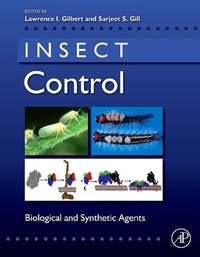
Insect Control
Biological and Synthetic Agents
Published on 28. May 2010
490 pages
978-0-12-381450-0 (ISBN)
Description

The publication of the extensive 7-volume work Comprehensive Molecular Insect Science provided library customers and their end-users with a complete reference encompassing important developments and achievements in modern insect science, including reviews on the ecdysone receptor, lipocalins, and bacterial toxins. One of the most popular areas in entomology is control, and this derivative work, Insect Control, taps into a previously unapproached market - the end user who desires to purchase a comprehensive yet affordable work on important aspects of this topic. Contents will include timeless articles covering insect growth- and development-disrupting insecticides, mechanisms and use of Bacillus thuringiensis, biology and genomics of polydnaviruses, pheromones: function and use in insect control, and more. New summaries for each chapter will give an overview of developments in the related article since its original publication.
- Articles selected by the known and respected editor-in-chief and co-editor of the original MRW
- The articles are classic reviews offering broad coverage of essential topics in insect control, with special addenda including author notes on the chapter since its original publication
- Introduction by the editors puts the selected body of work in context for this volume, highlighting the need for entomologists and related researchers to have these reviews in their personal collection
More details
Other editions
Additional editions
Book
08/2016
Academic Press
€79.22
Shipment within 15-20 days
Book
05/2010
Academic Press
€90.36
Withdrawn from sale
Content
- Front Cover
- Insect Control
- Copyright Page
- Contents
- Preface
- Contributors
- Chapter 1 Pyrethroids
- 1.1 Introduction
- 1.1.1 Pyrethrum Extract
- 1.1.2 Synthetic Pyrethroids
- 1.2 Development of Commercial Pyrethroids
- 1.3 Structure-Activity Relationships in Pyrethroids
- 1.4 Mode of Action of Pyrethroids
- 1.4.1 Classification of Pyrethroids
- 1.4.2 Site of Action
- 1.4.2.1 Investigations based on nerve preparations
- 1.4.2.2 Investigations based on sodium channels
- 1.4.3 Modeling Studies on Prediction of Putative Pharmacophores
- 1.5 Resistance to Pyrethroids
- 1.5.1 Resistance Mechanisms
- 1.5.1.1 Metabolic resistance
- 1.5.1.1.1 Metabolism of pyrethroids in insects
- 1.5.1.1.2 Metabolic pathways
- 1.5.1.1.3 Ester hydrolysis
- 1.5.1.1.4 Cytochrome P450 monooxygenases
- 1.5.1.1.5 Model substrates
- 1.5.1.1.6 Glutathione-S-transferases (GSTs)
- 1.5.1.2 Cuticle penetration
- 1.5.1.3 Target-site resistance
- 1.5.2 Resistance to Pyrethroids in the Field
- 1.5.2.1 Chemistry-led options for circumventing resistance
- Acknowledgments
- References
- Chapter A1 Addendum: Pyrethroid Insecticides and Resistance Mechanisms
- A1.1 Introduction
- A1.2 Market - Applications in Agricultural and Nonagricultural Fields
- A1.3 Research for Novel Commercial Compounds - Products
- A1.4 Resistance
- A1.5 Pyrethroid-Sodium Channel Interactions
- A1.6 Conclusions and Future Prospects
- Acknowledgments
- References
- Chapter 2 Indoxacarb and the Sodium Channel Blocker Insecticides: Chemistry, Physiology, and Biology in Insects
- 2.1 Introduction
- 2.2 Chemistry of the Na+ Channel Blockers
- 2.2.1 Chemical Evolution and Structure-Activity of the Naclose+ Channel Blocker Insecticides
- 2.2.2 Chemistry and Properties of Indoxacarb
- 2.3 Metabolism and Bioavailability of Indoxacarb
- 2.3.1 Bioactivation of Indoxacarb
- 2.3.2 Catabolism of Indoxacarb and Other Naclose+ Channel Blocker Insecticides
- 2.4 Physiology and Biochemistry of the Na+ Channel Blockers
- 2.4.1 Symptoms of SCBI Poisoning in Insects: Pseudoparalysis
- 2.4.2 Block of Spontaneous Activity in the Nervous System
- 2.4.3 Block of Naclose+ Channels in Sensory Neurons
- 2.4.4 Mechanism of Naclose+ Channel Block
- 2.4.5 SCBIs Act at Site 10 on the Naclose+ Channel
- 2.4.6 The Molecular Nature of Site 10 in Insects
- 2.4.7 Biochemical Measurements of the Effects of SCBIs
- 2.4.8 Intrinsic Activity of Indoxacarb on Naclose+ Channels
- 2.4.9 Effects of SCBIs on Alternative Target Sites
- 2.5 Biological Potency of Indoxacarb
- 2.5.1 Spectrum and Potency of Indoxacarb in the Laboratory
- 2.5.2 Safety of Indoxacarb to Beneficial Insects
- 2.5.3 Sublethal Effects of Indoxacarb
- 2.5.4 Spectrum and Insecticidal Potency of Indoxacarb in the Field
- 2.5.5 Indoxacarb and Insecticide Resistance
- 2.6 Conclusions
- References
- Chapter A2 Addendum: Indoxacarb and the Sodium Channel Blockers: Chemistry, Physiology, and Biology in Insects
- References
- Chapter 3 Neonicotinoid Insecticides
- 3.1 Introduction
- 3.2 Neonicotinoid History
- 3.3 Chemical Structure of Neonicotinoids
- 3.3.1 Ring Systems Containing Commercial Neonicotinoids
- 3.3.1.1 1-[(6-Chloro-3-pyridinyl)-methyl]-N-nitro-2-imidazolidinimine (imidacloprid, NTN 33893)
- 3.3.1.2 [3-(6-Chloro-3-pyridinyl)methyl-2-thiazolidinylidene]-cyanamidine (thiacloprid, YRC 2894)
- 3.3.1.3 3-[(2-Chloro-5-thiazolyl)methyl]tetrahydro-5-methyl-N-nitro-4H-1,3,5-oxadiazin-4-imine (thiamethoxam, CGA 293'343
- 3.3.2 Neonicotinoids Having Noncyclic Structures
- 3.3.2.1 N-[(6-chloro-3-pyridinyl)methyl]-N-ethyl-N'-methyl-2-nitro-1,1,-ethenediamine (nitenpyram, TI-304)
- 3.3.2.2 (E)-N-[(6-chloro-3-pyridinyl)methyl]-N'-cyano-N-methyl-ethanimidamide (acetamiprid, NI-25)
- 3.3.2.3 [C(E)]-N-[(2-chloro-5-thiazolyl)methyl]-N'-methyl-NPrime-nitroguanidine (clothianidin, TI-435)
- 3.3.2.4 (plusmn)-N-methyl-N'-nitro-NPrime-[(tetrahydro-3-furanyl)methyl]guanidine (dinotefuran, MTI-446)
- 3.3.3 Bioisosteric Segments of Neonicotinoids
- 3.3.3.1 Ring systems versus noncyclic structures
- 3.3.3.2 Isosteric alternatives to the heterocyclic N-substituents
- 3.3.3.3 Bioisosteric pharmacophors
- 3.3.4 Physicochemistry of Neonicotinoids
- 3.3.4.1 Physicochemical properties of commercialized neonicotinoids
- 3.3.4.1.1 Imidacloprid
- 3.3.4.1.2 Thiacloprid
- 3.3.4.1.3 Thiamethoxam
- 3.3.4.1.4 Nitenpyram
- 3.3.4.1.5 Acetamiprid
- 3.3.4.1.6 Clothianidin
- 3.3.5 Proneonicotinoids
- 3.3.5.1 Ring cleavage to noncyclic neonicotinoids
- 3.3.5.2 Mannich adducts as useful precursors
- 3.3.5.3 Active metabolites of neonicotinoids
- 3.4 Biological Activity and Agricultural Uses
- 3.4.1 Efficacy on Target Pests
- 3.4.2 Agricultural Uses
- 3.4.2.1 Rice
- 3.4.2.2 Cotton
- 3.4.2.3 Vegetables
- 3.4.2.4 Cereals
- 3.4.3 Foliar Application
- 3.4.4 Soil Application and Seed Treatment
- 3.5 Mode of Action
- 3.6 Interactions of Neonicotinoids with the Nicotinic Acetylcholine Receptor
- 3.6.1 Selectivity for Insect over Vertebrate nAChRs
- 3.6.2 Whole Cell Voltage Clamp of Native Neuron Preparations
- 3.6.3 Correlation between Electrophysiology and Radioligand Binding Studies
- 3.7 Pharmacokinetics and Metabolism
- 3.7.1 Metabolic Pathways of Commercial Neonicotinoids
- 3.7.1.1 Imidacloprid
- 3.7.1.2 Thiacloprid
- 3.7.1.3 Thiamethoxam
- 3.7.1.4 Nitenpyram
- 3.7.1.5 Acetamiprid
- 3.7.1.6 Clothianidin
- 3.8 Pharmacology and Toxicology
- 3.8.1 Safety Profile
- 3.8.1.1 Mammalian toxicity
- 3.8.1.2 Environmental fate
- 3.9 Resistance
- 3.9.1 Activity on Resistant Insect Species
- 3.9.2 Mechanisms of Resistance
- 3.9.3 Resistance Management
- 3.10 Applications in Nonagricultural Fields
- 3.10.1 Imidacloprid as a Veterinary Medicinal Product
- 3.10.1.1 Insecticidal efficacy in veterinary medicine
- 3.10.1.2 Larvicidal activity
- 3.10.1.3 Flea allergy dermatitis (FAD)
- 3.10.1.4 Imidacloprid as combination partner in veterinary medicinal products
- 3.11 Concluding Remarks and Prospects
- References
- Chapter A3 Addendum: The Neonicotinoid Insecticides
- References
- Chapter 4 Insect Growth- and Development-Disrupting Insecticides
- 4.1 Introduction
- 4.1.1 Physiological Role and Mode of Action of the Insect Molting Hormone
- 4.1.1.1 Molecular basis of 20E action
- 4.1.1.2 Ecdysone receptors
- 4.2 Ecdysteroid Agonist Insecticides
- 4.2.1 Discovery of Ecdysone Agonist Insecticides and Commercial Products
- 4.2.1.1 Synthesis and structure-activity relationships (SAR)
- 4.2.2 Bisacylhydrazines as Tools of Discovery
- 4.2.2.1 Molecular modeling
- 4.2.2.2 Mutational analysis
- 4.2.2.3 Ligand-dependent conformational changes
- 4.2.2.4 Photoaffinity reagents for studying receptor-ligand interactions
- 4.2.3 Mode of Action of Bisacylhydrazines
- 4.2.3.1 Bioassay
- 4.2.3.2 Whole organism effects
- 4.2.4 Basis for Selective Toxicity of Bisacylhydrazine Insecticides
- 4.2.5 Spectrum of Activity of Commercial Products
- 4.2.6.1 Chromofenozide (MATRICreg
- KILLATreg
- ANS-118
- CM-001)
- 4.2.5.2 Halofenozide (MACH II
- RH-0345)
- 4.2.5.3 Tebufenozide (MIMIC
- CONFIRM
- ROMDAN
- RH-5992) and methoxyfenozide (RUNNER
- INTREPID
- PRODIGY
- RH-2485)
- 4.2.6 Ecotoxicology and Mammalian Reduced Risk Profiles
- 4.2.7 Resistance, Mechanism, and Resistance Potential
- 4.2.8 Other Chemistries and Potential for New Ecdysone Agonist Insecticides
- 4.2.9 Noninsecticide Applications of Nonsteroidal Ecdysone Agonists
- Gene Switches in Animal and Plant Systems
- 4.2.9.1 Gene switch in mammalian systems
- 4.2.9.2 Gene switch for trait regulation in plants
- 4.2.10 Conclusions and Future Prospects of Ecdysone Agonists
- 4.3 Juvenile Hormone Analogs
- 4.3.1 Juvenile Hormone Action
- 4.3.2 Putative Molecular Mode of Action of JH
- 4.3.3 Pest Management with JHAs
- 4.3.3.1 Biological action of JHAs
- 4.3.3.2 Properties and mode of action of selected JHAs
- 4.3.3.2.1 Methoprene (ALTOSIDreg, APEXSEreg, DIANEXreg, PHARORIDreg, PRECORreg, VIODATreg)
- 4.3.3.2.2 Kinoprene (ENSTARreg)
- 4.3.3.2.3 Fenoxycarb (INSEGARreg, LOGICreg, TORUSreg, PICTYLreg, VARIKILLreg)
- 4.3.3.2.4 Pyriproxifen (KNACKreg, SUMILARVreg, ADMIRALreg)
- 4.3.4 Use of JHAs for Pest Management
- 4.3.4.1 Control of public health and veterinary insects
- 4.3.4.2 Anti-JH for pest management
- 4.3.5 Effects on Nontarget Invertebrates and Vertebrates
- 4.3.6 Conclusions and Future Research of JHAs
- 4.4 Insecticides with Chitin Synthesis Inhibitory Activity
- 4.4.1 Brief Review of Old Chitin Synthesis Inhibitors
- 4.4.2 New Chemistries and Products
- 4.4.3 Mode of Action and SAR
- 4.4.4 Spectrum of Activity
- 4.4.5 Ecotoxicology and Mammalian Safety
- 4.4.6 Resistance, Mechanism for Resistance and Resistance Potential
- 4.5 Conclusions and Future Prospects of Insect Growth- and Development-Disrupting Insecticides
- Acknowledgments
- References
- Relevant Website
- Chapter A4 Addendum: Recent Progress on Mode of Action of 20-Hydroxyecdysone, Juvenile Hormone (JH), Non-Steroidal Ecdysone Agonist and
- A4.1 Recent Progress on Mode of Action of 20-Hydroxyecdysone and Non-Steroidal Ecdysone Agonist Insecticides
- Acknowledgments
- References
- Further Reading
- Chapter 5 Azadirachtin, a Natural Product in Insect Control
- 5.1 Introduction
- 5.1.1 The Neem Tree
- 5.2 Azadirachtin Research up to 1985
- 5.3 Chemistry of Neem Products
- 5.3.1 Neem Limonoids
- 5.3.2 Isolation of Azadirachtin
- 5.3.3 Analysis
- 5.3.4 Stability and Persistence
- 5.4 Neem Insecticides in Pest Control.
- 5.4.1 Background
- 5.4.2 Use in Integrated Pest Management
- 5.4.3 Toxicity to Nontarget Organisms
- 5.4.4 Resistance
- 5.4.5 Systemic Action
- 5.5 Antifeedant Effects of Azadirachtin
- 5.6 Neuroendocrine Effects of Azadirachtin
- 5.6.1 Insect Growth Regulation
- 5.6.2 Reproduction
- 5.7 Studies on the Mode of Action of Azadirachtin
- 5.7.1 Studies using Insect Cell Lines
- 5.7.2 Effects on Cell Cycle Events
- 5.7.3 Binding Studies
- 5.7.4 Effects on Protein Synthesis
- 5.7.5 Studies Using Mammalian Cell Lines
- 5.7.6 Resolving the Mode of Action of Azadirachtin
- References
- Chapter A5 Addendum: Azadirachtin, A Natural Product in Insect Control: An Update
- A5.1 Synthesis of Azadirachtin
- A5.2 Emerging Technologies for Understanding Mode of Action
- A5.3 Commercial Use of Neem Seed Insecticides
- A5.4 Conclusions
- References
- Chapter 6 The Spinosyns: Chemistry, Biochemistry, Mode of Action, and Resistance
- 6.1 Introduction
- 6.2 Discovery, Structure, and Biosynthesis of the Spinosyns
- 6.2.1 The Spinosyns
- 6.2.2 The 21-Butenyl Spinosyns
- 6.2.3 Spinosyn Biosynthesis
- 6.2.4 Physical Properties of the Spinosyns
- 6.3 Pharmacokinetics of Spinosad
- 6.3.1 Metabolism of the Spinosyns
- 6.3.1.1 Mammalian and avian spinosyn metabolism
- 6.3.1.2 Spinosyn metabolism in insects
- 6.3.2 Spinosyn Penetration into Insects
- 6.3.3 Insecticidal Concentration in the Cockroach
- 6.4 Mode of Action of Spinosyns
- 6.4.1 Poisoning Symptoms
- 6.4.2 Gross Electrophysiology
- 6.4.2.1 Spinosyns excite the central nervous system in vivo and in vitro
- 6.4.2.2 Mechanism of paralysis by spinosyns
- 6.4.2.3 Spinosyns excite central neurons by inducing an inward, depolarizing, current
- 6.4.2.4 Activation of nicotinic receptors by spinosyns generates a depolarizing inward current
- 6.4.3 Nicotinic Receptors as the Spinosyn Target Site
- 6.4.3.1 Two subtypes of nicotinic receptors
- 6.4.3.2 Selective action of spinosyns on the nAChN subtype of nicotinic receptor
- 6.4.3.3 Correlation of spinosyn biological activity with potency on nAChN receptors
- 6.4.4 Effects of Spinosyns on GABA Receptors in Small Diameter Neurons of Cockroach
- 6.5 Biological Properties of the Spinosyns
- 6.5.1 Biological Activity and Spectrum of the Spinosyns
- 6.5.1.1 Pest insects
- 6.5.1.1.1 Structure-activity relationships of spinosyns - Lepidoptera
- 6.5.1.1.2 Structure-activity relationships of spinosyns - Diptera
- 6.5.1.1.3 Structure-activity relationships of spinosyns - Homoptera
- 6.5.1.1.4 Structure-activity relationships of spinosyns - Acarina
- 6.5.1.2 Nontarget organisms
- 6.5.1.2.1 Beneficial insects
- 6.5.1.2.2 Mammalian toxicology and ecotoxicology
- 6.6 Resistance Mechanisms and Resistance Management
- 6.6.1 Cross-Resistance
- 6.6.2 Resistance Mechanisms
- 6.6.3 Resistance Management
- 6.7 Spinosyns and Spinosoid Structure-Activity Relationships
- 6.7.1 Modifications of the Tetracycle
- 6.7.2 Modification or Replacement of the Forosamine Sugar
- 6.7.3 Modification or Replacement of the Tri-O-Methyl-Rhamnose Sugar
- 6.7.4 Quantitative Structure-Activity Relationships and the Spinosyns
- 6.8 Conclusion
- Acknowledgments
- References
- Relevant Websites
- Chapter A6 Addendum: The Spinosyns
- A6.1 Spinosyn Chemistry and Biosynthesis
- A6.2 Mode of Action
- A6.3 Spinosad Resistance and Cross Resistance
- References
- Chapter 7 Bacillus thuringiensis: Mechanisms and Use
- 7.1 General Characteristics
- 7.2 Virulence Factors and the PlcR Regulon
- 7.3 Insecticidal Toxins
- 7.3.1 Classification and Nomenclature
- 7.3.2 Structure of Toxins
- 7.3.3 Evolution of Three-Domain Toxins
- 7.4 Mode of Action of Three-Domain Cry Toxins
- 7.4.1 Intoxication Syndrome of Cry Toxins
- 7.4.2 Solubilization and Proteolytic Activation
- 7.4.3 Receptor Identification
- 7.4.4 Toxin Binding Epitopes
- 7.4.5 Receptor Binding Epitopes
- 7.4.6 Cry Toxin-Receptor Binding Function in Toxicity
- 7.4.7 Toxin Insertion
- 7.4.8 Pore Formation
- 7.5 Synergism of Mosquitocidal Toxins
- 7.6 Genomics
- 7.6.1 Sequence of Plasmid pBtoxis
- 7.7 Mechanism of Insect Resistance
- 7.7.1 Proteolytic Activation
- 7.7.2 Receptor Binding
- 7.7.3 Oligosaccharide Synthesis
- 7.8 Applications of Cry Toxins
- 7.8.1 Forestry
- 7.8.2 Control of Mosquitoes and Blackflies
- 7.8.3 Transgenic Crops
- 7.9 Public Concerns on the Use of B. thuringiensis Crops
- Acknowledgments
- References
- Chapter A7 Addendum: Bacillus thuringiensis, with Resistance Mechanisms
- A7.1 Mode of Action of Cry Toxins
- A7.2 Conserved Cry Toxin-binding Proteins Among Different Insect Orders
- A7.3 Other Cry Proteins Used in Insect Control
- A7.4 Cyt1Aa Functions as a Surrogate Receptor for Cry11Aa
- References
- Chapter 8 Mosquitocidal Bacillus sphaericus: Toxins, Genetics, Mode of Action, Use, and Resistance Mechanisms
- 8.1 Introduction
- 8.1.1 Generalities
- 8.1.2 Comparison of the Properties of Mosquitocidal Strains of Bacillus sphaericus
- 8.2 Biochemistry and Genetics of B. sphaericus Toxins
- 8.2.1 Crystal Toxins
- 8.2.2 Mtx Toxins
- 8.3 Mode of Action of B. sphaericus Toxins
- 8.3.1 The Crystal Toxins
- 8.3.1.1 Cytopathology and physiological effects
- 8.3.1.2 Binding to a specific receptor in the brush border membrane
- 8.3.1.3 Permeabilization of artificial lipid membranes
- 8.3.1.4 Identification and cloning of the Bin toxin receptor
- 8.3.2 The Mtx1 Toxin
- 8.4 Field Use of B. sphaericus
- 8.5 Resistance To B. sphaericus
- 8.5.1 Introduction
- 8.5.2 Genetics and Mechanisms of Resistance
- 8.5.2.1 Molecular basis of laboratory-selected resistance
- 8.5.2.2 Mechanisms of field-selected resistance
- 8.6 Conclusions and Perspectives: Management of B. sphaericus-Resistance
- References
- Chapter A8 Addendum: Bacillus sphaericus Taxonomy and Genetics
- A8.1 Mtx1 Toxin Structure
- A8.2 New Toxins
- A8.3 Characterization of Other Bin Toxin Receptors in Culicide Larvae
- A8.4 Characterization of Resistance Alleles and Resistance Management
- References
- Chapter 9 Insecticidal Toxins from Photorhabdus and Xenorhabdus
- 9.1 Introduction
- 9.1.1 The Biology of Photorhabdus and Xenorhabdus
- 9.1.1.1 Bacteria, nematodes, and insects
- 9.1.1.2 Bacterial nomenclature
- 9.1.2 The Need for Alternatives to Bt
- 9.2 The Toxin Complexes
- 9.2.1 Discovery of the Toxin Complexes
- 9.2.1.1 Purification and cloning of Photorhabdus toxins
- 9.2.1.2 Cloning of Xenorhabdus toxins
- 9.2.1.3 Genomic organization of Photorhabdus tc genes
- 9.2.2 Homologs in Other Bacteria
- 9.2.3 Molecular Biology of the toxin complex Genes
- 9.2.3.1 toxin complex gene organization
- 9.2.3.2 Expression and structure of Photorhabdus toxins
- 9.3 The Makes Caterpillars Floppy Toxins
- 9.3.1 Discovery of Makes Caterpillars Floppy
- 9.3.1.1 Cloning of mcf1
- 9.3.1.2 Cloning of mcf2 homologs
- 9.4 Toxin Genomics
- 9.4.1 Microarray Analysis
- 9.5 Conclusions
- References
- Chapter A9 Addendum: Recent Advances in Photorhabdus Toxins
- A9.1 Discovery of New Toxins
- A9.2 A New Genome Sequence for P. asymbiotica
- A9.3 New Systems for the Dissection of Bacterial Virulence
- A9.4 Advances in Toxin Mode of Action
- References
- Chapter 10 Genetically Modified Baculoviruses for Pest Insect Control
- 10.1 Introduction
- 10.2 Insertion of Hormone and Enzyme Genes
- 10.2.1 Hormones
- 10.2.1.1 Diuretic hormone
- 10.2.1.2 Eclosion hormone
- 10.2.1.3 Prothoracicotropic hormone
- 10.2.1.4 Pheromone biosynthesis activating neuropeptide
- 10.2.2 Juvenile Hormone Esterase
- 10.2.2.1 Increase in in vivo stability
- 10.2.2.2 Gene silencing and RNA interference
- 10.2.3 Proteases
- 10.2.3.1 Enhancins
- 10.2.3.2 Basement membrane degrading proteases
- 10.2.4 Other Enzymes and Factors
- 10.3 Insertion of Insect Selective Toxin Genes
- 10.3.1 Scorpion Toxins
- 10.3.1.1 AaIT
- 10.3.1.2 Lqh and Lqq
- 10.3.2 Mite Toxins
- 10.3.3 Other Toxins
- 10.3.4 Improvement of Toxin Efficacy by Genetic Modifications
- 10.3.4.1 Alteration of the timing and level of expression
- 10.3.4.2 Better secretion and folding
- 10.3.4.3 Expression of multiple synergistic toxins
- 10.3.5 Toxin Interactions with Chemical Pesticides
- 10.4 Modification of the Baculovirus Genome
- 10.4.1 Deletion of the Ecdysteroid UDP-Glucosyltransferase Gene
- 10.4.2 Removal of Other Nonessential Genes
- 10.4.3 Alteration of Host Range
- 10.5 Safety of GM Baculoviruses
- 10.5.1 Potential Effects of a GM Baculovirus on Nontarget Species
- 10.5.2 Fitness of GM Baculoviruses
- 10.5.3 Movement of the Introduced Gene to Another Organism
- 10.6 Field Testing and Practical Considerations
- 10.7 Concluding Remarks
- Acknowledgments
- References
- Chapter A10 Addendum: Genetically Modified Baculoviruses for Pest Insect Control
- Acknowledgments
- References
- Chapter 11 Entomopathogenic Fungi and their Role in Regulation of Insect Populations
- 11.1 Introduction
- 11.2 Entomopathogenic Fungi
- 11.2.1 Phylum Oomycota
- 11.2.2 Phylum Chytridiomycota
- 11.2.3 Phylum Zygomycota
- 11.2.4 Ascomycota (and Deuteromycota)
- 11.2.5 Basidiomycota
- 11.2.6 Approaches to Classification
- 11.3 Biology and Pathogenesis
- 11.3.1 Encounter with Host
- 11.3.2 Specificity and Host Range
- 11.3.2.1 Vertebrate safety
- 11.3.3 Mode of Action and Host Reactions
- 11.3.3.1 Toxin production
- 11.3.3.2 Behavioral responses
- 11.3.4 Spore Production on Host
- 11.3.5 Transmission and Dispersal
- 11.3.6 Interactions between Pathogens and Other Natural Enemies
- 11.4 Evaluation of and Monitoring Fate
- 11.5 Epizootiology and Its Role in Suppressing Pest Populations
- 11.5.1 Epigeal Environment
- 11.5.2 Soil Environment
- 11.5.3 Aquatic Environment
- 11.6 Development as Inundative Microbial Control Agents
- 11.6.1 Mass Production
- 11.6.2 Commercialized Products
- 11.6.2.1 Beauveria bassiana
- 11.6.2.2 Beauveria brongniartii
- 11.6.2.3 Lecanicillium lecanii
- 11.6.2.4 Metarhizium anisopliae
- 11.6.2.5 Paecilomyces fumosoroseus
- 11.6.2.6 Others
- 11.6.3 Improvement of Efficacy
- 11.6.3.1 Strain selection
- 11.6.3.2 Genetic modification
- 11.6.3.3 Formulation and application strategies
- 11.7 Development as Inoculative Microbial Control Agents
- 11.8 Use in Classical Biocontrol
- 11.9 Role in Conservation Biocontrol
- 11.10 What Does the Future Hold?
- References
- Chapter A11 Addendum: Entomopathogenic Fungi and Their Role in Regulation of Insect Populations, 2004-2009
- A11.1 Introduction
- A11.2 Systematics
- A11.3 Approaches to Classification and Development of PCR Tools for Ecological Studies
- A11.4 New Insights into an Ecological Role of Entomopathogenic Fungi
- A11.5 Potential in Conservation Biological Control
- A11.6 Production
- A11.7 Role of Metabolites
- A11.8 Advances in Molecular Genetics
- A11.9 Conclusion
- References
- Chapter 12 Insect Transformation for Use in Control
- 12.1 Introduction
- 12.2 The Status of Transgenic-Based Insect Control Programs
- 12.2.1 Load Imposition on the Target Population
- 12.2.2 Challenges of Long-Term Gene Introduction into Natural Populations
- 12.2.3 Engineering of Beneficial Insects
- 12.3 Conclusion
- References
- Chapter A12 Addendum: Insect Transformation for Use in Control
- A12.1 Introduction
- A12.2 Progress in strategies Dependent on the Release of Sterile Insects
- A12.3 Progress in Strategies of Population Replacement
- A12.4 Challenges that Remain
- References
- Subject Index
