

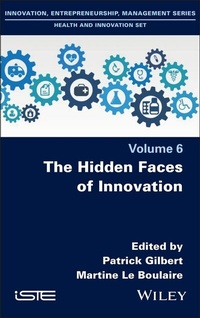
The Hidden Faces of Innovation
1st Edition
Published on 4. February 2026
250 pages
978-1-394-44144-0 (ISBN)
Description

More details
Other editions
Additional editions
Patrick Gilbert
The Hidden Faces of Innovation
Book
02/2026
1st Edition
Wiley
€157.50
Shipment within 3-4 weeks
Content
- Cover
- Title Page
- Copyright Page
- Contents
- Foreword
- Introduction
- Part 1. Managerial Dimensions of Creation and Innovation
- Chapter 1. Creation's Unique Managerial Paradigm
- 1.1. Creation as an organized social activity
- 1.1.1. Creation: from the romantic myth to organizational reality
- 1.1.2. The unknown and incomplete mandates
- 1.1.3. Designing without benchmarks: a specific context
- 1.2. The organization. against creation
- 1.2.1. The structural opposition between organization and creation
- 1.2.2. The temptation of the market
- 1.2.3. The delicate equation for organizing creation
- 1.3. Organizing and managing creation
- 1.3.1. The creative processes
- 1.3.2. Management and creation schemes
- 1.3.3. The unique paradigm of creative organizations
- 1.4. Epilogue
- 1.5. References
- Chapter 2. Manager Roles and Skills amid Transformation Dynamics
- 2.1. Prism for analyzing organizational transformations
- 2.1.1. Profound transformations, accelerated and accentuated by the health crisis
- 2.1.2. Human and organizational transformation phenomena according to the specialized literature
- 2.1.3. Contrasting transformation logics
- 2.1.4. Consequences of the drivers for managerial transformation
- 2.2. Manager roles and practices
- 2.2.1. Paradoxes identified and accepted by managers
- 2.2.2. Reported management practices
- 2.2.3. The lessons
- 2.3. Manager support provided by companies: various schemes
- 2.3.1. Promoting the transformation of corporate culture
- 2.3.2. Nourishing to "equip" managers and collaborators
- 2.3.3. Bringing reassurance by acting on the organizational framework
- 2.4. Conclusion: the return of the manager
- 2.5. References
- Chapter 3. Reconciling the Productivity and Well-being of Qualified Employees: The Managerial Challenge of Teleworking
- 3.1. The relationship between teleworking and productivity: a blind spot in research
- 3.1.1. The convergence of individual and organizational benefits: a widespread opinion tested by the facts
- 3.1.2. Some effects are beneficial, others not
- 3.1.3. An association between performance and well-being under certain conditions
- 3.1.4. Individual effects and organizational effects: a complex relationship
- 3.2. A questionnaire survey to gain further insight
- 3.2.1. The questionnaire and its administration
- 3.2.2. A first structuring of findings: descriptive statistics
- 3.2.3. A deeper analysis: a classification into four groups
- 3.3. Two major lessons
- 3.3.1. Teleworking: a situation leading to smaller changes than expected
- 3.3.2. Perception of teleworking contrary to the usual demographic segmentations
- 3.4. Guidance elements
- 3.4.1. Prioritizing diagnosis
- 3.4.2. Differentiated practical implications
- 3.5. Conclusion
- 3.6. References
- Chapter 4. The Socio-organizational Conditions for Innovation: The Israeli Experience
- 4.1. Israel, the unique case of a country managing innovation and talent
- 4.1.1. Non-transferable characteristics
- 4.1.2. Lessons for innovation management and human resources management
- 4.2. Tips and inspiration for businesses
- 4.2.1. Inspiration to better manage innovation
- 4.2.2. Avenues to consider for better talent management
- 4.3. Working on conditions propitiating innovation
- 4.3.1. The conditions required for the emergence of innovation
- 4.3.2. Which management and HR management principles should be deployed to encourage emergence?
- 4.3.3. Ways to manage talent differently
- 4.4. References
- Part 2. Organizational and Socio-material Dimensions of Innovation
- Chapter 5. Digital Technologies and Work Transformations
- 5.1. Digital technologies: reference points
- 5.1.1. Digital technologies: a history
- 5.1.2. Constantly evolving technologies
- 5.2. Analyzing changes in work in context through the prism of digital technologies
- 5.2.1. Professions in industry, maintenance and logistics
- 5.2.2. Professions in human resources management
- 5.2.3. Lessons learned from exploring different professions
- 5.3. Supporting work transformations: a collective responsibility
- 5.4. Conclusion: towards countless empirical and theoretical projects
- 5.5. References
- Chapter 6. The Influence of Atmospheres on R&D Creativity
- 6.1. The links between space, atmosphere and creativity
- 6.1.1. Defining organizational space
- 6.1.2. Organizational atmosphere and creativity
- 6.1.3. Four case studies and field observations
- 6.2. The impact of atmospheres on creativity
- 6.2.1. Atmospheres interact with attention focus and attention levels
- 6.2.2. Various types of spaces and atmospheres to stimulate the creative process
- 6.3. Recommendations for practice
- 6.4. Conclusion
- 6.5. References
- Chapter 7. The Expertise Factory: Shedding Light on a Blind Spot in Innovation Management
- 7.1. The production of expertise and its mysteries
- 7.1.1. "Expertise", "experts": a need for definition
- 7.1.2. An approach to expertise management that is still too confined
- 7.1.3. A growing need to understand the processes involved in building up expertise
- 7.2. A field survey to explore the question in depth
- 7.2.1. Selection and presentation of two cases: Galactica and Nucleosafe
- 7.2.2. Systematic data collection and analysis from semi-structured interviews
- 7.3. Diving into the heart of expertise production
- 7.3.1. Expertise, a construction that is both cognitive and relational
- 7.3.2. Management schemes with limited effects
- 7.3.3. The influence of business ecosystems
- 7.3.4. In short: an interactional factory engaging individuals and structures
- 7.4. Conclusion
- 7.5. References
- Chapter 8. Managing Agility in an R&D Context: Practices and Challenges
- 8.1. A wealth of literature, but still unanswered questions
- 8.1.1. Implications and scope of organizational agility
- 8.1.2. Agility in R&D
- 8.2. Four case studies
- 8.2.1. Methodology
- 8.2.2. AeroIndustry: in search of disruptive technologies
- 8.2.3. Constructor: accelerating the advent of product innovation
- 8.2.4. A-part: innovating in all business lines
- 8.2.5. Hydropalax: getting organized to promote innovation
- 8.3. Cross-disciplinary lessons
- 8.3.1. Contrasting representations of agility
- 8.3.2. The need for in-depth transformation
- 8.3.3. Interface management and internal cooperation: a difficult challenge
- 8.3.4. Openness to the environment and networking with the innovation ecosystem
- 8.4. Exploring avenues for agility in R&D: lessons learned and benchmarks for action
- 8.4.1. The need for coherent arrangements between practices
- 8.4.2. The profoundly paradoxical nature of agility
- 8.5. Conclusion
- 8.6. References
- List of Authors
- Index
- Other titles from ISTE in Innovation, Entrepreneurship and Management
- EULA
