

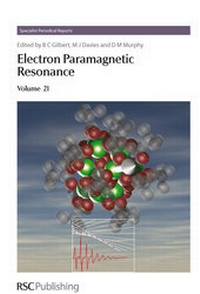
Electron Paramagnetic Resonance
Volume 21
1st Edition
Published on 19. December 2008
350 pages
978-1-84755-888-6 (ISBN)
Description

Electron Paramagnetic Resonance (EPR) Volume 21 highlights major developments in this area, with results being set into the context of earlier work and presented as a set of critical yet coherent overviews. The topics covered describe contrasting types of application, ranging from biological areas such as EPR studies of free-radical reactions in biology and medically-related systems, to experimental developments and applications involving EPR imaging, the use of very high fields, and time-resolved methods. Critical and up-to-the-minute reviews of advances involving the design of spin-traps, advances in spin-labelling, paramagnetic centres on solid surfaces, exchange-coupled oligomers, metalloproteins and radicals in flavoenzymes are also included. As EPR continues to find new applications in virtually all areas of modern science, including physics, chemistry, biology and materials science, this series caters not only for experts in the field, but also those wishing to gain a general overview of EPR applications in a given area. Volume 21 cover literature published during 2005 and 2006.
More details
Series
Edition
1. Auflage
Language
English
Place of publication
Cambridge
United Kingdom
Target group
Professional and scholarly
ISBN-13
978-1-84755-888-6 (9781847558886)
DOI
10.1039/9781847558886
Copyright in bibliographic data and cover images is held by Nielsen Book Services Limited or by the publishers or by their respective licensors: all rights reserved.
Schweitzer Classification
Other editions
New editions
E-Book
10/2007
1st Edition
Royal Society of Chemistry
€385.99
Available for download
Additional editions
Book
12/2008
Royal Society of Chemistry
€362.50
Shipment within 3-4 weeks
Person
Compiled by teams of leading authorities in the relevant subject, the series creates a unique service for the active research chemist with regular critical in-depth accounts of progress in Electron Paramagnetic Resonance (EPR).
Content
- Electron Paramagnetic Resonance
- CONTENTS
- Preface
- Biomedical applications of EPR spectroscopy
- Introduction
- Reactive oxygen species
- Reactive nitrogen species
- Consequences of free radical reactions with biomolecules
- Damage to lipids
- Damage to DNA
- Damage to proteins
- Free radicals and disease
- Cancer
- Infectious disease
- Alzheimers disease
- Diabetes
- Cardiovascular disease
- Miscellaneous conditions
- Selected biomedical EPR techniques
- In vivo EPR oximetry
- In vivo EPR imaging
- References
- EPR studies of radiation damage to DNA and related molecules
- Introduction
- Scope of this report
- Recent trends in DNA radiation chemistry
- Symbols used
- DNA constituents
- Single crystal studies
- Amorphous systems
- DNA
- Track structure in DNA irradiated with heavy ions
- Studies of DNA-iron complexes
- Formation of 8-oxo-G in irradiated DNA by multiple one-electron oxidations
- Electron transfer versus differential fading of radicals
- Role of excited states in DNA damage-experimental and theoretical results
- Photoinduced radical formation in DNA
- DNA yields and strand breaks
- Electron induced cleavage of thymine dimers
- Acknowledgements
- References
- Measurement of interspin distances by EPR
- Introduction to distance determination
- Related reviews
- CW
- Accessibility to paramagnetic relaxation reagents
- Relaxation of free radicals due to nearby paramagnetic metals
- DEER (PELDOR)
- Determination of relative orientations of radicals in DEER
- More than two spins
- Uncertainty in distributions
- Metal-metal distances by DEER
- Limitations of the DEER method
- Examples of applications of DEER
- Other spin echo methods
- DQC and DEER
- Out-of-phase echo detection
- Biological studies at room temperature
- Sample preparation limitations
- Acknowledgements
- References
- Time-resolved electron paramagnetic resonance studies of transient organic radicals
- Introduction
- Photochemical applications
- Photoionization
- Photoreduction of sensitizers
- Photooxidation
- Homolytic bond scission
- Addition reactions to double bonds
- CIDEP studies
- Pulse radiolysis EPR
- Concluding remarks
- References
- EPR of paramagnetic centres on solid surfaces
- Introduction
- s-Block metal oxides
- Transition metal oxides
- TiO2
- ZrO2
- CeO2
- V2O5 Oxides
- CrOx Oxides
- MoOx Oxides
- Iron oxides
- Copper oxides
- ZnO
- p-Block metal oxides
- References
- EPR of exchange coupled oligomers
- Introduction
- p-Block
- d-Block
- Dimetallic complexes
- Trimetallic complexes
- Tetrametallic complexes
- Polymetallic complexes
- Polymetallic cores encapsulated into polyoxometalates
- Molecular wheels
- Single-molecule magnets (SMMs)
- Mixed p/d- and d/f-block
- Biological systems
- Methods
- Nitrogenases
- Copper
- Manganese (excluding photosystems)
- Diiron (including 2Fe2S)
- Other iron-sulfur centres
- Coupled haems
- Cobalt
- Photosystems
- Nickel
- References
- Continuous wave and pulsed EPR analyses of metalloproteins
- Introduction
- Field-swept EPR methods
- Detecting nuclear interactions
- Now you see it, now you don't
- Interpretation of EPR data
- Choosing between different experiments
- Example 1. The study of high-spin ferric heme proteins
- Example 2. The nickel-containing methyl-coenzyme M reductase
- Conclusion
- Acknowledgements
- References
- An EPR tool box for exploring the formation and properties of ordered template mesoporous materials
- Introduction
- Templated mesoporous materials
- The formation mechanism of TMM
- General principles
- Methods for mechanistic studies
- The formation of TMM with ionic templates
- The formation of TMM with non-ionic templates
- The EPR tool box
- Spin-probes
- The EPR experiments
- EPR investigation of the formation of TMM
- The location of the nitroxide label in micelles
- EPR studies of MCM-41
- EPR studies of SBA-15
- Studies of cubic mesoporous materials
- Studies of wormlike mesoporous materials
- Summary and outlook
- Acknowledgements
- References
- High-field pulse EPR instrumentation
- Introduction
- Scope of the review
- High-field EPR spectroscopy
- History of high-frequency pulse EPR
- Sensitivity
- Cavities
- Sensitivity and deadtime
- Measurement bandwidth
- Averaging and pulse repetition time
- St Andrews system design
- Current system performance
- System overview
- Induction mode cavities and sample holders
- Pulse sources and pulse generation
- Phase coherent detection system
- Spectrometer front end system design
- Control software
- Discussion
- Fourier transform EPR and FID detection
- Hyperfine and electron-dipolar spectroscopies
- Dynamic nuclear polarisation (DNP)
- Conclusions and outlook
- References
