

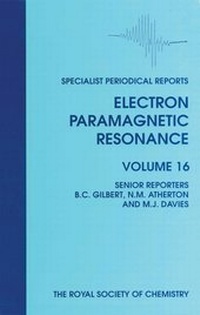
Electron Paramagnetic Resonance
Volume 16
1st Edition
Published on 31. October 2007
312 pages
978-1-84755-353-9 (ISBN)
Description

Specialist Periodical Reports provide systematic and detailed review coverage of progress in the major areas of chemical research. Written by experts in their specialist fields the series creates a unique service for the active research chemist, supplying regular critical in-depth accounts of progress in particular areas of chemistry. For over 80 years the Royal Society of Chemistry and its predecessor, the Chemical Society, have been publishing reports charting developments in chemistry, which originally took the form of Annual Reports. However, by 1967 the whole spectrum of chemistry could no longer be contained within one volume and the series Specialist Periodical Reports was born. The Annual Reports themselves still existed but were divided into two, and subsequently three, volumes covering Inorganic, Organic and Physical Chemistry. For more general coverage of the highlights in chemistry they remain a 'must'. Since that time the SPR series has altered according to the fluctuating degree of activity in various fields of chemistry. Some titles have remained unchanged, while others have altered their emphasis along with their titles; some have been combined under a new name whereas others have had to be discontinued. The current list of Specialist Periodical Reports can be seen on the inside flap of this volume.
More details
Series
Edition
1. Auflage
Language
English
Place of publication
Cambridge
United Kingdom
Target group
Professional and scholarly
ISBN-13
978-1-84755-353-9 (9781847553539)
DOI
10.1039/9781847553539
Copyright in bibliographic data and cover images is held by Nielsen Book Services Limited or by the publishers or by their respective licensors: all rights reserved.
Schweitzer Classification
Other editions
New editions
E-Book
10/2007
1st Edition
Royal Society of Chemistry
€389.99
Available for download
Additional editions
Book
12/1998
Royal Society of Chemistry
€398.50
Shipment within 3-4 weeks
Persons
Content
- ELECTRON PARAMAGNETIC RESONANCE
- Contents
- Chapter 1 Biological Free Radicals
- 1 Introduction and Scope of Review
- 2 Metal Ions
- 2.1 Iron
- 2.2 Copper
- 2.3 Chromium
- 2.4 Other Metal Ions
- 3 Hydroperoxides
- 3.1 Alkyl/Aryl Hydroperoxides
- 3.2 Amino Acid, Protein and Nucleic Acid Hydroperoxides
- 4 Protein-derived Radicals
- 5 Veratyl Alcohol
- 6 Beta-amyloid Protein
- 7 Ozone
- 8 Nitric Oxide
- 9 Peroxynitrite(ONOO?)
- 10 Asbestos, Mineral Fibres and Diesel Particles
- 11 Cigarette Smoke
- 12 Paraquat
- 13 Halogenated Compounds
- 14 Ethanol
- 15 Retinoic Acid
- 16 Quinones
- 17 Phenols and Related Compounds
- 18 Thiols, Disulfides and Related Compounds
- 19 Ascorbate
- 19.1 Clinical Studies
- 19.2 Animal Studies
- 19.3 In Vitro Studies
- 20 Toxins
- 21 Hydroxylamines and Hydrazines
- 22 Diazonium and Tetrazolium Compounds
- 23 Nitro Compounds and Nitrogen Heterocycles
- 24 Photochemistry
- 24.1 UV-generated Radicals
- 24.2 Radical Generation from Exogenous Photosensitisers
- 24.3 Other Photochemical Studies
- 25 Ischemia-Reperfusion Injury
- 25.1 Heart and Vasculature
- 25.2 Brain
- 25.3 Liver, Kidney and Other Organs
- 26 Radiation Dosimetry
- 27 Spin Trap Artifacts and Misassignments
- References
- Chapter 2 Time-resolved Electron Paramagnetic Resonance Studies in Organic Photochemistry
- 1 Introduction
- 2 The Mechanisms of CIDEP
- 3 Theoretical Developments
- 4 TREPR Experiments
- 4.1 The TR (CW) EPR Experiment
- 4.2 TREPR at Multiple Microwave Frequencies
- 4.3 Optically Detected Magnetic Resonance (ODMR)
- 4.3.1 RYDMR
- 4.3.2 FDMR
- 4.3.3 ADMR
- 4.4 Quantum Beats
- 4.5 Fourier Transform EPR
- 5 Applications in Organic Photochemistry
- 5.1 Fullerenes
- 5.2 Photosynthetic Model Systems
- 5.3 Radical Pairs in Micelles
- References
- Chapter 3 Radiation Damage to DNA and Related Biomolecules
- 1 Introduction
- 1.1 Scope of this Report
- 1.2 Significance of the Field of Research
- 1.3 Symbols Used
- 2 DNA Constituents
- 2.1 Introduction
- 2.2 Pyrimidines
- 2.2.1 Single Crystal Studies
- 2.2.2 Frozen Aqueous Solutions and Glasses
- 2.3 Purines
- 2.3.1 Single Crystals
- 2.3.2 Glasses
- 2.4 Mixed Crystal Systems
- 2.5 Multi-base Investigations
- 2.5.1 Frozen Aqueous Solutions and Glasses
- 2.5.2 Peroxyl and Sulfoxyl Radicals
- 3 DNA, Polynucleotides and Oligonucleotides
- 3.1 Introduction
- 3.1.1 Symbols for DNA Radicals
- 3.1.2 The Direct, Quasi-direct and Indirect Effects
- 3.2 Radical Yields in DNA
- 3.2.1 Radical Distributions at Low Temperatures
- 3.2.2 Deconvolution of Complex Spectra: Important Confirmatory Results
- 3.2.3 Where are the Sugar Radicals in Irradiated DNA?
- 3.2.4 Evidence for Sugar Radicals in High LET Irradiated DNA
- 3.2.5 Recombination: An Important Fundamental Process in Radiation Damage to DNA
- 3.3 Radical Transfer in DNA
- 3.3.1 Electron Transfer Distances in DNA
- 3.3.2 Hole Transfer from the DNA Hydration Layer: Yields of Hydroxyl Radicals
- 3.4 DNA-Thiol Systems
- 3.5 Irreversible Protonation of Electron-gain Centers in DNA
- 3.6 Radiation Damage to DNA by Heavy-ion Beams
- 3.7 Spin Trapping of DNA Intermediates
- 3.8 New Techniques
- References
- Chapter 4 Spin-trapping: Recent Developments and Applications
- 1 Introduction
- 2 New Spin-traps
- 2.1 New Nitrones
- 2.2 New Isotopically-labelled Spin-traps
- 3 Applications in Organic Solvents
- 3.1 Spontaneous Formation of Spin Adducts
- 3.1.1 Inverted Spin-trapping
- 3.1.2 Other Mechanisms
- 3.2 Spin-trapping of Various Radicals
- 3.3 Miscellaneous
- 4 Applications in Aqueous Solutions
- 4.1 Superoxide
- 4.2 Hydroxyl Radical
- 5 Trapping of Nitric Oxide
- 6 Miscellaneous
- References
- Chapter 5 EPR and ENDOR Studies of Metalloproteins
- 1 Introduction
- 2 Copper
- 2.1 'Blue'Copper Sites
- 2.2 Type 2 Copper Sites
- 2.3 Binuclear Sites and Multi-centered Copper Proteins
- 3 Iron
- 3.1 Non-heme Iron Proteins
- 3.2 Heme-Iron Proteins
- 3.3 Iron-Sulfur Proteins
- 4 Nickel
- 5 Molybdenum and Tungsten
- 6 Vanadium
- 7 Manganese
- 8 Conclusions
- Acknowledgements
- References
- Chapter 6 Pulsed ESR of Microporous and Mesoporous Oxide Materials
- 1 Introduction
- 2 Organic Radicals
- 3 Transition Metal Ions
- 3.1 Cu(II) Systems
- 3.2 Ni(I) Systems
- 3.3 Pd(I) Systems
- 3.4 Fe(III) Systems
- 3.5 Mn(II) Systems
- 3.6 Ti(III) Systems
- 3.7 Cr(V), Mo(V) and V(IV) Systems
- 3.8 Paramagnetic Silver Clusters
- Acknowledgement
- References
- Chapter 7 Advanced EPR in Millimetre Bands and Very High Fields
- 1 Introduction
- 2 Techniques
- 3 Applications
- 3.1 Molecular Structure Studies
- 3.1.1 Single-electron Spin Systems
- 3.1.2 Multi-electron Spin Systems
- 3.2 Molecular Mobility Studies
- 4 High-field Low-temperature Effects
- 5 Conclusions
- Acknowledgments
- References
- Chapter 8 Electron Transfer Kinetics Studied by EPR/ESR and Related Methods
- 1 Introduction
- 2 Bibliography
- 3 Marcus Theory of Electron Transfer Reactions in Solution
- 4 Intermolecular Electron Transfer Rate Constants from EPR Measurements
- 4.1 Time-resolved EPR at Constant Magnetic Field
- 4.2 Dynamic ESR Line-broadening Measurements
- 4.2.1 Homogeneous Electron Self-exchange Reactions
- 4.2.2 Degenerate Intramolecular Electron Exchange Reactions
- 4.3 Electron Self-exchange Rates from Other Magnetic Resonance Methods
- 4.3.1 Fluorescence-detected Magnetic Resonance Measurements
- 4.3.2 Time-resolved CIDNP and CIDEP Measurements
- 4.3.3 FT-EPR Measurements
- 4.3.4 RYDMR and MARY Methods
- Acknowledgements
- References
- Author Index
