

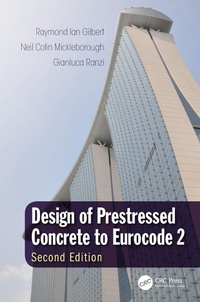
Design of Prestressed Concrete to Eurocode 2
2nd Edition
Published on 27. January 2017
699 pages
978-1-315-38951-6 (ISBN)
Description

The design of structures in general, and prestressed concrete structures in particular, requires considerably more information than is contained in building codes. A sound understanding of structural behaviour at all stages of loading is essential. This textbook presents a detailed description and explanation of the behaviour of prestressed concrete members and structures both at service loads and at ultimate loads and, in doing so, provide a comprehensive and up-to-date guide to structural design.
Much of the text is based on first principles and relies only on the principles of mechanics and the properties of concrete and steel, with numerous worked examples. However, where the design requirements are code specific, this book refers to the provisions of Eurocode 2: Design of Concrete Structures and, where possible, the notation is the same as in Eurocode 2. A parallel volume is written to the Australian Standard for Concrete Structures AS3600-2009.
The text runs from an introduction to the fundamentals to in-depth treatments of more advanced topics in modern prestressed concrete structures. It suits senior undergraduate and graduate students and also practising engineers who want comprehensive introduction to the design of prestressed concrete structures. It retains the clear and concise explanations and the easy-to-read style of the first edition, but the content has been extensively re-organised and considerably expanded and updated. New chapters cover design procedures, actions and loads; prestressing systems and construction requirements; connections and detailing; and design concepts for prestressed concrete bridges. The topic of serviceability is developed extensively throughout.
All the authors have been researching and teaching the behaviour and design of prestressed concrete structures for over thirty-five years and the proposed new edition of the book reflects this wealth of experience. The work has also gained much from Professor Gilbert active and long-time involvement in the development of standards for concrete buildings and concrete bridges.
Much of the text is based on first principles and relies only on the principles of mechanics and the properties of concrete and steel, with numerous worked examples. However, where the design requirements are code specific, this book refers to the provisions of Eurocode 2: Design of Concrete Structures and, where possible, the notation is the same as in Eurocode 2. A parallel volume is written to the Australian Standard for Concrete Structures AS3600-2009.
The text runs from an introduction to the fundamentals to in-depth treatments of more advanced topics in modern prestressed concrete structures. It suits senior undergraduate and graduate students and also practising engineers who want comprehensive introduction to the design of prestressed concrete structures. It retains the clear and concise explanations and the easy-to-read style of the first edition, but the content has been extensively re-organised and considerably expanded and updated. New chapters cover design procedures, actions and loads; prestressing systems and construction requirements; connections and detailing; and design concepts for prestressed concrete bridges. The topic of serviceability is developed extensively throughout.
All the authors have been researching and teaching the behaviour and design of prestressed concrete structures for over thirty-five years and the proposed new edition of the book reflects this wealth of experience. The work has also gained much from Professor Gilbert active and long-time involvement in the development of standards for concrete buildings and concrete bridges.
Reviews / Votes
"This book provides a comprehensive in-depth coverage of all aspects of analysis and design for both students and practising engineers. Explanations of structural behaviour and design concepts are given in terms that are easy to follow and understand. Requirements and application of Eurocode are fully explained and illustrated by worked examples."-- Tony Threlfall, Consultant, UK
"It is a first rate book which should be useful to both Masters Level students and practitioners. The book is very clearly written and structured. The emphasis on providing clear explanations of physical behavior is particularly appealing."
-- Robert Vollum, Imperial College London
"The book is organized in a logical sequence from simply support beam to continuous beam and then two way slabs, from basic principles to more complicate analysis such as long term creep and shrinkage effect and cracking."
-- Neil Tsang, Coventry University, UK
"There are many diagrams and worked examples, the second edition benefiting from a clearer layout and some photographs, the first having only diagrams. It refers to provisions of Eurocode 2 (EN 1992-1-1:2004) and other relevant EN Standards where the design requirements are Code specific."
-- The Concrete Society, UK
More details
Edition
2nd edition
Language
English
Place of publication
London
United Kingdom
Publishing group
Taylor & Francis Ltd
Target group
Professional and scholarly
College/higher education
Illustrations
45 Tables, black and white; 268 Line drawings, black and white; 28 Halftones, black and white; 341 Illustrations, black and white
File size
10,68 MB
ISBN-13
978-1-315-38951-6 (9781315389516)
Copyright in bibliographic data and cover images is held by Nielsen Book Services Limited or by the publishers or by their respective licensors: all rights reserved.
Schweitzer Classification
Other editions
Additional editions
Raymond Ian Gilbert | Neil Colin Mickleborough | Gianluca Ranzi
Design of Prestressed Concrete to Eurocode 2
Book
01/2019
2nd Edition
CRC Press
€64.40
Shipment within 15-20 days
Raymond Ian Gilbert | Neil Colin Mickleborough | Gianluca Ranzi
Design of Prestressed Concrete to Eurocode 2
Book
01/2017
2nd Edition
CRC Press
€158.90
Shipment within 15-20 days
Persons
Raymond Ian Gilbert is Emeritus Professor of Civil Engineering at The University of New South Wales, UK, and Deputy Director of the UNSW Centre for Infrastructure Engineering and Safety, Australia. His books, 'Structural Analysis: Principles, Methods and Modelling' and 'Time-Dependent Behaviour of Concrete Structures' were also published by CRC Press.
Neil Colin Mickleborough is Professor of Civil Engineering and the Director of the Center for Engineering Education Innovation at Hong Kong University of Science and Technology, China.
Gianluca Ranzi is Professor of Civil Engineering, ARC Future Fellow and Director of the Centre for Advanced Structural Engineering at the University of Sydney, Australia.
Neil Colin Mickleborough is Professor of Civil Engineering and the Director of the Center for Engineering Education Innovation at Hong Kong University of Science and Technology, China.
Gianluca Ranzi is Professor of Civil Engineering, ARC Future Fellow and Director of the Centre for Advanced Structural Engineering at the University of Sydney, Australia.
Content
1. Basic Concepts
2. Design Procedures and Applied Actions
3. Prestressing Systems
4. Material Properties
5. Design for Serviceability
6. Flexural Resistance
7. Design Resistance in Shear and Torsion
8. Anchorage Zones
9. Composite Members
10. Design Procedures for Determinate Beams
11. Statically Indeterminate Members
12. Two-Way Slabs - Behavior and Design
13. Compression and Tension Members
14. Detailing - Members and Connections
Index
Appendices
2. Design Procedures and Applied Actions
3. Prestressing Systems
4. Material Properties
5. Design for Serviceability
6. Flexural Resistance
7. Design Resistance in Shear and Torsion
8. Anchorage Zones
9. Composite Members
10. Design Procedures for Determinate Beams
11. Statically Indeterminate Members
12. Two-Way Slabs - Behavior and Design
13. Compression and Tension Members
14. Detailing - Members and Connections
Index
Appendices
