

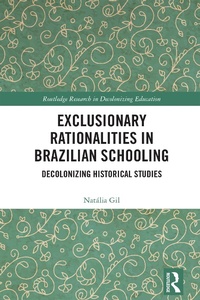
Exclusionary Rationalities in Brazilian Schooling
Decolonizing Historical Studies
1st Edition
Published on 23. June 2023
238 pages
978-1-000-89906-1 (ISBN)
Description

Through in-depth socio-historical analysis of discourses and processes of quantification around school performance and student failure rates in Brazil, this volume highlights the prevalence of Eurocentric colonized thought that results in the persistence of exclusion bottlenecks; different trajectories according to gender, race, and class; and significant regional variations in the rates of failure and dropout, among other problems.
Focusing on processes performed between 1918 and 2012, this book offers rich analysis of historiographic sources including journals, newspapers, and administrative documentation to trace the development of initiatives intended to promote the democratization of Brazilian schooling. An examination of reforms including school classification, the graduated school model, admissions examinations, and automatic promotion reveal a school system that mirrors wider societal injustices and guarantees academic success for only a minority of students.
Bringing a nuanced and elaborated historical perspective of the pragmatics of the selective classificatory logic in different institutional and epistemic qualities of the school organization of children and the reasoning about abilities and achievement, this book will appeal to scholars and researchers with interests in curriculum and assessment, the sociology of education, and the history of education.
Focusing on processes performed between 1918 and 2012, this book offers rich analysis of historiographic sources including journals, newspapers, and administrative documentation to trace the development of initiatives intended to promote the democratization of Brazilian schooling. An examination of reforms including school classification, the graduated school model, admissions examinations, and automatic promotion reveal a school system that mirrors wider societal injustices and guarantees academic success for only a minority of students.
Bringing a nuanced and elaborated historical perspective of the pragmatics of the selective classificatory logic in different institutional and epistemic qualities of the school organization of children and the reasoning about abilities and achievement, this book will appeal to scholars and researchers with interests in curriculum and assessment, the sociology of education, and the history of education.
Reviews / Votes
"This is a remarkable book on Exclusion in Brazilian Schools. Thanks to extensive historical research, Natalia Gil offers us an admirable synthesis of quantification, classification, and other colonized rationalities that, in Brazil, have marked the history of education over the centuries." - Antonio Novoa, University of Lisbon, Portugal"This comprehensive study of the Brazilian school system discusses central issues of our times, which speak to problems and debates equally felt in different latitudes. Natalia Gil's analysis focuses on the production of inequalities through testing and grading, the role of school organization and academic regime, particularly policies on retention and promotion, the rise of meritocracy, and the quantification of educational problems, and calls for a decolonizing of educational rationales. The author undertakes a historical approach that ranges from the emergence of modern schooling to contemporary debates in the press on evaluation and promotion and educational quality, and it does so using a wide set of archival documents and pedagogical literature. Through this detailed study, Natalia Gil provides a well-sustained argument about the need to rethink how schools are organized and what is at stake in contemporary educational reforms." - Ines Dussel, DIE-Cinvestav, Mexico; President, International Standing Conference for the History of Education (ISCHE) "This is a remarkable book on Exclusion in Brazilian Schools. Thanks to extensive historical research, Natalia Gil offers us an admirable synthesis of quantification, classification, and other colonized rationalities that, in Brazil, have marked the history of education over the centuries." - Antonio Novoa, University of Lisbon, Portugal
"This comprehensive study of the Brazilian school system discusses central issues of our times, which speak to problems and debates equally felt in different latitudes. Natalia Gil's analysis focuses on the production of inequalities through testing and grading, the role of school organization and academic regime, particularly policies on retention and promotion, the rise of meritocracy, and the quantification of educational problems, and calls for a decolonizing of educational rationales. The author undertakes a historical approach that ranges from the emergence of modern schooling to contemporary debates in the press on evaluation and promotion and educational quality, and it does so using a wide set of archival documents and pedagogical literature. Through this detailed study, Natalia Gil provides a well-sustained argument about the need to rethink how schools are organized and what is at stake in contemporary educational reforms." - Ines Dussel, DIE-Cinvestav, Mexico; President, International Standing Conference for the History of Education (ISCHE)
"Natalia Gil's Exclusionary Rationalities in Brazilian Schooling: Decolonizing Historical Studies has a historical, cultural/sociological elegance importance in the understanding of the politics of knowledge in modernity and its issues of coloniality. The book's exploration of the representational logics and the inscriptions of statistics in the practices of educational measurement and evaluation makes visible the political of what seems as the non-polemic diagnoses of children's learning and evaluation. Made visible are how the infrastructures of the sciences assemble European rationalities in a comparative reason connected to solving the large-scale social dilemmas, issues of exclusion, and the democratization of Brazilian education. The detailed historical analyses makes a significant contribution for thinking about how phenomena of measurement perform as spaces of action in schooling that differentiate and distribute differences designed to include and correct social wrong." - Thomas S. Popkewitz, University of Wisconsin-Madison
More details
Series
Edition
1. Auflage
Language
English
Place of publication
London
United Kingdom
Publishing group
Taylor & Francis Ltd
Target group
College/higher education
Illustrations
12 Tables, black and white
ISBN-13
978-1-000-89906-1 (9781000899061)
Copyright in bibliographic data and cover images is held by Nielsen Book Services Limited or by the publishers or by their respective licensors: all rights reserved.
Schweitzer Classification
Other editions
Additional editions
Book
11/2024
1st Edition
Routledge
€61.60
Shipment within 10-20 days
Book
06/2023
1st Edition
Routledge
€206.40
Shipment within 10-20 days
Person
Natalia Gil is Professor and Researcher in the School of Education at The Federal University of Rio Grande do Sul (UFRGS), Brazil.
Content
Chapter 1. Exclusion in Brazilian schooling: quantification, classification, and other colonized rationalities Chapter 2. Exams in modern school, the moralization of conducts, and the purposes of schooling poor children Chapter 3. Overlapping evaluation functions in Brazilian schools Chapter 4. Measurement and classification of persons: tests in the service of school efficiency Chapter 5. Graded school, homogenization of classes, and reductions of teaching programs Chapter 6. Democratization of teaching and the hierarchy of capacities Chapter 7. The scandal of numbers and the quantification of educational problems Chapter 8. Non-approval, repetition, and dropout: the debate around statistics Chapter 9. Causes of school repetition from the perspective of periodical press: a long inventory of prejudices Chapter 10. Solutions for school non-approval and concern with the quality of teaching Index
