


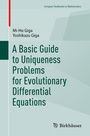
A Basic Guide to Uniqueness Problems for Evolutionary Differential Equations
Description

This book addresses the issue of uniqueness of a solution to a problem - a very important topic in science and technology, particularly in the field of partial differential equations, where uniqueness guarantees that certain partial differential equations are sufficient to model a given phenomenon.
This book is intended to be a short introduction to uniqueness questions for initial value problems. One often weakens the notion of a solution to include non-differentiable solutions. Such a solution is called a weak solution. It is easier to find a weak solution, but it is more difficult to establish its uniqueness. This book examines three very fundamental equations: ordinary differential equations, scalar conservation laws, and Hamilton-Jacobi equations. Starting from the standard Gronwall inequality, this book discusses less regular ordinary differential equations. It includes an introduction of advanced topics like the theory of maximal monotone operators as wellas what is called DiPerna-Lions theory, which is still an active research area. For conservation laws, the uniqueness of entropy solution, a special (discontinuous) weak solution is explained. For Hamilton-Jacobi equations, several uniqueness results are established for a viscosity solution, a kind of a non-differentiable weak solution. The uniqueness of discontinuous viscosity solution is also discussed. A detailed proof is given for each uniqueness statement.
The reader is expected to learn various fundamental ideas and techniques in mathematical analysis for partial differential equations by establishing uniqueness. No prerequisite other than simple calculus and linear algebra is necessary. For the reader's convenience, a list of basic terminology is given at the end of this book.
Reviews / Votes
"The advantage of the book is that it contains sections with exercises after each chapter. The book is also a valuable reference for experts." (Piotr Rybka, Mathematical Reviews, July, 2025)
More details
Other editions
Additional editions
Persons
Dr. Yoshikazu Giga is professor at the Graduate School of Mathematical Sciences of the University of Tokyo, Japan. He is a fellow of the American Mathematical Society as well as of the Japan Society for Industrial and Applied Mathematics. Through his more than 250 papers and 2 monographs, he has substantially contributed to the theory for parabolic partial differential equations including geometric evolution equations, semilinear heat equations, as well as the incompressible Navier-Stokes equations. He has received several prizes including the Medal of Honor with Purple Ribbon from the Government of Japan and the second Kodaira Kunihiko Prize from the Mathematical Society of Japan.
Dr. Mi-Ho Giga is a project researcher at the Graduate School of Mathematical Sciences of the University of Tokyo, Japan. She is a mathematical analyst working on parabolic partial differential equations related to crystal growth at low temperature. She is a member of both the Mathematical Society of Japan and the Japan Society for Industrial and Applied Mathematics. She is one of the authors of the book 'Nonlinear Partial Differential Equations: Asymptotic Behavior of Solutions and Self-Similar Solutions' published from Birkhauser in 2010 as well as its Japanese original version published from Kyoritu-Shuppan in 1999.
