

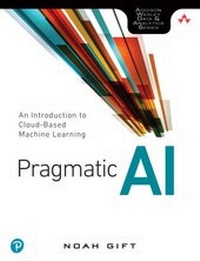
Pragmatic AI
An Introduction to Cloud-Based Machine Learning
1st Edition
Published on 12. July 2018
256 pages
978-0-13-486389-4 (ISBN)
Description

Master Powerful Off-the-Shelf Business Solutions for AI and Machine Learning
Pragmatic AI will help you solve real-world problems with contemporary machine learning, artificial intelligence, and cloud computing tools. Noah Gift demystifies all the concepts and tools you need to get results-even if you don't have a strong background in math or data science.
Gift illuminates powerful off-the-shelf cloud offerings from Amazon, Google, and Microsoft, and demonstrates proven techniques using the Python data science ecosystem. His workflows and examples help you streamline and simplify every step, from deployment to production, and build exceptionally scalable solutions. As you learn how machine language (ML) solutions work, you'll gain a more intuitive understanding of what you can achieve with them and how to maximize their value.
Building on these fundamentals, you'll walk step-by-step through building cloud-based AI/ML applications to address realistic issues in sports marketing, project management, product pricing, real estate, and beyond. Whether you're a business professional, decision-maker, student, or programmer, Gift's expert guidance and wide-ranging case studies will prepare you to solve data science problems in virtually any environment.
Get and configure all the tools you'll need
Quickly review all the Python you need to start building machine learning applications
Master the AI and ML toolchain and project lifecycle
Work with Python data science tools such as IPython, Pandas, Numpy, Juypter Notebook, and Sklearn
Incorporate a pragmatic feedback loop that continually improves the efficiency of your workflows and systems
Develop cloud AI solutions with Google Cloud Platform, including TPU, Colaboratory, and Datalab services
Define Amazon Web Services cloud AI workflows, including spot instances, code pipelines, boto, and more
Work with Microsoft Azure AI APIs
Walk through building six real-world AI applications, from start to finish
Register your book for convenient access to downloads, updates, and/or corrections as they become available. See inside book for details.
Pragmatic AI will help you solve real-world problems with contemporary machine learning, artificial intelligence, and cloud computing tools. Noah Gift demystifies all the concepts and tools you need to get results-even if you don't have a strong background in math or data science.
Gift illuminates powerful off-the-shelf cloud offerings from Amazon, Google, and Microsoft, and demonstrates proven techniques using the Python data science ecosystem. His workflows and examples help you streamline and simplify every step, from deployment to production, and build exceptionally scalable solutions. As you learn how machine language (ML) solutions work, you'll gain a more intuitive understanding of what you can achieve with them and how to maximize their value.
Building on these fundamentals, you'll walk step-by-step through building cloud-based AI/ML applications to address realistic issues in sports marketing, project management, product pricing, real estate, and beyond. Whether you're a business professional, decision-maker, student, or programmer, Gift's expert guidance and wide-ranging case studies will prepare you to solve data science problems in virtually any environment.
Get and configure all the tools you'll need
Quickly review all the Python you need to start building machine learning applications
Master the AI and ML toolchain and project lifecycle
Work with Python data science tools such as IPython, Pandas, Numpy, Juypter Notebook, and Sklearn
Incorporate a pragmatic feedback loop that continually improves the efficiency of your workflows and systems
Develop cloud AI solutions with Google Cloud Platform, including TPU, Colaboratory, and Datalab services
Define Amazon Web Services cloud AI workflows, including spot instances, code pipelines, boto, and more
Work with Microsoft Azure AI APIs
Walk through building six real-world AI applications, from start to finish
Register your book for convenient access to downloads, updates, and/or corrections as they become available. See inside book for details.
More details
Language
English
Place of publication
Boston
United States
Publishing group
Pearson Education (US)
Target group
Adult education
ISBN-13
978-0-13-486389-4 (9780134863894)
Copyright in bibliographic data and cover images is held by Nielsen Book Services Limited or by the publishers or by their respective licensors: all rights reserved.
Schweitzer Classification
Other editions
Additional editions
Noah Gift
Pragmatic AI: An Introduction to Cloud-Based Machine Learning
An Introduction to Cloud-Based Machine Learning
Book
12/2018
1st Edition
Addison Wesley
€37.49
Shipment within 15-20 days
Person
Noah Gift is lecturer and consultant at UC Davis Graduate School of Management in the MSBA program. Professionally, Noah has approximately 20 years' experience programming in Python and is a member of the Python Software Foundation. He has worked for a variety of companies in roles ranging from CTO, general manager, consulting CTO, and cloud architect. Currently, he is consulting start-ups and other companies on machine learning and cloud architecture, and is doing CTO-level consulting via Noah Gift Consulting. He has published close to 100 technical publications including two books on subjects ranging from cloud machine learning to DevOps. He is also a certified AWS Solutions Architect. Noah has an MBA from University of California, Davis; an MS in computer information systems from California State University, Los Angeles; and a BS in nutritional science from Cal Poly, San Luis Obispo. You can find more about Noah by following him on Github ( https://github.com/noahgift/), visiting http://noahgift.com, or connecting with him on https://www.linkedin.com/in/noahgift/.
Content
Foreword
Preface
Acknowledgments
About the Author
Part I: Introduction to Pragmatic AI
Chapter 1: Introduction to Pragmatic AI
Chapter 2: AI and ML Toolchain
Chapter 3: Spartan AI Lifecycle
Part II: AI in the Cloud
Chapter 4: Cloud AI Development with Google Cloud Platform
Chapter 5: Cloud Ai Development with Amazon Web Services
Part III: Creating Practical AI Applications from Scratch
Chapter 6: Predicting Social-Media Influence in the NBA
Chapter 7: Creating an Intelligent Slackbot on AWS
Chapter 8: Finding Project Management Insights from a Github Organization
Chapter 9: Dynamically Optimizing EC2 Instances on AWS
Chapter 10: Real Estate
Chapter 11: Production AI for User Generated Content (UGC)
Appendix A: AI Accelerators
Appendix B: Deciding on Cluster Size
Index
Preface
Acknowledgments
About the Author
Part I: Introduction to Pragmatic AI
Chapter 1: Introduction to Pragmatic AI
Chapter 2: AI and ML Toolchain
Chapter 3: Spartan AI Lifecycle
Part II: AI in the Cloud
Chapter 4: Cloud AI Development with Google Cloud Platform
Chapter 5: Cloud Ai Development with Amazon Web Services
Part III: Creating Practical AI Applications from Scratch
Chapter 6: Predicting Social-Media Influence in the NBA
Chapter 7: Creating an Intelligent Slackbot on AWS
Chapter 8: Finding Project Management Insights from a Github Organization
Chapter 9: Dynamically Optimizing EC2 Instances on AWS
Chapter 10: Real Estate
Chapter 11: Production AI for User Generated Content (UGC)
Appendix A: AI Accelerators
Appendix B: Deciding on Cluster Size
Index
