


The Connectivity of Things
Network Cultures since 1832
Published on 15. October 2024
444 pages
978-0-262-38108-6 (ISBN)
Description

A media history of the material and infrastructural features of networking practices, a German classic translated for the first time into English.
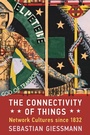
Nets hold, connect, and catch. They ensnare, bind, and entangle. Our social networks owe their name to a conceivably strange and ambivalent object. But how did the net get into the network? And how can it reasonably represent the connectedness of people, things, institutions, signs, infrastructures, and even nature? The Connectivity of Things by Sebastian Giessmann, the first media history that addresses the overwhelming diversity of networks, attempts to answer all these questions and more.
Reconstructing the decisive moments in which networking turned into a veritable cultural technique, Giessmann takes readers below the street to the Parisian sewers and to the Suez Canal, into the telephone exchanges of Northeast America, and on to the London Underground. His brilliant history explains why social networks were discovered late, how the rapid rise of mathematical network theory was able to take place, how improbable the invention of the internet was, and even what diagrams and conspiracy theories have to do with it all. A primer on networking as a cultural technique, this translated German classic explains everything one ever could wish to know about networks.
Nets hold, connect, and catch. They ensnare, bind, and entangle. Our social networks owe their name to a conceivably strange and ambivalent object. But how did the net get into the network? And how can it reasonably represent the connectedness of people, things, institutions, signs, infrastructures, and even nature? The Connectivity of Things by Sebastian Giessmann, the first media history that addresses the overwhelming diversity of networks, attempts to answer all these questions and more.
Reconstructing the decisive moments in which networking turned into a veritable cultural technique, Giessmann takes readers below the street to the Parisian sewers and to the Suez Canal, into the telephone exchanges of Northeast America, and on to the London Underground. His brilliant history explains why social networks were discovered late, how the rapid rise of mathematical network theory was able to take place, how improbable the invention of the internet was, and even what diagrams and conspiracy theories have to do with it all. A primer on networking as a cultural technique, this translated German classic explains everything one ever could wish to know about networks.
More details
Other editions
Additional editions
Book
10/2024
MIT Press
€105.50
Shipment within 10-20 days
Person
Sebastian Giessmann is Reader in Media Theory at the University of Siegen. He is Principal Investigator of the DFG-funded research project "Digital Network Technologies between Specialization and Generalization" with the collaborative research center Media of Cooperation.
Content
Contents
1 Getting Caught Up
2 Six Strata of Network History: Genealogy of a Cultural Technique
3 An Archive of Networking
4 Channels: Politics of Networking around 1850
5 Exchanges: Telephones and Voices around 1890
6 A Visual History of the Network Diagrams (I): From the Visual Models of the Natural Sciences to the Calculation of Social Networks
7 Transportation: Map, Network, and Synchronization around 1930
8 A Visual History of the Network Diagram (II): Network Projects and the Material Culture of Capitalism
9 Network Protocols: Architectures of Computers and Communication around 1970
10 A Visual History of the Network Diagram (III): Economic Entanglements and the Mediology of Conspiracy
11 The Connectivity of Things
Acknowledgements
Notes
References
Index
1 Getting Caught Up
2 Six Strata of Network History: Genealogy of a Cultural Technique
3 An Archive of Networking
4 Channels: Politics of Networking around 1850
5 Exchanges: Telephones and Voices around 1890
6 A Visual History of the Network Diagrams (I): From the Visual Models of the Natural Sciences to the Calculation of Social Networks
7 Transportation: Map, Network, and Synchronization around 1930
8 A Visual History of the Network Diagram (II): Network Projects and the Material Culture of Capitalism
9 Network Protocols: Architectures of Computers and Communication around 1970
10 A Visual History of the Network Diagram (III): Economic Entanglements and the Mediology of Conspiracy
11 The Connectivity of Things
Acknowledgements
Notes
References
Index
