

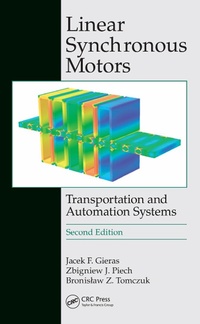
Linear Synchronous Motors
Transportation and Automation Systems, Second Edition
2nd Edition
Published on 20. April 2018
520 pages
978-1-4398-4222-5 (ISBN)
Description

Considered to be the first book devoted to the subject, Linear Synchronous Motors: Transportation and Automation Systems, Second Edition evaluates the state of the art, demonstrating the technological innovations that are improving the design, construction, and performance of modern control systems. This new edition not only illustrates the development of linear synchronous motor drives, but it also discusses useful techniques for selecting a motor that will meet the specific requirements of linear electrical drives.
New Features for the Second Edition:
Several updated and expanded sections, as well as two new chapters on FEM
Even more numerical examples, calculations, and mathematical models
Broadened target audience that includes researchers, scientists, students, and more
Evaluating trends and practical techniques for achieving optimal system performance, the authors showcase ready-to-implement solutions for common roadblocks in this process. The book presents fundamental equations and calculations used to determine and evaluate system operation, efficiency, and reliability, with an exploration of modern computer-aided design of linear synchronous motors, including the finite element approach. It covers topics such as linear sensors and stepping motors, magnetic levitation systems, elevators, and factory automation systems. It also features case studies on flat PM, tubular PM, air-cored, and hybrid linear synchronous motors, as well as 3D finite element method analysis of tubular linear reluctance motors, and linear oscillatory actuators.
With such an exceptional presentation of practical tools and conceptual illustrations, this volume is an especially powerful resource. It will benefit readers from all walks by providing numerical examples, models, guidelines, and diagrams to help develop a clear understanding of linear synchronous motor operations, characteristics, and much more.
New Features for the Second Edition:
Several updated and expanded sections, as well as two new chapters on FEM
Even more numerical examples, calculations, and mathematical models
Broadened target audience that includes researchers, scientists, students, and more
Evaluating trends and practical techniques for achieving optimal system performance, the authors showcase ready-to-implement solutions for common roadblocks in this process. The book presents fundamental equations and calculations used to determine and evaluate system operation, efficiency, and reliability, with an exploration of modern computer-aided design of linear synchronous motors, including the finite element approach. It covers topics such as linear sensors and stepping motors, magnetic levitation systems, elevators, and factory automation systems. It also features case studies on flat PM, tubular PM, air-cored, and hybrid linear synchronous motors, as well as 3D finite element method analysis of tubular linear reluctance motors, and linear oscillatory actuators.
With such an exceptional presentation of practical tools and conceptual illustrations, this volume is an especially powerful resource. It will benefit readers from all walks by providing numerical examples, models, guidelines, and diagrams to help develop a clear understanding of linear synchronous motor operations, characteristics, and much more.
More details
Series
Edition
2nd edition
Language
English
Place of publication
Baton Rouge
United States
Publishing group
Taylor & Francis Inc
Target group
Professional and scholarly
Electrical, mechanical, civil, electric machine, linear motor, manufacturing, plant, transportation planning, electromechanical design, and industrial engineers.
Edition type
Revised edition
Illustrations
311 s/w Abbildungen, 67 s/w Tabellen
67 Tables, black and white; 311 Illustrations, black and white
File size
22,37 MB
ISBN-13
978-1-4398-4222-5 (9781439842225)
Copyright in bibliographic data and cover images is held by Nielsen Book Services Limited or by the publishers or by their respective licensors: all rights reserved.
Schweitzer Classification
Other editions
Additional editions
Jacek F. Gieras | Zbigniew J. Piech | Bronislaw Tomczuk
Linear Synchronous Motors
Transportation and Automation Systems, Second Edition
Book
04/2017
2nd Edition
CRC Press
€150.30
Shipment within 10-20 days
Jacek F. Gieras | Zbigniew J. Piech | Bronislaw Tomczuk
Linear Synchronous Motors
Transportation and Automation Systems, Second Edition
Book
08/2011
2nd Edition
CRC Press
€299.60
Shipment within 15-20 days
Persons
Jacek F. Gieras graduated in 1971 from the Technical University of Lodz, Poland, with distinction. In 1980, he received his Ph.D degree in Electrical Engineering (Electrical Machines) in 1975, and the Dr habil. degree (corresponding to DSc), also in Electrical Engineering, from the University of Technology, Poznan, Poland. His research area is Electrical Machines, Drives, Electromagnetics, Power Systems, and Railway Engineering. In 1987 he was promoted to the rank of full professor. Since 1998 he has been affiliated with United Technologies Corporation, USA. In 2007 he also joined the University of Technology and Life Sciences in Bydgoszcz, Poland, as a full professor. An IEEE fellow, Prof. Gieras has authored and co-authored 11 books of international standing and more than 250 scientific and technical papers. In addition, he holds 30 patents.
Zbigniew (Jerry) Piech graduated in 1975 from the Technical University of Wroclaw, Poland. He received his Ph.D degree in Electrical Engineering in 1981, also from the Technical University of Wroclaw. From 1975 to 1989 he was an academic staff member of the Department of Electrical Engineering at the University of Technology and Life Sciences, Bydgoszcz, Poland. He joined United Technologies Corporation in 1990.
His major contributions in the area of electric machines and power systems include development of a series of modern permanent magnet brushless motors for Otis Elevator Company. During the past 10 years he has had a leading role in establishing permanent magnet motor technology for the company. Dr Piech authored and coauthored 20 publications and holds 14 patents in the area of electric machine design and controls.
Bronislaw Z. Tomczuk graduated in 1977 from the Opole University of Technology, Poland, with honors. He received his PhD and Dr habil. (corresponding to DSc) degrees from the Technical University of Lodz, Poland, in 1985 and 1995, respectively. Since 1978, he has been on the academic staff of the Technical University of Opole, Poland, and he was promoted to full professor in 2007. His area of interest is 3D mathematical modeling of electromagnetic fields using numerical methods and its applications to CAD of transformers, linear motors, actuators, magnetic bearings, and other electromagnetic devices. He has authored or coauthored five books and more than 170 scientific and technical articles, and he holds 10 patents. He is also a recipient of the Gold Cross of Merit from the President of Poland.
Zbigniew (Jerry) Piech graduated in 1975 from the Technical University of Wroclaw, Poland. He received his Ph.D degree in Electrical Engineering in 1981, also from the Technical University of Wroclaw. From 1975 to 1989 he was an academic staff member of the Department of Electrical Engineering at the University of Technology and Life Sciences, Bydgoszcz, Poland. He joined United Technologies Corporation in 1990.
His major contributions in the area of electric machines and power systems include development of a series of modern permanent magnet brushless motors for Otis Elevator Company. During the past 10 years he has had a leading role in establishing permanent magnet motor technology for the company. Dr Piech authored and coauthored 20 publications and holds 14 patents in the area of electric machine design and controls.
Bronislaw Z. Tomczuk graduated in 1977 from the Opole University of Technology, Poland, with honors. He received his PhD and Dr habil. (corresponding to DSc) degrees from the Technical University of Lodz, Poland, in 1985 and 1995, respectively. Since 1978, he has been on the academic staff of the Technical University of Opole, Poland, and he was promoted to full professor in 2007. His area of interest is 3D mathematical modeling of electromagnetic fields using numerical methods and its applications to CAD of transformers, linear motors, actuators, magnetic bearings, and other electromagnetic devices. He has authored or coauthored five books and more than 170 scientific and technical articles, and he holds 10 patents. He is also a recipient of the Gold Cross of Merit from the President of Poland.
Content
Topologies and Selection. Materials and Construction. Theory of Linear Synchronous Motors. FEM Analysis. Hybrid and Special Linear Permanent Magnet Motors. Motion Control. Sensors. High-Speed Maglev Transport. Building and Factory Transportation Systems. Industrial Automation Systems. Appendices. Patents.
