

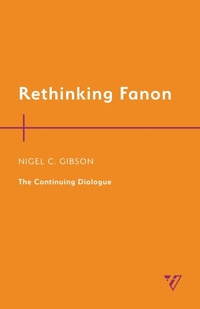
Rethinking Fanon
The Continuing Dialogue
2nd Edition
Published on 17. October 2022
1 pages
979-8-7651-8695-4 (ISBN)
Description

Over sixty years after his death, the social philosopher and psychiatrist Frantz Fanon (1925-1961) remains a towering intellectual figure. Born in Martinique and trained as a psychiatrist in France, Fanon rejected his French citizenship to join the Algerian liberation movement in the 1950s. In the short decade from 1952 to 1961 this brilliant and engaged intellectual composed three books Black Skin, White Masks, A Dying Colonialism, and The Wretched of the Earth, which continue to spur intellectual awakenings across the world.
The rebirth of Fanonism today in universities and the English-speaking world is a testament to his relevance. Edited by distinguished Fanon scholar Nigel C. Gibson, Rethinking Fanon: The Continuing Dialogue, first published in 1999, has become a classic, grounding new discussions of Fanon and cultural, postcolonial, Africana and gender studies with earlier African and African American dialogues. The bookopens with an authoritative biography by the Ghanaian political scientist Emmanuel Hansen, which corrects fallacious assertions about Fanon's life, situating him in Marxism, Negritude, Pan-Africanism, and the historical context of postwar decolonization, specifically the Algerian revolution. Section one is highlighted by extended discussions of Fanon's theories on revolution and "true liberation," including Fanon's revolutionary psychiatry by Hussein A. Bulhan, now the President of the Frantz Fanon University, and discussions of Fanon's dialectic of liberation by African American theorist Tony Martin, and Marxist-Humanists, John Alan and Lou Turner. The next section examines Fanon's re-emergence in postcolonial studies in British and American universities with now classic chapters by Homi K. Bhabha, Henry Louis Gates Jr., Edward W. Said and Benita Parry. The third section, "Fanon, Gender, and National Consciousness" includes chapters by Anne McClintock, Diana Fuss and T. Denean Sharpley-Whiting remain important to the ongoing debates about identity and agency. This excellent collection reflects the continuing impact of Fanon's thought on Africana studies, feminism and sexuality studies, postcolonialism, decolonial, and cultural studies.
The rebirth of Fanonism today in universities and the English-speaking world is a testament to his relevance. Edited by distinguished Fanon scholar Nigel C. Gibson, Rethinking Fanon: The Continuing Dialogue, first published in 1999, has become a classic, grounding new discussions of Fanon and cultural, postcolonial, Africana and gender studies with earlier African and African American dialogues. The bookopens with an authoritative biography by the Ghanaian political scientist Emmanuel Hansen, which corrects fallacious assertions about Fanon's life, situating him in Marxism, Negritude, Pan-Africanism, and the historical context of postwar decolonization, specifically the Algerian revolution. Section one is highlighted by extended discussions of Fanon's theories on revolution and "true liberation," including Fanon's revolutionary psychiatry by Hussein A. Bulhan, now the President of the Frantz Fanon University, and discussions of Fanon's dialectic of liberation by African American theorist Tony Martin, and Marxist-Humanists, John Alan and Lou Turner. The next section examines Fanon's re-emergence in postcolonial studies in British and American universities with now classic chapters by Homi K. Bhabha, Henry Louis Gates Jr., Edward W. Said and Benita Parry. The third section, "Fanon, Gender, and National Consciousness" includes chapters by Anne McClintock, Diana Fuss and T. Denean Sharpley-Whiting remain important to the ongoing debates about identity and agency. This excellent collection reflects the continuing impact of Fanon's thought on Africana studies, feminism and sexuality studies, postcolonialism, decolonial, and cultural studies.
More details
Other editions
Additional editions
Book
09/2022
2nd Edition
Rowman & Littlefield Publishers
€37.40
Shipment within 3-4 weeks
Person
Nigel C. Gibson is an activist and scholar specializing in the work of the Algerian revolutionary Frantz Fanon. Gibson is author of Fanon: The Postcolonial Imagination (Polity Press, 2003), which won the 2009 Caribbean Philosophy Frantz Fanon Outstanding Book Award and was translated into Arabic in 2013, and Fanonian Practices in South Africa: From Steve Biko to Abahlali baseMjondolo (University of Kwa Zulu-Natal Press and Palgrave MacMillan, 2011). He is the co-author of Fanon: Psychiatry and Politics, with Roberto Beneduce (Rowman and Littlefield and University of Witwatersrand Press, 2017). He has edited three books on Fanon, Rethinking Fanon: The Continuing Dialogue (1999), Living Fanon: Global Perspectives (2011) and Reason and Revolt of the Wretched of the Earth (2021). He teaches at Emerson College, Boston USA and is Honorary Professor in the Humanities Unit at the University currently known as Rhodes, South Africa.
