

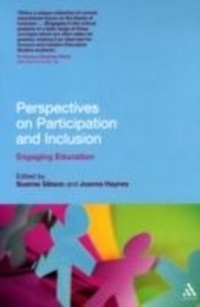
Perspectives on Participation and Inclusion
Engaging Education
1st Edition
Published on 23. March 2009
184 pages
978-1-4411-9016-1 (ISBN)
Description

Perspectives on Participation and Inclusion draws on the research and scholarship of academics working in the field of Education Studies. The writers are concerned with enduring yet contemporary themes: making education engaging and vital for both learners and educators, and achieving wider participation and more effective and meaningful inclusion for all.
- The book draws on philosophical ideas and educational theories, practical examples and case studies in a wide variety of educational settings and styles.
- Through the medium of brief 'edu-autobiography', each chapter is situated in the context of the author's life as an educator, appealing to readers to consider ways in which the ideas and examples discussed could be pertinent to their own life or work in education.
- Includes sections on voice and empowerment, critical and alternative perspectives on inclusion in education, and practical approaches to widening participation.
- Authors discuss ideas such as 'otherness' and 'voice', freedom, belonging and well-being in education and the relational nature of learning.
Perspectives on Participation and Inclusion is a key text for Education Studies students. In addressing fundamental questions in education, the audience will encompass school practitioners, student teachers and lecturers in further and higher education. This book will also be of interest to students and professionals in fields such as childhood studies and youth and community studies.
- The book draws on philosophical ideas and educational theories, practical examples and case studies in a wide variety of educational settings and styles.
- Through the medium of brief 'edu-autobiography', each chapter is situated in the context of the author's life as an educator, appealing to readers to consider ways in which the ideas and examples discussed could be pertinent to their own life or work in education.
- Includes sections on voice and empowerment, critical and alternative perspectives on inclusion in education, and practical approaches to widening participation.
- Authors discuss ideas such as 'otherness' and 'voice', freedom, belonging and well-being in education and the relational nature of learning.
Perspectives on Participation and Inclusion is a key text for Education Studies students. In addressing fundamental questions in education, the audience will encompass school practitioners, student teachers and lecturers in further and higher education. This book will also be of interest to students and professionals in fields such as childhood studies and youth and community studies.
Reviews / Votes
'Offers a unique collection of current educational topics on the theme of inclusion...[Engages] in the critical analysis of a wide range of those concepts which are often taken for granted, making it an ideal text for honours and masters Education Studies students.' Stephen Ward, Professor of Education and Dean of the School of Education, Bath Spa University, UK 'This book would be useful and of interest to students on Education Studies programme, both undergraduate and postgraduate, and also students and professionals working in childhood studies, or in youth and community studies. It is a collection of accounts by different authors, all involved in some way in developments in the field of Education Studies. However, this book does more than merely give an account of particular policies or how they impact upon the field of education as a whole. It engages the reader with the theory and offers them a critical angle from which they can explore this extensive field (education) as a theory and practice. Overall, this is an interesting collection of papers that would equip education studies students with a rounded basic knowledge of different issues and perspectives on participation and inclusion.' The Higher Education Academy, November 2009More details
Edition
1. Auflage
Language
English
Place of publication
New York
United States
ISBN-13
978-1-4411-9016-1 (9781441190161)
Copyright in bibliographic data and cover images is held by Nielsen Book Services Limited or by the publishers or by their respective licensors: all rights reserved.
Schweitzer Classification
Other editions
Additional editions
Book
03/2009
Continuum International Publishing Group Ltd.
€247.50
Shipment within 15-20 days
Book
03/2009
Continuum International Publishing Group Ltd.
€62.50
Shipment within 3-4 weeks
Persons
Suanne Gibson is Senior Lecturer and Programme Leader for Education Studies at the University of Plymouth, UK, where she also co-ordinates the Inclusion and Social Justice Research Network. Joanna Haynes is Senior Lecturer in Education Studies at the University of Plymouth, UK. She taught in nursery and primary schools in Glasgow and Bristol and has also worked in teacher education and continuing professional development.
Content
Acknowledgements
Introduction
Part One: The Voice of the Learner
Chapter 1: Inclusion versus neo-liberalism: Empowering the 'Other'
Suanne Gibson
Inclusion: what, when, why, and Neo-liberalism: the barrier
Starting from the learner's perspective
Dialogue and safe spaces versus 'school effectiveness'?
Author's note
Chapter 2: Listening to the voice of the child in education
Joanna Haynes
Constructs of child as learner
So what is a child?
Children's rights
Initiatives to promote children's participation in education
Conclusion
Author's note
Part Two: Critical and Alternative Perspectives on Participation and Inclusion
Chapter 3: Education and after-education: Exploring learning as a relational process
Tony Brown
Emotions and learning
Secure attachment
Conceptions of student
The relational psychoanalytic lens
Emotion, cognition and student identity
Imagination, disturbance and education
Identificatory confusion
Alternative ways of reading classroom spaces
Conclusion
Author's note
Chapter 4: Including Deaf Culture: Deaf young people and participation
Hannah Smith
Experiences of Exclusion
Inclusion in Whose Culture?
Specialist Provision or Inclusion?
Conclusion: Learning with and from Deaf Culture
Author's Note
Chapter 5: Freedom, Inclusion and Education
Joanna Haynes
Interpretations of freedom
Education and political liberation
Experimental and alternative education
Mainstream education: freedom through philosophical dialogue
Freedom to think
Conclusion
Author's note
Chapter 6: Wellbeing and Education
Alan Hutchison
The idea of Wellbeing
What is Wellbeing Education?
Why Wellbeing Education Now?
Problematising Wellbeing Education
Critical voices
Contemporary developments in Wellbeing
Conclusion
Author's note
Chapter 7: Where should pupils who experience Social, Emotional and Behavioural Difficulties (SEBD) be educated?
Helen Knowler
Where do I belong?
Words Matter
The historic 'burden' of SEBD
Including pupils who experience SEBD
Mainstream school or special school: does it really matter where pupils are taught?
Belonging and school
Conclusion
Author's note
Part Three: Approaches to Participation
Chapter 8: Informal learning outdoors
Tony Rea
The nature of informal learning
Participation in informal learning outdoors: benefits and learner outcomes
Current debates about challenge and risk in the outdoors and how this might affect participation
A pedagogy for outdoor learning?
Author's Note
Chapter 9: E's of access: e-Learning and widening participation in Education
Steve Wheeler
The Information Age and the knowledge society
Digital Divides
The 'e' is for Everything
The Nature of e-Learning
Where does the learner fit into the 'E'quation?
E is for Extended Learning
E is for Enhanced Learning
E is for Everywhere Learning
E is for Exclusion
Conclusion
Author's Note
Chapter 10: Widening Participation in Adult Education
Roger Cutting
The Parents as Educators Programme
Getting Going
The Course Design
Recruitment
Unlocking the door
The 'R' word - Retention issues
Maintaining retention
The End
Evaluating a programme
Conclusions
Author's note
Introduction
Part One: The Voice of the Learner
Chapter 1: Inclusion versus neo-liberalism: Empowering the 'Other'
Suanne Gibson
Inclusion: what, when, why, and Neo-liberalism: the barrier
Starting from the learner's perspective
Dialogue and safe spaces versus 'school effectiveness'?
Author's note
Chapter 2: Listening to the voice of the child in education
Joanna Haynes
Constructs of child as learner
So what is a child?
Children's rights
Initiatives to promote children's participation in education
Conclusion
Author's note
Part Two: Critical and Alternative Perspectives on Participation and Inclusion
Chapter 3: Education and after-education: Exploring learning as a relational process
Tony Brown
Emotions and learning
Secure attachment
Conceptions of student
The relational psychoanalytic lens
Emotion, cognition and student identity
Imagination, disturbance and education
Identificatory confusion
Alternative ways of reading classroom spaces
Conclusion
Author's note
Chapter 4: Including Deaf Culture: Deaf young people and participation
Hannah Smith
Experiences of Exclusion
Inclusion in Whose Culture?
Specialist Provision or Inclusion?
Conclusion: Learning with and from Deaf Culture
Author's Note
Chapter 5: Freedom, Inclusion and Education
Joanna Haynes
Interpretations of freedom
Education and political liberation
Experimental and alternative education
Mainstream education: freedom through philosophical dialogue
Freedom to think
Conclusion
Author's note
Chapter 6: Wellbeing and Education
Alan Hutchison
The idea of Wellbeing
What is Wellbeing Education?
Why Wellbeing Education Now?
Problematising Wellbeing Education
Critical voices
Contemporary developments in Wellbeing
Conclusion
Author's note
Chapter 7: Where should pupils who experience Social, Emotional and Behavioural Difficulties (SEBD) be educated?
Helen Knowler
Where do I belong?
Words Matter
The historic 'burden' of SEBD
Including pupils who experience SEBD
Mainstream school or special school: does it really matter where pupils are taught?
Belonging and school
Conclusion
Author's note
Part Three: Approaches to Participation
Chapter 8: Informal learning outdoors
Tony Rea
The nature of informal learning
Participation in informal learning outdoors: benefits and learner outcomes
Current debates about challenge and risk in the outdoors and how this might affect participation
A pedagogy for outdoor learning?
Author's Note
Chapter 9: E's of access: e-Learning and widening participation in Education
Steve Wheeler
The Information Age and the knowledge society
Digital Divides
The 'e' is for Everything
The Nature of e-Learning
Where does the learner fit into the 'E'quation?
E is for Extended Learning
E is for Enhanced Learning
E is for Everywhere Learning
E is for Exclusion
Conclusion
Author's Note
Chapter 10: Widening Participation in Adult Education
Roger Cutting
The Parents as Educators Programme
Getting Going
The Course Design
Recruitment
Unlocking the door
The 'R' word - Retention issues
Maintaining retention
The End
Evaluating a programme
Conclusions
Author's note
