

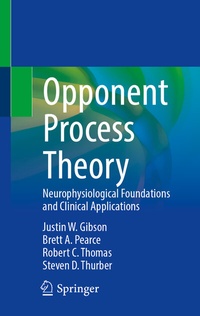
Opponent Process Theory
Description

This book discusses the role of the opponent processes across disparate areas ranging from psychiatric disorders to altruistic behaviors such as blood donation. Opponent process theory unites data from neurophysiology and behavioral science and connects seemingly unrelated phenomena, such as bulimia and the afterimages one can see after staring at an object. Information in this book will help demystify certain disorders and will facilitate patient understanding, a precursor for effective interventions.
This volume's opening chapter relates a brief history of the antecedents of opponent process theory, including homeostasis and motivation. After a discussion of the fundamentals of opponent process theory, acquired motivation, and the neurological underpinnings of opponent processes, the book moves on to examine different situations where we can see opponent process theory at work. These chapters discuss topics such as learning, substance use disorder, food addiction, pain, acupuncture, and self-inflicted injury. Finally, the authors outline treatment modalities with opponent process-learning theory foundations and propose a discussion of opponent processes in the DSM-5.
Opponent Process Theory: Neurophysiological Foundations and Clinical Applications will be of great interest to psychiatrists, psychologists, social workers, and counselors.
More details
Other editions
Additional editions
Persons
Justin W. Gibson, MA
School of Medicine
Department of Psychiatry
Louisiana State University Health Sciences Center, New Orleans
Brett A. Pearce, MD
School of Medicine
Department of Psychiatry
Louisiana State University Health Sciences Center, New Orleans
Robert C.Thomas, MD
School of Medicine
Department of Psychiatry
Louisiana State University Health Sciences Center, New Orleans
Steven D.Thurber, PhD
School of Medicine
Department of Psychiatry
Louisiana State University Health Sciences Center, New Orleans
Content
Chapter 1. Historical Precursors.- Chapter 2. Neurophysiological Underpinnings.- Chapter 3. Substance Usage.- Chapter 4. Commonplace Behaviors with Opponent Process Foundations.- Chapter 5. Criminology and Risk Motivation.- Chapter 6. Pain Relief, Self-inflicted Injuries, and Acupuncture.- Chapter 7. Learning, Motivation, and Opponent Process Theory.- Chapter 8. Practical Implications.- Chapter 9. Epilogue.
