

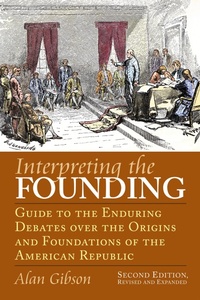
Interpreting the Founding
Description

Now widely regarded as the best available guide to the study of the Founding, the first edition of Interpreting the Founding provided summaries and analyses of the leading interpretive frameworks that have guided the study of the Founding since the publication of Charles Beard's An Economic Interpretation of the Constitution in 1913. For this new edition, Gibson has revised and updated his study, including his comprehensive bibliography, and also added a new concluding chapter on the ?Unionist Paradigm? or ?Federalist Interpretation? of the Constitution.
As in the original work, Gibson argues in the new edition that scholarship on the Founding is no longer steered by a single dominant approach or even by a set of questions that control its direction. He features insightful extended discussions of pioneering works by leading scholars of the Founding?including Louis Hartz, Bernard Bailyn, Gordon Wood, and Garry Wills?that best exemplify different schools of interpretation. He focuses on six approaches that have dominated the modern study of the Founding-Progressive, Lockean/liberal, Republican, Scottish Enlightenment, multicultural, and multiple traditions approaches?before concluding with the Unionist or Federalist paradigm. For each approach, Gibson traces its fundamental assumptions, revealing deeper ideological and methodological differences between schools of thought that, on the surface, seem to differ only about the interpretation of historical facts.
While previous accounts have treated the study of the Founding as the sequential replacement of one paradigm by another, Gibson argues that all of these interpretations survive as alternative and still viable approaches. By examining the strengths and weaknesses of each approach and showing how each has simultaneously illuminated and masked core truths about the American Founding, he renders a balanced account of the continuing and very vigorous debate over the origins and foundations of the American republic.
Brimming with intellectual vigor and a based on both a wide and deep reading in the voluminous literature on the subject, Gibson's new edition is sure to reinforce this remarkable book's reputation while winning new converts to his argument.
More details
Other editions
Additional editions

Person
Alan Gibson is associate professor of political science at California State University-Chico and has been a Fellow at the James Madison Program of Ideals and Institutions at Princeton University. He is also the author of Understanding the Founding: The Crucial Questions.
Content
Preface to the Second Edition
Preface to the First Edition
Acknowledgments
1. The Center Will No Longer Hold
2. The Progressive Interpretation
3. The Liberal Tradition
4. The Tunnel History of Republicanism
5. The Scottish Conversation
6. The Multiple Traditions Approach
7. ?From the Bottom Up?: Feminine, Forgotten, and Forced Founders
8. The American Founding in Geopolitical Context: The ?Federal Interpretation? or ?Unionist Paradigm?
Epilogue: Contributions, Confrontations, and Future Prospects
Notes
Bibliography
Index
