

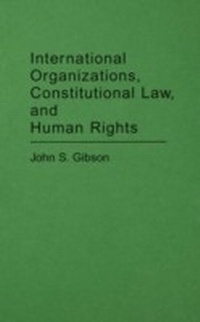
International Organizations, Constitutional Law, and Human Rights
1st Edition
Published on 30. September 1991
288 pages
978-0-313-38889-7 (ISBN)
Description

Since World War II, remarkable progress has been made toward establishing more effective international laws and organizations to reduce opportunities for confrontation and conflict, and to enhance the pursuit of security and well-being. This book offers a detailed record of that progress, as well as its meaning for our times and those ahead. Taking a historical, theoretical, and case-study approach, John Gibson provides the reader with a broad understanding of how international organizations evolved to serve the interests of their member states, how the constitutional charters of organizations provide a coherent statement of goals and means to goals, and how these organizations are assuming increasing authority in the international system.
The work traces the progression of international constitutional and human rights law, with an emphasis on the past 45 years. In the first part, Gibson discusses the historic processes of political relations and mutual reliance; the evolution of these patterns through World War II; the subsequent history of the United Nations; the prime goals of international constitutional law; and the organizations' range of authority--from the high state to the supra-organization level. Part two offers a case study of the progression of international human rights law. Separate chapters trace the history of human rights in religion and philosophy and the role of the state in international law, while the concluding chapter on the United Nations Commission on Human Rights demonstrates how organizations actually function. This book will be a valuable resource for courses in international relations and international law, as well as an important addition to academic and professional libraries.
The work traces the progression of international constitutional and human rights law, with an emphasis on the past 45 years. In the first part, Gibson discusses the historic processes of political relations and mutual reliance; the evolution of these patterns through World War II; the subsequent history of the United Nations; the prime goals of international constitutional law; and the organizations' range of authority--from the high state to the supra-organization level. Part two offers a case study of the progression of international human rights law. Separate chapters trace the history of human rights in religion and philosophy and the role of the state in international law, while the concluding chapter on the United Nations Commission on Human Rights demonstrates how organizations actually function. This book will be a valuable resource for courses in international relations and international law, as well as an important addition to academic and professional libraries.
More details
Edition
1. Auflage
Language
English
Place of publication
New York
United States
Publishing group
Bloomsbury Publishing Plc
Target group
College/higher education
Interest Age: From 7 to 17 years
ISBN-13
978-0-313-38889-7 (9780313388897)
Copyright in bibliographic data and cover images is held by Nielsen Book Services Limited or by the publishers or by their respective licensors: all rights reserved.
Schweitzer Classification
Other editions
Additional editions
Book
09/1991
Praeger Publishers Inc
€99.20
Shipment within 15-20 days
Person
JOHN S. GIBSON is Professor of Political Science at Tufts University, and Director of Tufts Program in International Relations. An acknowledged expert in international organizations, he is the author or editor of ten books and numerous journal articles and book chapters.
Content
Preface
International Organizations: Evolution and Mission
The Processes of History and Patterns of Mutuality
International Organizations: The First Hundred Years
The United Nations Era: 1945 to Today and Tomorrow
International Organizations: Goals and Means to Goals
International Organizations: From High State Authority to Supra-Organization Authority
Human Rights: Organization and Pursuit of Mission
The Evolution of Rights for Humans
The State
The Organizations: Human Rights as a Case Study
Annotated Bibliography
Index
International Organizations: Evolution and Mission
The Processes of History and Patterns of Mutuality
International Organizations: The First Hundred Years
The United Nations Era: 1945 to Today and Tomorrow
International Organizations: Goals and Means to Goals
International Organizations: From High State Authority to Supra-Organization Authority
Human Rights: Organization and Pursuit of Mission
The Evolution of Rights for Humans
The State
The Organizations: Human Rights as a Case Study
Annotated Bibliography
Index
