

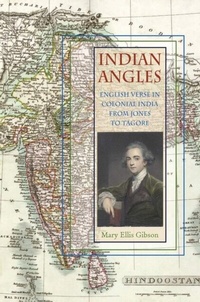
Indian Angles
English Verse in Colonial India from Jones to Tagore
1st Edition
Published on 13. May 2011
277 pages
978-0-8214-4358-3 (ISBN)
Description

A new historical approach to Indian English literature
Mary Ellis Gibson shows that poetry, not fiction, was the dominant literary genre of Indian writing in English until 1860 and that poetry written in colonial situations can tell us as much or even more about figuration, multilingual literacies, and histories of nationalism than novels can. Gibson re-creates the historical webs of affiliation and resistance that were experienced by writers in colonial India-writers of British, Indian, and mixed ethnicities.
Advancing new theoretical and historical paradigms for reading colonial literatures, Indian Angles makes accessible many writers heretofore neglected or virtually unknown. Gibson recovers texts by British women, by nonelite British men, and by persons who would, in the nineteenth century, have been called Eurasian. Her work traces the mutually constitutive history of English-language poets from Sir William Jones to Toru Dutt and Rabindranath Tagore. Drawing on contemporary postcolonial theory, her work also provides new ways of thinking about British internal colonialism as its results were exported to South Asia.
In lucid and accessible prose, Gibson presents a new theoretical approach to colonial and postcolonial literatures.
Mary Ellis Gibson shows that poetry, not fiction, was the dominant literary genre of Indian writing in English until 1860 and that poetry written in colonial situations can tell us as much or even more about figuration, multilingual literacies, and histories of nationalism than novels can. Gibson re-creates the historical webs of affiliation and resistance that were experienced by writers in colonial India-writers of British, Indian, and mixed ethnicities.
Advancing new theoretical and historical paradigms for reading colonial literatures, Indian Angles makes accessible many writers heretofore neglected or virtually unknown. Gibson recovers texts by British women, by nonelite British men, and by persons who would, in the nineteenth century, have been called Eurasian. Her work traces the mutually constitutive history of English-language poets from Sir William Jones to Toru Dutt and Rabindranath Tagore. Drawing on contemporary postcolonial theory, her work also provides new ways of thinking about British internal colonialism as its results were exported to South Asia.
In lucid and accessible prose, Gibson presents a new theoretical approach to colonial and postcolonial literatures.
Reviews / Votes
"This is genuinely groundbreaking work: ambitiously conceived, suggestively presented, and potentially paradigm-shifting." - Tricia Lootens, author of Lost Saints: Silence, Gender, and Victorian Literary Canonization "Indian Angles showcases and reflects the vibrant poetry culture of India in the nineteenth century and therein lies its contribution to the scholarship of that period." (Victorian Studies) "Both of Gibson's books (Indian Angles and Anglophone Poetry in Colonial India) stand as shining examples of the strategic comparativist work needed to assess the full array of literary voices in/on India during the long nineteenth century." (English Literature in Transition, 1880-1920) "In this thoroughly researched, well-theorized study, Gibson traces the rise of English-language poetics in India from the late 18th century to the early 20th. She acknowledges the complex, changing identity politics informing colonial affiliation, showing how poets of British, Indian, or mixed origin and affiliation were involved in the complementary project of establishing Anglo-Indian poetics.... Summing Up: Highly recommended." (Choice: Current Reviews for Academic Libraries) "Asserting that poetry-rather than prose fiction-dominated English-language writing in India for most of the nineteenth century, Indian Angles examines 'the rise and expansion of English language poetics in India,'...." (Studies in English Literature, 1500-1900)More details
Series
Language
English
Place of publication
Athens
United States
Target group
Professional and scholarly
ISBN-13
978-0-8214-4358-3 (9780821443583)
Copyright in bibliographic data and cover images is held by Nielsen Book Services Limited or by the publishers or by their respective licensors: all rights reserved.
Schweitzer Classification
Other editions
Additional editions
Book
02/2023
Ohio University Press
€53.47
Shipment within 10-20 days
Book
05/2011
Ohio University Press
€44.50
Shipment within 10-20 days
Person
Mary Ellis Gibson is Arthur Jeremiah Roberts Professor of Literature at Colby College. Her books include Indian Angles: English Verse in Colonial India from Jones to Tagore (Ohio, 2011); History and the Prism of Art: Browning's Poetic Experiments; and Epic Reinvented: Ezra Pound and the Victorians. She has also edited several other anthologies, including New Stories by Southern Women; Homeplaces: Stories of the South by Women Writers; and Critical Essays on Robert Browning.
Content
- Intro
- Illustrations
- Acknowledgments
- A Note on Names
- Introduction
- Part One: Languages, Tropes, and Landscape in the Beginnings of English Language Poetry
- 1: Contact Poetics in Eighteenth-Century Calcutta
- 2: Bards and Sybils
- Part Two: The Institutions of Colonial Mimesis, 1830-57
- 3: Books, Reading, and the Profession of Letters
- 4: Sighing, or Not, for Albion
- Part Three: Nationalisms, Religion, and Aestheticism in the Late Nineteenth Century
- 5: From Christian Piety to Cosmopolitan Nationalisms
- 6: Cosmopolitanism, Nationalism, and Aestheticism in Fin-de-Siècle London
- Epilogue
- Notes
- Bibliography
- Index
