

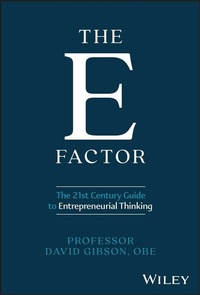
The E Factor
Description

Transform your approach to learning and working in the 21st century
In In The E Factor: The 21st Century Guide to Entrepreneurial Thinking, award-winning professor, entrepreneur, and accountant David Gibson delivers a singularly practical guide to critical thinking that will transform the way you think about learning and take action. The book explains all the key skills useful to teachers, students, and professionals in the contemporary classroom and marketplace, offering hands-on strategies and techniques for work and school that enhance productivity and effectiveness.
You'll discover how to apply the author's one-of-a-kind model to everyday learning and working and become more successful. You'll also find:
- Practical case studies that demonstrate the power of the E Factor approach in the real world
- Strategies for teaching students to apply the E Factor to enhance their overall educational experience and get more out of each class and lesson they take
- Ways to apply critical thinking techniques to become more interactive as you learn in the classroom, the boardroom, the office, and anywhere else
Perfect for students, educators, and aspiring and practicing professionals in any industry, The E Factor is a must-read guide to active learning, development, and working that will transform the way you interact with the world around you.
More details
Other editions
Additional editions
Person
DAVID GIBSON, OBE, is a Professor at Queen's University with over twenty years' experience as an accountant and entrepreneur. He is passionate about teaching other entrepreneurs how to start, grow, and run profitable businesses and lead happy and effective teams using the E Factor method.
Content
Preface ix
Part I The Eight E Factors 1
Chapter 1 Resilience 3
Chapter 2 Finance 17
Chapter 3 Creativity 33
Chapter 4 Negotiation 43
Chapter 5 Personal Branding 51
Chapter 6 Strategic Thinking 59
Chapter 7 Leadership 65
Chapter 8 Personal Influence 73
Part II Applying the E Factors 87
Chapter 9 Achieving Daily Practice 89
Chapter 10 The Power of Dreams 93
Chapter 11 Being Yourself 103
Chapter 12 Going Global 109
Part III E Factor Application 113
Chapter 13 Using the E Factor 115
Chapter 14 Working with Global Technology 119
Chapter 15 E-Factor Learning 123
Chapter 16 Coaching and Mentoring Support 133
Chapter 17 The History of the E Factor, 2005-2024 139
Chapter 18 How Can You Become an E-Factor Peak Performer? 145
Chapter 19 Twenty-One Steps for Success with the E Factor 149
Chapter 20 Who Needs the E Factor and How Can It Help Them? 153
Chapter 21 How Do You Change any International Organisation or Community with the E Factor? 161
Chapter 22 E-Factor Case Studies 169
Conclusion 175
Execute the Plan 177
About the Author 181
Index 183
Chapter 1
Resilience
If I had to encourage you to have one skill that would increase your chance of surviving and thriving in the global economy, it would be to develop resilience.
At times, the word is overused but I'll explain what it means and how you can develop it.
It is the capacity to anticipate setbacks and crises. That seems a little negative, I know, but the reality is that not everything will go according to plan. The Fourth Industrial Revolution and the technological impact will bring constant change and challenges.
As an entrepreneur and a lifetime adviser to other entrepreneurs, I have found that many people expect that everything will go to plan and will be straightforward. However, business and your career will provide both opportunities and setbacks - sometimes at the same time! Sadly, I have seen many people give up great ventures and careers when the inevitable first obstacle appears.
People tend to believe you are born confident or an entrepreneur and some people have lucky breaks, and some don't. During my time as an enterprise educator, I have heard many highly intelligent people tell me it's all down to luck as to how you and your career turn out.
Nonsense. Certainly, genetics and upbringing have an influence, but you can still have a significant impact if you are prepared to learn and find new innovative ways to meet challenges.
You can be resilient, learn from your mistakes and achieve your goals whatever happens, but you must be prepared to learn. It is not enough to have knowledge - you need to find the right strategies and change your own behaviour and mindset to survive and thrive in this colourful arena of change. You live in a different world, one that is more uncertain than the one your predecessors faced, but arguably with more opportunity as you can potentially have more global opportunities than the previous generation.
The questions are: Will you be prepared to learn the skills and the mindset? What are these? How can you learn them?
Without good resilience you might miss significant opportunities, but you will acquire the skillset. Knowing about the theories is not enough. Let's review these skills and develop a plan together so that this core skill/mindset will allow you to welcome both challenges and opportunities.
- The first thing is to be self-aware, so ask yourself: Are you resilient? How do you act in a crisis? What do others think about your ability to cope under pressure and deal with unexpected challenges? Ask a variety of people so that you can measure the response, and look for brutal honesty no matter how sensitive you are, and a range of responses to improve the validity of the feedback. This is something you should do on an ongoing basis.
You may not like some of the responses but if the feedback is from a variety of people these responses can provide valuable analysis on the areas you will have to work on. It is important to learn how to fail, without it destroying your dreams.
Sometimes you might feel it would be nice to avoid feedback that is indicating areas of weakness but responding to this in an appropriate and positive way will save you years of heartache and provide the opportunity to be even better prepared for future challenges.
- What is your physical health like? The stronger and fitter you are, the better prepared you will be for any potential crisis or opportunity. What is your weight? How fit would you describe yourself?
At one point in my life, I was unfit. I was also working extremely hard, long days and hours, with poor sleep. Then I had a health scare which encouraged me to embrace physical exercise and examine my lifestyle. I now run 5 k every morning and eat healthier.
This enables me to cope much better with pressure and unexpected events. If you are physically fit, it helps with your sleeping and lifestyle.
I am not trying to turn you into a fitness fanatic but instead to make you aware that physical health plays a part in helping you manage your energy levels and be more productive in your work. You become better prepared to deal with unexpected events, crises and even those great opportunities. Develop a plan and realise that physical and mental health are vital tools for you to use.
Make a realistic plan, one with no pressure to do too much at once if you are trying to create good habits and behaviours that last. Whichever physical exercise you choose must be appropriate for your age and personal background. You also need to find something you enjoy as you are more likely to turn it into a habit. Is there a sport you like or a class to attend which is fun? The more enjoyable and convenient it is the more sustainable the impact.
Personally, I find t'ai chi to be an exercise technique that provides physical and mental health benefits and is appropriate for me. It can be practised in a group or on your own and you do not need any specialist equipment or venue.
Ultimately, you will only keep doing a physical fitness programme if it is simple and easy to undertake, with a dash of enjoyment. The key is little and often, and be aware that healthy food can enhance your physical and mental well-being.
Your mental health is equally important. There is pressure to constantly be productive, which can induce stress. This can then lead to anxiety, which is not good for either your physical or mental health. You might be young and fit at the minute, but stress can sneak up, and you need to be able to recognise when to switch off from work and learn how to relax your mind and body. Bringing yourself into a natural state of balance helps to make you more productive, more successful. What is the best way to do this?
Mindfulness is a word you will hear often, and it plays a significant role in improving mental health. It is the capacity to relax physically and mentally at any time, learning to focus your mind on what is going on now around you and how you are feeling, but remain detached so you do not respond or react. Learning strategies to help you relax and gather your physical and mental strength are important. Learning to breathe deeply and slowly can help to reduce any potential imminent stress. One amazingly simple exercise you can practise is to breathe through your diaphragm. Slow breath in for five and out for ten. It's the outbreath that helps you to remain calm. The most important thing is to be aware of how you are feeling, and what might need to change.
The key is learning to be mindful in the moment by not reacting immediately or giving into your emotions - taking a little bit of time to adjust and refocus will prove useful. It is all about controlling and reducing any anxiety, which unfortunately has become all too common in today's business world and particularly since the Covid-19 pandemic. There are a variety of techniques you could experiment with to find what works for you.
If we can learn to accept that life moves around us at distinct levels, sometimes high sometimes low, then we can become more resilient and respond in the appropriate way. The calmer and more relaxed you are in your response to different challenges the easier it will be to find solutions and the better you will feel physically and mentally.
This strengthens your resilience. Some people are naturally calm and relaxed in all situations - perhaps personality and life experiences have taught them to take their time and relax when a problem arises. The rest of us need simple strategies with good impact.
My wife is a professional relaxation therapist, therefore I benefit and learn techniques first hand. As a meditation teacher, she ensures we start every morning with a 10-15-minute meditation. It is a myth to think you must meditate for at least an hour, 10-15 minutes is beneficial. When you are relaxed and focused, you are much more resilient and much more likely to solve challenges and problems as they arise; therefore you become resilient.
I am not saying you must do meditation to be resilient but what you must do is understand your own stress levels and triggers, and how you cope with them. We have many more triggers now than ever before, with technology changing regularly, and our dependence on it, and how we use it. Many people find themselves in stressful situations at work and at home. This is why many people are reluctant and frightened to run their own business and find it difficult to separate home and work life on an even balance. It makes sense to find several simple strategies and techniques that will not only provide solutions but will enhance your well-being and improve your resilience significantly no matter what you face.
There are many apps around and authors who specialise in helping you to find the appropriate techniques that may suit you. You can learn and adapt more than one technique and use them in different scenarios, and all will increase your resilience.
Find what works best for you and have the strategies to remain calm whatever comes up. Not always easy I know, but when you find or create what keeps you calm your resilience level will be extraordinarily strong.
Resilience is your capacity to deal with the changes we all face in the 21st century. The more you look after yourself the less anxious you will be when challenges appear at any stage. You will bounce back whatever unexpected changes and challenges arise. You will also have the confidence that you are ready for anything. Learn to be calm in the eye of the storm. Clearly, how you respond to sudden change may be the key quality or skill we all need. No matter...
