

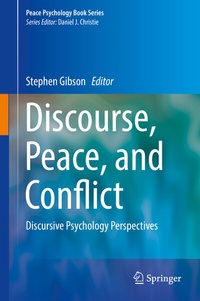
Discourse, Peace, and Conflict
Description

This first-of-its-kind volume brings discursive psychology and peace psychology together in a compelling practical synthesis. An array of internationally-recognised contributors examine multiple dimensions of discourse-official and casual, speech, rhetoric, and text-in creating and maintaining conflict and building mediation and reconciliation. Examples of strategies for dealing with longstanding conflicts (the Middle East), significant flashpoints (the Charlie Hebdo case), and current heated disputes (the refugee 'crisis' in Europe) demonstrate discursive methods in context as they bridge theory with real life. This diversity of subject matter is matched by the range of discursive approaches applied to peace psychology concepts, methods, and practice.
Among the topics covered:
- Discursive approaches to violence against women.
- The American gun control debate: a discursive analysis.
- Constructing peace and violence in the Palestinian-Israeli conflict.
- Discursive psychological research on refugees.
- Citizenship, social injustice, and the quest for a critical social psychology of peace.
- The emotional and political power of images of suffering: discursive psychology and the study of visual rhetoric.
Discourse, Peace, and Conflict offers expansive ideas to scholars and practitioners in peace psychology, as well as those in related areas such as social psychology, political psychology, and community psychology with an interest in issues pertaining to peace and conflict.
Reviews / Votes
"The work is an excellent collection of relevant theory and research concerning the discursive themes and strategies dealing with conflict and peaceful resolutions within and between groups. This book will prove valuable to peace researchers as well as students interested in furthering their understanding of discursive psychology." (S. Reysen, Choice, Vol. 56 (10), June, 2019)
More details
Other editions
Additional editions
Person
Stephen Gibson is based at York St John University, UK, where he has taught psychology since 2005. In his research, Stephen uses discursive and rhetorical approaches to explore a range of social psychological topics, including citizenship, national identity, dis/obedience and representations of peace and conflict. He is editor of Representations of Peace and Conflict (Palgrave Macmillan, 2012; with Simon Mollan) and Doing Your Qualitative Psychology Project (Sage, 2012; with Cath Sullivan and Sarah Riley).
