

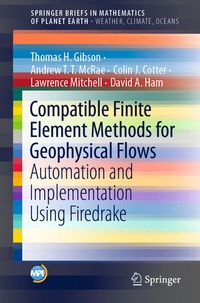
Compatible Finite Element Methods for Geophysical Flows
Description

This book introduces recently developed mixed finite element methods for large-scale geophysical flows that preserve essential numerical properties for accurate simulations. The methods are presented using standard models of atmospheric flows and are implemented using the Firedrake finite element library. Examples guide the reader through problem formulation, discretisation, and automated implementation.
The so-called "compatible" finite element methods possess key numerical properties which are crucial for real-world operational weather and climate prediction. The authors summarise the theory and practical implications of these methods for model problems, introducing the reader to the Firedrake package and providing open-source implementations for all the examples covered.
Students and researchers with engineering, physics, mathematics, or computer science backgrounds will benefit from this book. Those readers who are less familiar with the topic are providedwith an overview of geophysical fluid dynamics.
More details
Other editions
Additional editions
Persons
Thomas Gibson is a PhD student in the Department of Mathematics at Imperial College London. He is supported and funded by the EPSRC Centre for Doctoral Training in The Mathematics of Planet Earth. His current interests are in the development of scalable numerical algorithms for simulating climate, weather, and ocean dynamics. He is an active developer of the Firedrake project.
Andrew McRae is a Research Associate working on reduced-precision weather forecasting in the Department of Physics at Oxford University. He received his PhD from Imperial College London on the use of finite element methods for weather prediction.
Colin Cotter is a Reader in Numerical Analysis and Scientific Computing at Imperial College London. His research focusses on the design, analysis, and implementation of numerical methods for weather forecasting, ocean modelling, and climate simulation.
Lawrence Mitchell is an Assistant Professor in the Department of Computer Science at Durham University. He received his PhD from the University of Edinburgh in condensed matter physics. His current research is in the development of scientific software for unstructured mesh problems and scalable solver algorithms for discretized PDEs. He is a leading developer of the Firedrake project.
David Ham is a Senior Lecturer in the Department of Mathematics at Imperial College London. His research interests center on the development of high-level abstractions for scientific computing. His interests span computational and computer science and include both new numerical schemes for geophysical fluid dynamics and novel approaches to their implementation. He is the founding developer of the Firedrake project.
