

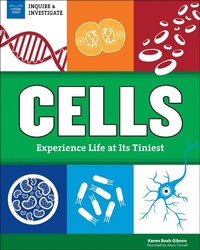
Cells
Experience Life at Its Tiniest
Published on 17. July 2017
129 pages
978-1-61930-523-6 (ISBN)
Description

If you look at a piece of a leaf or a drop of saliva through a microscope, what do you see? Cells are the basic building blocks of life and they make up every living thing, from plants to animals, from humans to bacteria! In Cells: Experience the World at Its Tiniest, readers ages 12 to 15 investigate cells and learn how they affect our health, reproduction, criminal investigations, and agriculture.
More than 250 years ago, scientists discovered that all living things are made up of cells. Since then, cell science has been a foundational step on the path to understanding why living things function and develop and how we can use our knowledge of cells to improve human life. Through cell science, scientists have been able to create many things to help society, such as seeds that grow better in certain locations, which increases the amount of crops to better feed the world. The criminal justice system now uses DNA to prove whether people committed crimes or not, helping to ensure that innocent people aren't punished for crimes they didn't commit. Through the study of certain cells, scientists have been able to create immunizations and medicines that have virtually eliminated some diseases, such as smallpox, which once killed almost a third of the people who caught it. This book will also encourage readers to examine the controversy that surrounds the way scientists use some types of cells.
To reinforce learning and encourage investigation, hands-on activities include finding and identifying bacteria from pond water and human mouths and building models of different types of cells. Links to online primary sources, videos, and other relevant websites provide a digital learning component that appeals to this age group and promotes further, independent learning while strengthening practical connections to the material. Additional materials include a glossary and a list of current reference works, websites, and Internet resources.
More than 250 years ago, scientists discovered that all living things are made up of cells. Since then, cell science has been a foundational step on the path to understanding why living things function and develop and how we can use our knowledge of cells to improve human life. Through cell science, scientists have been able to create many things to help society, such as seeds that grow better in certain locations, which increases the amount of crops to better feed the world. The criminal justice system now uses DNA to prove whether people committed crimes or not, helping to ensure that innocent people aren't punished for crimes they didn't commit. Through the study of certain cells, scientists have been able to create immunizations and medicines that have virtually eliminated some diseases, such as smallpox, which once killed almost a third of the people who caught it. This book will also encourage readers to examine the controversy that surrounds the way scientists use some types of cells.
To reinforce learning and encourage investigation, hands-on activities include finding and identifying bacteria from pond water and human mouths and building models of different types of cells. Links to online primary sources, videos, and other relevant websites provide a digital learning component that appeals to this age group and promotes further, independent learning while strengthening practical connections to the material. Additional materials include a glossary and a list of current reference works, websites, and Internet resources.
More details
Other editions
Additional editions
Book
07/2017
Nomad Press
€22.00
Shipment within 3-4 weeks
Persons
Karen Bush Gibson is the author of more than 30 nonfiction books for children and a member of the Society of Children Book Writers and Illustrators. One of her books about women aviators was named a 2014 Notable Social Studies Trade Book for Young People by the NCSS and a selection in Air & Space/Smithsonian's Best Children's Books of 2013 roundup of aviation and space-themed books. She wrote Marine Biology: Cool Women Who Dive for Nomad Press. Karen lives in Norman, Oklahoma.
Alexis Cornell is a graduate of The Center for Cartoon Studies. She illustrated Bioengineering: Discover How Nature Inspires Human Designs for Nomad Press and lives in Northampton, Massachusetts.
Alexis Cornell is a graduate of The Center for Cartoon Studies. She illustrated Bioengineering: Discover How Nature Inspires Human Designs for Nomad Press and lives in Northampton, Massachusetts.
Content
.Timeline
.Introduction: Cells Are Life
Build a Microscope
Spontaneous Generation
.Chapter 1: How Do Cells Work?
Eukaryotic Cell Model
.Chapter 2: Discovering Single-Cell Life
Using a Microscope
It's Alive!
.Chapter 3: Growing Plants
Elongating Plant Cells
Examine Plant Cells
.Chapter 4: Explore Animal Cells
Animal Cells
Osmosis
.Chapter 5: The Human Side of Cell Science
Genetic Predictions
DNA Model
.Chapter 6: Cells Impact Medicine and Agriculture
Your DNA
.Chapter 7: The Future of Cell Science
DNA Sequence Bracelet
Differentiated vs. Undifferentiated Cells
Glossary
Metric Conversions
Resources
Essential Questions
Index
