

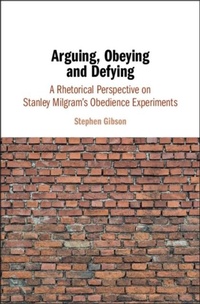
Arguing, Obeying and Defying
A Rhetorical Perspective on Stanley Milgram's Obedience Experiments
Published on 27. February 2019
244 pages
978-1-108-37321-0 (ISBN)
Description

Stanley Milgram's obedience experiments are among the most influential and controversial scientific studies ever conducted. The experiments are commonly understood to have shown how easily people can be led into harming another person, simply as a result of following orders. Recently, however, Milgram's studies have been subjected to a sustained critique and re-evaluation. This book draws on the vast stock of audio recordings from Milgram's experiments to reveal how these experiments can be understood as occasions for argumentation and rhetoric, rather than showing how passive subjects can be led into simply doing as they are told. In doing so, it reconsiders what we understand by 'obedience' and extends how social psychologists have understood rhetoric itself.
Reviews / Votes
'Stephen Gibson's superb book looks at social psychology's most famous experiment. By closely examining what actually occurred, Gibson shows that Milgram's obedience studies were not really about obedience. In focusing on Milgram, Gibson offers a sophisticated, original analysis of social psychology itself.' Michael Billig, Emeritus Professor, Loughborough University 'This book provides a wealth of new insights into classic studies and is a compelling read for all those interested in the psychology of obedience. Stephen Gibson invites us to reconsider what is often taken for granted as established knowledge, and makes an excellent case for a social psychology that focuses on the detail of social interaction.' Chris McVittie, Queen Margaret University 'In this exhaustively researched and carefully argued volume, Stephen Gibson provides a compelling reappraisal of one of psychology's best-known experiments and the disciplinary practice of social psychology. He effectively demonstrates that the obedience study was not a demonstration of 'blind obedience', as is often claimed, but an exercise in rhetoric and persuasion.' Ian Nicholson, Editor, Journal of the History of the Behavioral Sciences 'If you thought there was nothing more to be learned from Milgram's obedience experiments conducted over fifty years ago, Stephen Gibson's rigorous forensic analysis of the archived audio recordings of these infamous experiments challenges how we should view them. Using theoretical principles from discursive and rhetorical psychology, Gibson details the rhetorical and argumentative interactions that test the standard story told in textbooks. Invoking Protagoras's maxim that there are always two sides to every story, Gibson also warns us not to summarily dismiss Milgram's findings either. A must-read for all social psychologists and their students.' Martha Augoustinos, University of Adelaide, AustraliaMore details
Language
English
Place of publication
Cambridge
United Kingdom
Target group
Professional and scholarly
Illustrations
Worked examples or Exercises; 1 Tables, black and white; 2 Halftones, black and white
File size
5,62 MB
ISBN-13
978-1-108-37321-0 (9781108373210)
Copyright in bibliographic data and cover images is held by Nielsen Book Services Limited or by the publishers or by their respective licensors: all rights reserved.
Schweitzer Classification
Other editions
Additional editions
Stephen Gibson
Arguing, Obeying and Defying
A Rhetorical Perspective on Stanley Milgram's Obedience Experiments
Book
03/2019
Cambridge University Press
€127.50
Shipment within 15-20 days
Person
Content
1. Introduction; 2. The obedience experiments; 3. Re-evaluating Milgram; 4. A rhetorical perspective; 5. From standardised procedure to flexible rhetoric; 6. From proximity to argumentation; 7. From passive agents to active rhetoricians; 8. From a physical to a rhetorical metaphor; 9. Conclusion.
