

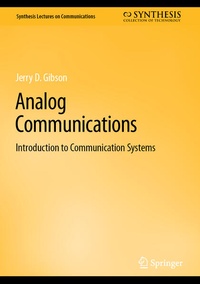
Analog Communications
Description

This book develops the basic concepts in understanding Analog Communications. Beginning with coverage of amplitude modulation, including the time and frequency domain representations of double sideband, single sideband, and vestigial sideband modulation, and introduces the student to the fundamental ideas of quadrature amplitude modulation, frequency division multiplexing, and digital communications using on-off keying.
The author continues with additional discussion and coverage of the time and frequency domain representations of frequency and phase modulation, including bandwidth calculations, and the use of frequency shift keying, phase shift keying, and differential phase shift keying for the transmission of digital information.
Contents include applications and further analyses of the effects of channel noise on amplitude, phase, and frequency modulation performance based on input versus output signal to noise ratios and some systemcomparisons are discussed.
More details
Other editions
Additional editions
Person
Jerry D. Gibson is Professor of Electrical and Computer Engineering at the University of California, Santa Barbara. He is co-author of the books Digital Compression for Multimedia (Morgan-Kaufmann, 1998) and Introduction to Nonparametric Detection with Applications (Academic Press, 1975 and IEEE Press, 1995) and author of the textbook, Principles of Digital and Analog Communications (Prentice-Hall, second ed., 1993). He is Editor-in-Chief of The Mobile Communications Handbook (CRC Press, 3rd ed., 2012), Editor-in-Chief of The Communications Handbook (CRC Press, 2nd ed., 2002), and Editor of the book, Multimedia Communications: Directions and Innovations (Academic Press, 2000). His most recent books are Rate Distortion Bounds for Voice and Video (Coauthor with Jing Hu, NOW Publishers, 2014), and Information Theory and Rate Distortion Theory for Communications and Compression (Morgan-Claypool, 2014).
Dr. Gibson was Associate Editor for Speech Processing for the IEEE Transactions on Communications from 1981 to 1985 and Associate Editor for Communications for the IEEE Transactions on Information Theory from 1988-1991. He was an IEEE Communications Society Distinguished Lecturer for 2007-2008.
In 1990, Dr. Gibson received The Fredrick Emmons Terman Award from the American Society for Engineering Education, and in 1992, he was elected Fellow of the IEEE. He was the recipient of the 1993 IEEE Signal Processing Society Senior Paper Award for the Speech Processing area. He received the IEEE Transactions on Multimedia Best Paper Award in 2010 and the IEEE Technical Committee on Wireless Communications Recognition Award for contributions in the area of Wireless Communications Systems and Networks in 2009.
