

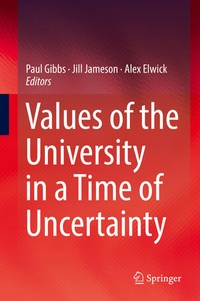
Values of the University in a Time of Uncertainty
Description

This deliberately wide-ranging book addresses issues related to trust, compassion, well-being, grace, dignity and integrity. It explores these within the context of higher education, giving existential and empirical accounts of how these moral duties can be expressed within the academy and why they ought to be. The chapters range from values used in the marketing and management of institutions to their realisation in therapeutic and teacher training spaces. The book opens with a specific introduction which positions the work and outlines the context of duties and obligations at play. This is followed by two distinct but related sections including chapters on theoretical issues, organisational practices and personal praxis. The first part is more abstract and theoretical, the second locates the values discussed within the practices of the university. In doing so the book encompasses a wide range of issues from multi-disciplinary and geo-political regions. The authors are a mixture of world-leading authorities on values in higher education and earlier career researchers, who are nonetheless equally passionate contributors. This mix gives the book vibrancy and offers insight which appeals to both an academic and managerial readership.
More details
Other editions
Additional editions
Persons
Professor Paul Gibbs, Director of Centre for Education Research and Scholarship, Middlesex University
Director of the Hong Kong Practice Based Research Centre
Dr Alex Elwick, Research Assistant, Middlesex University (2016-present)
Professor Jill Jameson is Professor of Education, Chair/Director of the Centre for Leadership and Enterprise, Faculty of Education and Health, University of Greenwich. Chair of the Society for Research into Higher Education (SRHE) and Convenor for the Educational Technology (and previously Post-Compulsory and Lifelong Learning) British Educational Research Association (BERA) Special Interest Groups, Jill is Guest Editor for four Special Editions (2006, 2013, 2016) of the British Journal of Educational Technology (BJET) and Principal Investigator for the ESRC Higher Vocational Education and Pedagogy (HIVE-PED) seminar series. An ESRC and ESRC/NRF Newton, South African and Irish Research Council peer reviewer and evaluator, Jill has 38 years of educational governance, leadership and management experience in HE/FE, Herarticles and books on leadership, e-learning and higher/post-compulsory education include Leadership in Post-Compulsory Education (2006), the Ultimate FE Leadership and Management Handbook (2007, with Professor I McNay), the e-Learning Reader (2012, with Prof S de Freitas), Vocationalism in Further and Higher Education (2016, with Dr S Loo, UCL IoE) and a forthcoming book on International Perspectives on Leadership in Higher Education: Critical Thinking for Global Challenges for the OxCHEPs Series entitled International Studies in Higher Education.
Content
