

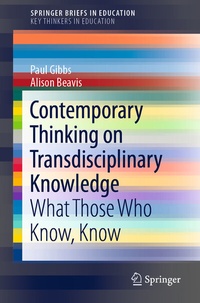
Contemporary Thinking on Transdisciplinary Knowledge
Description

How can we understand what a transdisciplinary (TD) approach might actually comprise of, given its complex and various uses? This book asks the question of leading practitioners in the field of higher education and transdisciplinarity.
The emergence of transdisciplinarity has been a response to the often-failed closed-system, discipline-based approaches to solving complex social problems (various reports and definitions may be found in projects reported by the OECD, UNESCO and EU). These failures are often contingent upon disaggregated notions of epistemology and the compounding failures of ontological incongruities that are evident in these discipline-based approaches. Such approaches are not necessarily confined to large, seemingly insurmountable social problems, but apply equally well to issues in educational institutions as workplaces. Transdisciplinary knowledge is in the liberation of new and imaginative understanding of the structured reality of open social systems. It gives rise to generative mechanisms, which are central to relationships of agency and structure.
More details
Other editions
Additional editions
Persons
Paul Gibbs is Emeritus professor at the University of Middlesex, Advisor to the Rector at Azerbaijan University and vesting professor at University of Technology Sydney. His particular approach to transdisciplinarity that informs his work is through the works of Heidegger, neo-Confucian thought and the insights of Basarab Nicolescu.
Alison Beavis is an Associate Professor at the University of New South Wales (UNSW Sydney) where she was recently appointed as the Deputy Dean (Education) in the Faculty of Science. Her passion for transdisciplinarity was shaped through her role as the founding Deputy Dean in the Faculty of Transdisciplinary Innovation at the University of Technology Sydney
Content
Section1. Contextualisation.- 1. Introduction to the Project; Paul Gibbs and Alison Beavis.- 2. Transdisciplinary Knowledge - An emergent concept; Alison Beavis and Paul Gibbs.- Section 2. The Interviews.- 3. Sue L. T. McGregor.- 4. Valerie Brown.- 5. Gray Kochhar-Lindgren.- 6. Kate Maguire.- 7. Julie Thompson Klien.- 8. Basarab Nicolescu.- 9. Linda Neuhauser.- 10. Christian Pohl.- Section 3. Reflections and Case Study.- 11. Thematic reflection; Paul Gibbs and Alison Beavis.- Appendix 1. UTS Case Study.
