

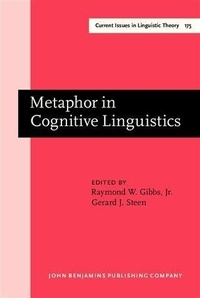
Metaphor in Cognitive Linguistics
Selected papers from the 5th International Cognitive Linguistics Conference, Amsterdam, 1997
1st Edition
Published on 15. June 1999
VIII, 226 pages
978-90-272-8401-3 (ISBN)
Description

This book contains a selection of refereed and revised papers originally presented at the 5th ICLC. After an introduction by the editors, the book opens with a long-needed chapter on historical precedents for the Cognitive Linguistic theory of metaphor. Two chapters demonstrate the method of lexical analysis of linguistic metaphors and how it can be fruitfully applied to a characterization of the conceptual domains of smell and economics. Three chapters deal with theoretical aspects of conceptual metaphor, one of which is a commissioned chapter on the relation between conceptual metaphor theory and conceptual blending. Finally there are five chapters presenting novel theoretical issues and empirical findings about the relation between conceptual metaphor and culture. This book is hence a wide-ranging sample of current approaches to metaphor in Cognitive Linguistics, with some chapters breaking new grounds for future research.
More details
Other editions
Additional editions
Raymond W. Gibbs, Jr. | Gerard J. Steen
Metaphor in Cognitive Linguistics
Selected papers from the 5th International Cognitive Linguistics Conference, Amsterdam, 1997
Book
06/1999
John Benjamins Publishing Co
€111.30
Shipment within 10-15 days
Persons
Content
- METAPHOR IN COGNITIVE LINGUISTICS
- Editorial page
- Title page
- Copyright page
- Acknowledgements
- Table of contents
- INTRODUCTION
- References
- KANT, BLUMENBERG, WEINRICH SOME FORGOTTEN CONTRIBUTIONS TO THE COGNITIVE THEORY OF METAPHOR
- 1. Predecessors: An overview
- 2. KanVs concept of analogy and his "symbolical sensualisation
- 3. Blumenberg's philosophical "metaphorology
- 4. Weinrich's linguistic theory of metaphorical "image fields
- 5. Summary and conclusion
- Notes
- References
- METAPHORICAL MAPPINGS IN THE SENSE OF SMELL
- 1. Introduction
- 2. The sense of smell: Extended meanings
- 3. The sense of smell: Property selection process
- 3.1 Properties of the sense of smell
- 3.2 Distribution of properties in the target domain:
- 4. Conclusions
- Acknowledgment
- Notes
- References
- WHEN A BODILY SOURCE DOMAIN BECOMES PROMINENT THE JOY OF COUNTING METAPHORS IN THE SOCIO-ECONOMIC DOMAIN
- 1. Introduction
- 2. Parameters of variation
- 3. The HEALTH metaphor: A case of seasonal adjustment?
- 4. Conclusion
- References
- FROM LINGUISTIC TO CONCEPTUAL METAPHOR IN FIVE STEPS
- 1. Metaphor focus identification
- 2. Metaphorical idea identification
- 3. Nonliteral comparison identification
- 4. Nonliteral analogy identification
- 5. Nonliteral mapping identification
- 6. Conclusion
- Author's note
- References
- A TYPOLOGY OF MOTIVATION FOR CONCEPTUAL METAPHOR CORRELATION VS. RESEMBLANCE
- 1. Conceptual metaphors and experiential motivation
- 2. Death is a thief
- 3. Experiential correlation as a motivation for primary metaphors
- 4. Resemblance metaphors
- 4.1 "Achilles is a lion
- 4.2 The 'similarity theory' vs. the 'resemblance hypothesis'
- 4.3 A network model
- 5. 'GENERIC-IS-SPECIFIC' metaphors
- 6. Comparison between the types of metaphor
- 6.1 Directionality
- 6.2 Ontology
- 6.3 Conventionality
- 7. Conclusion
- Notes
- References
- BLENDING AND METAPHOR
- 1. Introduction
- 2. Blending theory and conceptual metaphor theory
- 2.1 Domains vs. mental spaces
- 2.2 Two domains vs. four spaces
- 2.3 Emergent structure
- 2.4 On-line processing and entrenchment
- 2.5 Basic processes of blending
- 2.6 Optimality principles of BT
- 3. The ship of state
- 4. Metaphors as inputs to blending
- 4.1 Types of counterpart connection
- 4.2 Complex metaphorical blends
- 5. What makes a blend metaphoric
- 5.1 Fusion with accommodation
- 5.2 Directionality and asymmetric topicality
- 5.3 Metaphors vs. counterfactuals: The role of linguistic context
- 6. Conclusion
- Notes
- References
- SELF AND AGENCY IN RELIGIOUS DISCOURSE PERCEPTUAL METAPHORS FOR KNOWLEDGE AT A MARIAN APPARITION SITE
- 1. Introduction
- 2. Pilgrims' narratives
- 3. Cultural models
- 4. Language and agency
- 5. Perceptual metaphors for knowledge
- 6. Method
- 6.1 Participants and materials
- 6.2 Coding and analyses
- 7. Results and discussion
- 7.1 Religious vs. secular experiences
- 7.2 Elicited vs. non-elicited accounts
- 7.3 Face-to-Face vs. on-line narratives
- 7.4 Metaphorical vs. non-metaphorical perceptual vocabulary
- 8. Conclusion
- References
- TAKING METAPHOR OUT OF OUR HEADS AND PUTTING IT INTO THE CULTURAL WORLD
- 1. Metaphoric representations and embodied experience
- 2. What's missing from the psycholinguistic evidence
- 3. The cultural basis for embodied metaphor
- 4. Metaphor as external representations
- 5. Implications for empirical research
- 6. Conclusion
- References
- METAPHOR DOES IT CONSTITUTE OR REFLECT CULTURAL MODELS?
- 1. Literal emergence (1)
- 2. Literal emergence (2)
- 2.1 Marriage
- 3. Metaphorical emergence (3)
- 4. Metaphorical emergence (4)
- 5. Conclusions
- References
- METAPHORS AND CULTURAL MODELS AS PROFILES AND BASES
- 1. Introduction: The problem to be considered
- 2. Previous approaches to this problem
- 3. Terms for two moral categories as a case study
- 3.1 Metaphors for chestnost'
- 3.2 Metaphors for porjadochnost'
- 4. The wider context of usage
- 5. Conclusion: Approaches advocated in this study
- Notes
- References
- CONGRUENCE BY DEGREE ON THE RELATION BETWEEN METAPHOR & CULTURAL MODELS
- 1. Introduction
- 2. Metaphors of sex & lust in the Chagga language
- 3. Metaphorical correspondences outside language?
- 4. Discussion
- 5. Concluding remarks
- Acknowledgments
- Notes
- References
- SUBJECT INDEX
- NAME INDEX
