


The New Production of Knowledge
The Dynamics of Science and Research in Contemporary Societies
1st Edition
Published on 21. July 1994
192 pages
978-1-4462-6587-1 (ISBN)
Description

In this provocative and broad-ranging work, the authors argue that the ways in which knowledge - scientific, social and cultural - is produced are undergoing fundamental changes at the end of the twentieth century. They claim that these changes mark a distinct shift into a new mode of knowledge production which is replacing or reforming established institutions, disciplines, practices and policies.
Identifying features of the new mode of knowledge production - reflexivity, transdisciplinarity, heterogeneity - the authors show how these features connect with the changing role of knowledge in social relations. While the knowledge produced by research and development in science and technology is accorded central concern, the authors also outline the changing dimensions of social scientific and humanities knowledge and the relations between the production of knowledge and its dissemination through education.
Identifying features of the new mode of knowledge production - reflexivity, transdisciplinarity, heterogeneity - the authors show how these features connect with the changing role of knowledge in social relations. While the knowledge produced by research and development in science and technology is accorded central concern, the authors also outline the changing dimensions of social scientific and humanities knowledge and the relations between the production of knowledge and its dissemination through education.
Reviews / Votes
`It is a significant book... is recommended as highly readable, for policy makers, R&D planners, educationalists, graduate students, as well as reflective scientists' - Higher Education Policy`Thought-provoking in its identification of issues that are global in scope' - Choice
`Sociology of knowledge in the borderlands of cyberspace' - Jesse Ausubel, Director, Program for the Human Environment, Rockefeller University
`By their insightful identification of the recent social transformation of knowledge production, the authors have been able to assert new imperatives for policy instructions. The lessons of the book are deep' - Alexis Jacquemin, Universite Catholique de Louvain and adviser to Foreign Studies Unit, European Commission
`Should we celebrate the emergence of a `post-academic' mode of postmodern knowledge production for the post-industrial society of the 21st century? Or should we turn away from it with increasing fear and loathing as we also uncover its contradictions. A generation of enthusiasts and/or critics will be indebted to the team of authors for exposing so forcefully the intimate connections between all the cognitive, educational, organizational and commercial changes that are together revolutionizing the sciences, the technologies and the humanities. This book will surely spark off a vigorous and fruitful debate about the meaning and purpose of knowledge in our culture' - Professor John Ziman, University of Bristol
`This book is a timely contribution to current discussion on the breakdown of and need to renegotiate the social contract between science and society that Vannevar Bush and likeminded architects of science policy constructed immediately after World War II. It goes far beyond the usual scattering of fragmentary insights into changing institutional landscapes, cognitive structures, or quality control mechanisms of present day science, and their linkages with society at large. Tapping a wide variety of sources, the authors provide a coherent picture of important new characteristics that, taken altogether, fundamentally challenge our traditional notions of what academic research is all about. This well-founded analysis of the social redistribution of knowledge and its associated power patterns helps articulate what otherwise tends to remain an - albeit widespread - intuition. Unless they adapt to the new situation, universities in future will find the centres of gravity of knowledge production moving even further beyond their ken. Knowledge of the social and cognitive dymanics of science in research is much needed as a basis of science and technology policy-making. The New Production of Knowledge does a lot to fill this gap. Another unique feature is its discussion of the humanities, which are usually left out in works coming out of the social studies of science' - Aant Elzinga, Univeristy of Goteborg
All prices
More details
Language
English
Place of publication
London
United Kingdom
Target group
College/higher education
Professional and scholarly
ISBN-13
978-1-4462-6587-1 (9781446265871)
Copyright in bibliographic data and cover images is held by Nielsen Book Services Limited or by the publishers or by their respective licensors: all rights reserved.
Schweitzer Classification
Other editions
Additional editions
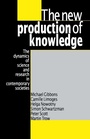
Michael Gibbons | Camille Limoges | Helga Nowotny
The New Production of Knowledge
The Dynamics of Science and Research in Contemporary Societies
Book
07/1994
1st Edition
SAGE Publications Inc
€111.50
Shipment within 15-20 days
Persons
Born in Vienna (Austria). Helga Nowotny has been Professor of Social Studies of Science at ETH Zurich and Director of Collegium Helveticum until 2002. She has been Founding Director of "Society in Science:The Branco Weiss Fellowship" based at ETH Zurich. Currently she is Chair of EURAB, the European Research Advisory Board of the European Commission and member of the Scientific Council of the proposed ERC. She is a Fellow of the Science Center Vienna (WZW).
She has a doctorate in law from the University of Vienna and a Ph.D. in sociology from Columbia University, New York. She has held teaching and research positions in Vienna, Cambridge, Bielefeld, Berlin and Paris and has been a Fellow at the Wissenschaftskolleg zu Berlin. From 1974-1986 she has been Executive and Founding Director of the European Center in Vienna and for seven years Chairperson of the Standing Committee for the Social Sciences of the European Science Foundation. From 1987 she was Professor of Social Studies of Science at the University of Vienna and Permanent Fellow of Collegium Budapest/Institute for Advanced Study before moving to ETH Zurich.
Helga Nowotny is a member of the Scientific or Advisory Board of many scientific and policy-oriented institutions in Europe and Member of the Academia Europaea. She was awarded the Bernal Prize 2003 by the Society for Social Studies of Science, and is prizewinner of the "Arthur Burkhardt Preis fuer Wissenschaftsfoerderung 2002. She has authored, co-authored or edited more than 25 books and published widely on topics of societal development, social studies of science and technology and on the relationship between science and society. Trow was born in New York on June 21, 1926, and attended primary and secondary schools in New York City. He served in the U.S. Navy for three years, separating with officer rank, before matriculating at the Stevens Institute of Technology in 1947. He practiced briefly as a mechanical engineer before entering Columbia University as a graduate student in sociology in 1948.
She has a doctorate in law from the University of Vienna and a Ph.D. in sociology from Columbia University, New York. She has held teaching and research positions in Vienna, Cambridge, Bielefeld, Berlin and Paris and has been a Fellow at the Wissenschaftskolleg zu Berlin. From 1974-1986 she has been Executive and Founding Director of the European Center in Vienna and for seven years Chairperson of the Standing Committee for the Social Sciences of the European Science Foundation. From 1987 she was Professor of Social Studies of Science at the University of Vienna and Permanent Fellow of Collegium Budapest/Institute for Advanced Study before moving to ETH Zurich.
Helga Nowotny is a member of the Scientific or Advisory Board of many scientific and policy-oriented institutions in Europe and Member of the Academia Europaea. She was awarded the Bernal Prize 2003 by the Society for Social Studies of Science, and is prizewinner of the "Arthur Burkhardt Preis fuer Wissenschaftsfoerderung 2002. She has authored, co-authored or edited more than 25 books and published widely on topics of societal development, social studies of science and technology and on the relationship between science and society. Trow was born in New York on June 21, 1926, and attended primary and secondary schools in New York City. He served in the U.S. Navy for three years, separating with officer rank, before matriculating at the Stevens Institute of Technology in 1947. He practiced briefly as a mechanical engineer before entering Columbia University as a graduate student in sociology in 1948.
Content
Evolution of Knowledge Production
The Marketability and Commercialisation of Knowledge
Massification of Research and Education
The Case of the Humanities
Competitiveness, Collaboration and Globalisation
Reconfiguring Institutions
Towards Managing Socially Distributed Knowledge
The Marketability and Commercialisation of Knowledge
Massification of Research and Education
The Case of the Humanities
Competitiveness, Collaboration and Globalisation
Reconfiguring Institutions
Towards Managing Socially Distributed Knowledge
