
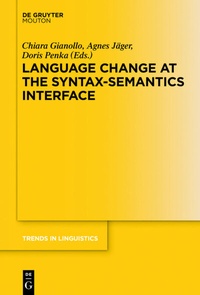
Language Change at the Syntax-Semantics Interface
Description
Alles über E-Books | Antworten auf Fragen rund um E-Books, Kopierschutz und Dateiformate finden Sie in unserem Info- & Hilfebereich.
Bringing together diachronic research from a variety of perspectives, notably typology, formal syntax and semantics, this volume focuses on the interplay of syntactic and semantic factors in language change - an issue so far largely neglected both in (mostly lexical) historical semantics as well as historical syntax, but recently brought into focus by grammaticalization theory as well as Minimalist diachronic syntax. The contributions draw on data from numerous Indo-European languages including Vedic Sanskrit, Middle Indic, Greek as well as English and German, and discuss a range of phenomena such as change in negation markers, indefinite articles, quantifiers, modal verbs, argument structure among others. The papers analyze diachronic evidence in the light of contemporary syntactic and semantic theory, addressing the crucial question of how syntactic and semantic change are linked, and whether both are governed by similar constraints, principles and systematic mechanisms. The volume will appeal to scholars in historical linguistics and formal theories of syntax and semantics.
More details
Other editions
Additional editions
Persons
Content
- Intro
- Preface and acknowledgements
- Table of contents
- 1 Language change at the syntax-semantics interface. Perspectives and challenges
- 2 Semantic and formal features: Feature economy in language change
- 3 Linking syntax and semantics of adnominal possession in the history of German
- 4 Most historically
- 5 The "indefinite article" from cardinal to operator to expletive
- 6 The Greek Septuagint and language change at the syntax-semantics interface: from null to "pleonastic" object pronouns
- 7 The agreement of collective nouns in the history of Ancient Greek and German
- 8 Vedic local particles at the syntax-semantics interface
- 9 Aspect shifts in Indo-Aryan and trajectories of semantic change
- 10 The development of conditional should in English
- 11 The Greek Jespersen's cycle: Renewal, stability and structural microelevation
- Subject index

System requirements
File format: ePUB
Copy protection: Watermark-DRM (Digital Rights Management)
System requirements:
- Computer (Windows; MacOS X; Linux): Use a reading software that can process the file format ePUB: e.g., Adobe Digital Editions or FBReader – both free (see eBook Help).
- Tablet/Smartphone (Android; iOS): Before downloading, install the free app Adobe Digital Editions (see eBook Help).
- E-reader: Bookeen, Kobo, Pocketbook, Sony, Tolino and many more (not Kindle).
The file format ePUB works well for novels and non-fiction books – i.e., „flowing” text without complex layout. On an e-reader or smartphone, line and page breaks automatically adjust to fit the small displays.
This eBook uses Watermark-DRM, a „soft” copy protection. This means that there are no technical restrictions to prevent illegal distribution. However, there is a personalised watermark embedded in the eBook that can be used to identify the purchaser of the eBook in the event of misuse and to provide evidence for legal purposes.
For more information, see our eBook Help page.
File format: PDF
Copy protection: Watermark-DRM (Digital Rights Management)
System requirements:
- Computer (Windows; MacOS X; Linux): Use the free software Adobe Reader, Adobe Digital Editions, or any other PDF viewer of your choice (see eBook Help).
- Tablet/Smartphone (Android; iOS): Install the free app Adobe Digital Editions or another reading app for eBooks, e.g., PocketBook (see eBook Help).
- E-reader: Bookeen, Kobo, Pocketbook, Sony, Tolino and many more (only limited: Kindle).
The file format PDF always displays a book page identically on any hardware. This makes PDF suitable for complex layouts such as those used in textbooks and reference books (images, tables, columns, footnotes). Unfortunately, on the small screens of e-readers or smartphones, PDFs are rather annoying, requiring too much scrolling.
This eBook uses Watermark-DRM, a „soft” copy protection. This means that there are no technical restrictions to prevent illegal distribution. However, there is a personalised watermark embedded in the eBook that can be used to identify the purchaser of the eBook in the event of misuse and to provide evidence for legal purposes.
For more information, see our eBook Help page.
