

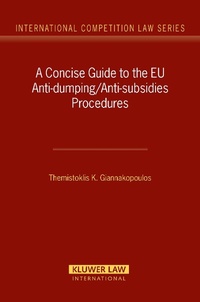
A Concise Guide to the EU Anti-dumping/Anti-subsidies Procedures
Published on 24. August 2006
244 pages
978-90-411-4976-3 (ISBN)
Description

Unfair trading practices such as dumping and the granting of subsidies have
long been identified as threats to open markets. Yet despite decades of
international trading rules, global markets are still jeopardized by practices
which can cause material injury to industries and put employment at risk. The
European Union has been a leader in its determination to ensure that its
industries are not disadvantaged by such practices, that Community interests
are defended, and that fair competition is restored where needed.
The basic texts which form the legal basis of anti-dumping and anti-subsidy
investigations in the Community entered into force in 1996 and 1997. The
procedures developed in these texts, as amended, and in their corresponding
regulations, are the subject of this extremely helpful guide. Practitioners
who must follow these often complex procedures will find precise guidelines
for the substantive determinations that must be made such as calculating the
material injury, determining the cause of injury, and applying the Community
interest test and then be able to move confidently through every procedural
step, including the following:
Initial complaint
-
Questionnaires
Confrontation meetings and oral hearings
Investigations by Commission official;
Offer and acceptance /rejection of undetaking;
Commenting on the Commission's provisional decision
Requesting review of measures and refunds and
Judicial review
Throughout the presentation the author describes relevant cases and actual
measures taken. Tables of cases and measures as well as a bibliography are
included.
Business people and their counsel, whether engaged in trade within the EU or
between any country and an EU Member State, will benefit enormously from the
detailed guidance offered in this incomparable volume. The book will also be
invaluable to academics and policymakers as an unclouded analysis of
anti-dumping/anti-subsidies procedures under EC law.
long been identified as threats to open markets. Yet despite decades of
international trading rules, global markets are still jeopardized by practices
which can cause material injury to industries and put employment at risk. The
European Union has been a leader in its determination to ensure that its
industries are not disadvantaged by such practices, that Community interests
are defended, and that fair competition is restored where needed.
The basic texts which form the legal basis of anti-dumping and anti-subsidy
investigations in the Community entered into force in 1996 and 1997. The
procedures developed in these texts, as amended, and in their corresponding
regulations, are the subject of this extremely helpful guide. Practitioners
who must follow these often complex procedures will find precise guidelines
for the substantive determinations that must be made such as calculating the
material injury, determining the cause of injury, and applying the Community
interest test and then be able to move confidently through every procedural
step, including the following:
Initial complaint
-
Questionnaires
Confrontation meetings and oral hearings
Investigations by Commission official;
Offer and acceptance /rejection of undetaking;
Commenting on the Commission's provisional decision
Requesting review of measures and refunds and
Judicial review
Throughout the presentation the author describes relevant cases and actual
measures taken. Tables of cases and measures as well as a bibliography are
included.
Business people and their counsel, whether engaged in trade within the EU or
between any country and an EU Member State, will benefit enormously from the
detailed guidance offered in this incomparable volume. The book will also be
invaluable to academics and policymakers as an unclouded analysis of
anti-dumping/anti-subsidies procedures under EC law.
More details
Other editions
Additional editions
Themistoklis K. Giannakopoulos
A Concise Guide to the EU Anti-dumping/Anti-subsidies Procedures
Book
08/2006
Kluwer Law International
€229.16
Shipment within 10-20 days
Content
- Cover
- Half Title Page
- Title Page
- Copyright Page
- Table of Contents
- Chapter I Introduction
- I. Definition of Dumping and Subsidy - Conditions for Taking Action
- II. Brief Description of the Procedure
- Schematic Diagram: How an Investigation Proceeds in Anti-dumping/Anti-subsidies Cases
- Chapter II Substantial Issues of Dumping and Subsidies
- I. Basic Principles Regarding Dumping and Subsidies
- II. Definition of a Subsidy - Countervailable and Non- Countervailable Subsidies
- A. Countervailable Subsidies: The Condition of Being Specific
- B. Non-countervailable Subsidies
- C. The Annexes to the Anti-subsidies Regulation
- 1. Annex I: A Non-exhaustive List of Export Subsidies
- 2. Annex II: Guidelines on Consumption of Inputs in the Production Process
- 3. Annex III: Guidelines on the Determination of Substitution Drawback Systems as Export Subsidies
- III. Calculation of Dumping and Countervailable Subsidies
- A. Determination of Dumping
- 1. 'Like Product'
- 2. Normal Value
- a. No Production or Sales of the Like Product by the Exporter
- b. Sales between Associated Entities/Entities having a Compensatory Arrangement
- c. Representative Domestic Sales of the Like Product
- d. Constructed Normal Value: No or Insufficient Sales of the Like Product/No Chance of Comparison Due to Particular Market Situation
- e. Sales at Prices below Unit Production Costs
- f. Constructed Normal Value: Calculation of Costs
- i. The Records of the Parties
- ii. Allocation of Costs
- iii. Start-up Operations
- g. Constructed Normal Value: Determination of the Amounts for Selling, General and Administrative Costs and Profits
- h. Normal Value of Products Imported from Traditional Non-market Economy Countries
- i. Market Economy Treatment (MET) for Companies
- j. Country-wide Market Economy Status (MES)
- 3. Export Price
- 4. Comparison
- a. Physical Characteristics
- b. Import Charges and Indirect Taxes
- c. Discounts, Rebates and Quantities
- d. Level of Trade
- e. Transport, Insurance, Handling, Loading and Ancillary Costs
- f. Packing
- g. Credit
- h. After-sales Costs
- i. Commissions
- j. Currency Conversions
- k. Other Factors
- 5. Dumping Margin
- B. Calculation of the Amount of Countervailable Subsidies
- 1. Calculation of Benefit to the Recipient
- 2. General Provisions on Calculation of Countervailable Subsidies
- a. Elements Deductible from the Total Amount of Subsidy
- b. Subsidy Granted by Reference Other than the Quantities Manufactured, Produced, Exported, or Transported
- c. Subsidy Linked to Acquisition of Fixed Assets
- IV. Determination of Injury
- A. Injury
- 1. Injury Indicators
- B. Causation
- C. Other Factors Causing Injury
- D. Threat of Material Injury
- E. Material Retardation
- V. Definition of Community Industry
- A. Major Proportion
- B. Community Producers Who are Related to Exporters/ Importers, or are Importers Themselves of the Product
- C. Regional Industry
- VI. Sampling
- Chapter III Procedural Issues of Dumping and Subsidies
- I. Initiation of an Anti-dumping/Anti-subsidies Procedure: the Filing of a Complaint
- A. Legal Basis
- B. Form and Content of the Complaint
- C. Selectivity of the Complaint
- D. Withdrawal of the Complaint
- E. The Position of Complainants Once an Anti-dumping/ Anti-subsidies Complaint has been Lodged
- F. Legal Remedies with Regard to the Commission's Handling of the Complaint
- 1. Action for Annulment
- 2. Action for Failure to Act
- II. The Procedure Following the Initiation of Proceedings
- A. Initiation of Proceedings
- B. Requests for Information: No Obligation of the Parties to Co-operate and Provide It
- C. Verification of Information by the Commission: No Obligation of the Parties to Co-operate and Submit to On-the-spot Investigations
- D. Non-cooperation of the Parties - Best Information Available Rule
- E. Procedural Safeguards for the Parties Involved in an Anti-dumping/Anti-subsidies Investigation
- F. The Right to a Fair Hearing
- 1. Access to Information
- a. Access to the File
- i. Legal Basis - Conditions of Access - Categories of Entitled Parties
- ii. The Content of the File that should be Accessible to the Parties
- iii. Forms of Access to the File
- b. The Right to be Informed of the Essential Facts and Considerations and the Right to Make Submissions Thereon
- 2. The Right to be Heard
- G. The Right to Confidential Treatment of Information
- H. The Right to Meet Opponents: Confrontation Meetings
- I. The Assessment of the Community Interest Prior to the Imposition of Anti-dumping/Countervailing Measures (Community Interest Test)
- 1. Substantive Issues
- 2. Procedural Issues
- Chapter IV The Outcome of Anti-dumping/Anti-subsidies Investigations
- I. Imposition of Provisional Measures by the Commission
- A. Prerequisites for the Imposition of Provisional Duties
- B. Procedure for the Imposition of Provisional Duties
- C. Duration of Provisional Duties
- II. Termination of Investigation by Acceptance of Undertakings by the Commission
- A. Prerequisites for the Acceptance of Undertakings by the Commission and Consequences Thereof
- B. The Option of the Commission to Suggest Undertakings
- C. Obligations of the Parties Offering/Accepting Undertakings
- D. Breach or Withdrawal of Undertakings
- E. Example of an Acceptable Undertaking
- III. Termination of the Proceedings Without Measures - Imposition of Definitive Duties by the Commission
- A. Termination Without Measures - De Minimis
- B. Imposition of Definitive Duties
- C. Retroactive Application of Measures
- IV. Duration of Measures - Reviews
- A. Expiry Reviews
- B. Interim Reviews
- C. Newcomer Reviews in Anti-dumping Cases
- D. Accelerated Reviews in Anti-subsidies Cases
- E. Time-limits for Reviews
- F. General Provisions on Reviews
- V. Refunds
- A. The Notice of the Commission Regarding Refunds
- 1. General Issues
- a. The Persons Entitled to Apply for Reimbursement
- b. Establishment of Revised Dumping Margin
- c. The Parties that have to Co-operate for a Successful Refund Application
- d. Deadlines Regarding Submission of Applications, Decisions by the Commission, Payment by Member States' Authorities
- e. The Sum that may be Refunded
- 2. Procedural Issues
- a. Lodging the Application - Form and Content of the Application
- b. Submission of the Application
- c. Time-limits for the Submission of an Application
- d. Recurring Applications
- 3. Substantive Issues
- a. Investigation of a Refund Application
- i. Evidence Requested from the Applicant
- ii. Evidence Requested from the Exporting Producer
- (a) Representative Period
- (b) Questionnaires
- iii. Analysis of Merits
- (a) General Methodology
- (b) Construction of the Export Price
- (c) Use of Review Findings
- (d) Extrapolation
- iv. Non-cooperation of the Parties Involved - Best Information Available Rule
- v. Disclosure for Importers - Co-operating Exporters
- 4. Results of a Successful Refund Application
- a. Excess Amount to be Repaid
- b. Payment
- c. Revocation of a Decision to Reimburse
- VI. Absorption of Measures
- VII. Circumvention of Measures
- VIII. Suspension of Measures
- IX. General Provisions - Publication of Measures - Consultations
- Chapter V Judicial Review of the Various Commission Decisions in Anti-dumping/Anti-subsidies Cases
- I. Action for Annulment: Challengeable Acts and the Locus Standi of the Interested Persons
- A. Initiation by the Commission of an Anti-dumping or an Anti-subsidies Proceeding
- B. Regulations Imposing Anti-dumping or Countervailing Duties
- 1. Exporters and Producers
- 2. Importers
- 3. Complainants and Community Producers Supporting the Complaint
- 4. Users and Consumers
- C. Actions against Regulations Imposing Provisional Duties Superseded by a Definitive Regulation
- D. Action against the Termination Without Measures
- E. Action against the Council's Failure to Adopt a Regulation Imposing Definitive Duties
- F. Action against a Refusal of the Council to Grant Retroactivity to a Regulation Reducing the Anti-dumping Duty
- G. Action against a Decision Terminating a Review Proceeding
- II. Actions for Failure to Act - Actions for Damages
- Indicative Bibliography
- Case Law of the European Courts
- Community Institutions' Acts Imposing Measures
- Index
- Back Cover
