

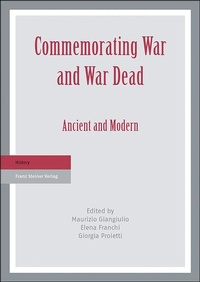
Commemorating War and War Dead
Description

Since Bouthoul's seminal work on polemology (1951), war studies have been increasingly influenced by sociology, psychology and psychoanalysis, memory studies, and even literary theory; while also weathering the storms of the cultural turn and, more generally, postmodernism. These are challenges that raised new questions, or offered new answers. How is war memorialized and commemorated? How do individuals react to war trauma? How are individual reactions and narratives implemented in collective thoughts, narratives and memories? How do societies remember wars, and how do these memories, in turn, affect political structures? How are public commemorations organized? These are some of the questions contemporary war studies are still engaged in. By presenting case studies both ancient and modern, from the ancient Greeks and Romans through medieval and modern times to contemporary history, this volume stimulates reflection on how and why individuals and societies remember and commemorate war.
More details
Other editions
Additional editions
Persons
ISNI:
Content
- Intro
- TABLE OF CONTENTS
- PREFACE
- FOREWORD
- INTRODUCTIVE SECTION
- (Maurizio Giangiulio) Do Societies Remember? The Notion of 'Collective Memory': Paradigms and Problems (from Maurice Halbwachs on)
- (Elena Franchi) Memories of Winners and Losers. Historical Remarks on why Societies Remember and Commemorate Wars
- (Giorgia Proietti) Can an Ancient Truth Become an Old Lie? A Few Methodological Remarks Concerning Current Comparative Research on War and its Aftermath
- SECTION I: WAR MEMORIALS: OBJECTS IN PERFORMANCE
- (Lilah Grace Canevaro) Commemoration through Objects? Homer on the Limitations of Material Memory
- (Birgit Bergmann) Beyond Victory and Defeat. Commemorating Battles prior to the Persian Wars
- (Holger Baitinger) Commemoration of War in Archaic and Classical Greece. Battlefields, Tombs and Sanctuaries
- (James Roy) Memorials of War in Pausanias
- (Nina Fehrlen-Weiss) The Thirty Years' War in German Commemorative Culture from the Beginning of the Holy Roman Empire to the Present - An Overview
- (Simone A. Bellezza) Nation Building through Commemoration: Stalinism, WWII, and Holocaust Memorials in Post-Soviet Ukraine
- SECTION II: WAR DEAD: FROM CITIZENS TO SYMBOLS
- (Mirko Canevaro) Courage in War and the Courage of the War Dead - Ancient and Modern Reflections
- (Blanka Misic) Cognitive Aspects of Funerary Commemoration of Soldiers and Veterans in Roman Poetovio
- (Johannes Birgfeld) Commemorating War and War Dead in 18th Century Germany
- (Marco Mondini (with the collaboration of Cecilia Cozzi)) Brothers and Heroes. Literary Sources on Death in the First World War (the Italian Case)
- SECTION III: NARRATIVES OF WAR:HISTORIOGRAPHY, PUBLIC DISCOURSE,AND CULTURAL MEMORY
- (Roel Konijnendijk) Commemoration through Fear: The Spartan Reputation as a Weapon of War
- (Elena Franchi) The Memory of the Sacred Wars and Some Origin Stories
- (Mark Thorne) Caesar and the Challenge of Commemorating the Battle of Pharsalia
- (Giuseppe Albertoni) Heroes in aula Dei: Commemorating Wars and the Fallen in the Time of Charlemagne
- (Alessandro Salvador) Nationalism, the Politics of Memory and Revisionism: German World War I Veterans and their Transnational Relations
- CONCLUSIVE SECTION
- (Mirko Canevaro) Conclusive Remarks
- ABSTRACTS AND KEYWORDS
- CONTRIBUTORS
- INDEX
