

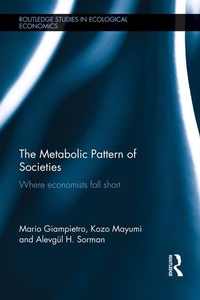
The Metabolic Pattern of Societies
Where Economists Fall Short
1st Edition
Published on 12. October 2011
496 pages
978-1-136-61993-9 (ISBN)
Description

It is increasingly evident that the conventional scientific approach to economic processes and related sustainability issues is seriously flawed. No economist predicted the current planetary crisis even though the world has now undergone five severe recessions primed by dramatic increases in the price of oil. This book presents the results of more than twenty years of work aimed at developing an alternative method of analysis of the economic process and related sustainability issues: it is possible to perform an integrated and comprehensive analysis of the sustainability of socio-economic systems using indicators and variables that have been so far ignored by conventional economists.
The book's innovative approach aims to provide a better framework with which we can face the predicaments of sustainability issues. It begins by presenting practical examples of the shortcomings of conventional economic analysis and examines the systemic problems faced when trying to use quantitative analysis for governance. In providing a critical appraisal of current applications of economic narratives to the issue of sustainability, the book presents several innovative concepts required to generate a post-Newtonian approach to quantitative analysis in the Musiasem approach. An empirical section illustrates the results of an analysis of structural changes in world and EU countries. Finally, the book, using the insight gained in the theoretical and empirical analysis, exposes the dubious quality of many narratives currently used in the sustainability debate.
Overall, the performance of modern economies across different hierarchical levels of organization and across different disciplinary knowledge systems is fully analyzed and a more realistic measure of happiness and well-being is devised. The book should be of interest to researchers and students looking at the issue of sustainability within a variety of disciplines.
The book's innovative approach aims to provide a better framework with which we can face the predicaments of sustainability issues. It begins by presenting practical examples of the shortcomings of conventional economic analysis and examines the systemic problems faced when trying to use quantitative analysis for governance. In providing a critical appraisal of current applications of economic narratives to the issue of sustainability, the book presents several innovative concepts required to generate a post-Newtonian approach to quantitative analysis in the Musiasem approach. An empirical section illustrates the results of an analysis of structural changes in world and EU countries. Finally, the book, using the insight gained in the theoretical and empirical analysis, exposes the dubious quality of many narratives currently used in the sustainability debate.
Overall, the performance of modern economies across different hierarchical levels of organization and across different disciplinary knowledge systems is fully analyzed and a more realistic measure of happiness and well-being is devised. The book should be of interest to researchers and students looking at the issue of sustainability within a variety of disciplines.
Reviews / Votes
'This is a wide-ranging and thought-provoking book. As a guiding biological metaphor the metabolic flow replaces the circulatory fixation of standard economics. Many insights ranging from an elaboration of Georgescu-Roegen's fund-flow model, to the clever explanation of dimensional incongruities such as "cubic dollars", and the strange case of the elephant as a dematerialized mouse will instruct and delight the reader.' - Herman Daly, Professor Emeritus, University of Maryland'Giampietro, Mayumi and Sorman clearly and convincingly show that the idea of metabolism of societies and economic systems can be a guiding principle for a new economics of production. The demise of Walrasian economics has left a void in economic theory and policy and this book goes a long way in filling that gap. On the behavioral side progress is being made to construct a realistic theory of economic decision making but the same cannot be said for the production side of the economy. The authors have taken a large step forward in constructing a framework to analyze production in its biophysical and social context.' - John Gowdy, Rittenhouse Professor of Humanities and Social Science and Professor of Economics, Rensselaer Polytechnic Institute, Troy, New York, USA
More details
Series
Edition
1. Auflage
Language
English
Place of publication
London
United Kingdom
Publishing group
Taylor & Francis Ltd
Target group
College/higher education
Product notice
Reflowable
Illustrations
7 s/w Tabellen, 110 s/w Zeichnungen
7 Tables, black and white; 110 Line drawings, black and white
File size
34,08 MB
ISBN-13
978-1-136-61993-9 (9781136619939)
Copyright in bibliographic data and cover images is held by Nielsen Book Services Limited or by the publishers or by their respective licensors: all rights reserved.
Schweitzer Classification
Other editions
Additional editions
Mario Giampietro | Kozo Mayumi | Alevguel Sorman
The Metabolic Pattern of Societies
Where Economists Fall Short
Book
05/2014
1st Edition
Routledge
€88.04
Shipment within 10-20 days
Mario Giampietro | Kozo Mayumi | Alevguel Sorman
The Metabolic Pattern of Societies
Where Economists Fall Short
Book
10/2011
1st Edition
Routledge
€244.99
Shipment within 15-20 days
Persons
Mario Giampietro is ICREA Research Professor at the Institute of Science and Technology for the Environment (ICTA) at Universitat Autonoma Barcelona, Spain.
Kozo Mayumi is a Professor at The University of Tokushima, Japan, and is the author of The Origin of Ecological Economics, also published by Routledge.
Alevguel Hadiye Sorman is a researcher working in the Research Group of Integrated Assessment at the Institute of Science and Technology for the Environment (ICTA) at Universitat Autonoma Barcelona, Spain.
Kozo Mayumi is a Professor at The University of Tokushima, Japan, and is the author of The Origin of Ecological Economics, also published by Routledge.
Alevguel Hadiye Sorman is a researcher working in the Research Group of Integrated Assessment at the Institute of Science and Technology for the Environment (ICTA) at Universitat Autonoma Barcelona, Spain.
Content
1. The Red Pill: How Real is the Reality Perceived and Represented by Economists? 2. The Process of Demographic Change: The Importance of Multi-Scale and Multi-Level Analysis 3. Going Beyond Economic Energy Intensity and Environmental Kuznets Curves: Combining Extensive and Intensive Variables 4. The Quality of Quantitative Analyses for Governance: How to Choose a Relevant Perception and a Pertinent Representation 5. A Critical Appraisal of Conventional Economic Approaches to Sustainability Problems 6. Five Theoretical Pillars of Musiasem for a New Quantitative Analysis of Sustainability 7. Building Blocks of the Musiasem approach 8. Looking for "Beyond GDP Indicators": Bio-Economic Pressure 9. An International Comparison of the Metabolic Pattern of Modern Societies at the Level of Economic Sectors 10. Other Applications of Musiasem 11. Poor Narratives and Granfalloons Hampering the Sustainability Debate: Can we Escape Soddy's Prophecy? 12. What Went Wrong and Where Do We Go From Here?
