

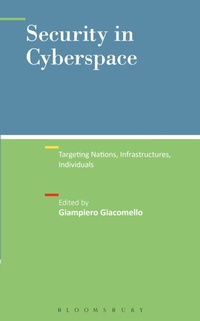
Security in Cyberspace
Targeting Nations, Infrastructures, Individuals
1st Edition
Published on 31. July 2014
256 pages
978-1-62356-570-1 (ISBN)
Description

Today, the Internet has become a source of information that no country or company can forgo. It is not only used to communicate or entertain, but most importantly to operate utilities and public services such as banking or air traffic. As the reliance on computer networks across societies and economies keeps growing, so do security risks in cyberspace - referred to as "cybersecurity."
Cybersecurity means protecting information and control systems from those who seek to compromise them. It also involves actors, both malicious or protective, policies and their societal consequences. This collection of essays provides a better understanding of the risks, perceptions, and myths that surround cybersecurity by looking at it from three different levels of analysis: the sovereign state, the infrastructure and stakeholders of the Internet, and the individual. The essays explore such issues as information ownership, censorship, cyberwars, cyberterrorism, privacy, and rebellion, bringing together expert knowledge from computer science and the social sciences with case studies. It reviews existing policies and practices and discusses the threats and benefits of living in an increasingly networked world. This authoritative analysis of one of the most controversial and compelling security debates of the twenty-first century will appeal to scholars and practitioners interested in security, international relations and policymaking.
Cybersecurity means protecting information and control systems from those who seek to compromise them. It also involves actors, both malicious or protective, policies and their societal consequences. This collection of essays provides a better understanding of the risks, perceptions, and myths that surround cybersecurity by looking at it from three different levels of analysis: the sovereign state, the infrastructure and stakeholders of the Internet, and the individual. The essays explore such issues as information ownership, censorship, cyberwars, cyberterrorism, privacy, and rebellion, bringing together expert knowledge from computer science and the social sciences with case studies. It reviews existing policies and practices and discusses the threats and benefits of living in an increasingly networked world. This authoritative analysis of one of the most controversial and compelling security debates of the twenty-first century will appeal to scholars and practitioners interested in security, international relations and policymaking.
Reviews / Votes
This excellent volume brings exciting new perspectives to the fast-moving field of cybersecurity studies. Giacomello and colleagues provide novel analyses of whose security is at stake in cyberspace. Complexities and intricacies of surveillance, attacks, governance, and privacy in cyberspace are unpacked and presented in a critical and accessible way in this collection. Given today's digitally connected world and global cyberplagues, the readership of this timely book should be very wide indeed. * Johan Eriksson, Swedish Institute of International Affairs, and Soedertoern University, Sweden * Giacomello's edited volume explores the conjunctions of two prominent but contested terms 'security' and 'cyberspace' and how these manifest themselves, for better or worse, in a wide range of contemporary contexts, from nuclear weapons to Wikileaks. The text is admirably wide-ranging in terms of its contributors too, featuring contributions from IT specialists, politics scholars, media scholars, engineers, an arms control specialist, and others. It also contains a diversity of national viewpoints focusing not just on the US perspective, but also analyses of the EU's and China's perspectives on cybersecurity issues contributed by European and Chinese scholars respectively. Today's cyber security scene is complex, contested, and multi-layered, this text makes the reader cognisant of this whilst also providing an accessible map of this space. * Dr. Maura Conway, Senior Lecturer in International Security, Dublin City University *More details
Edition
1. Auflage
Language
English
Place of publication
New York
United States
Publishing group
Bloomsbury Publishing PLC (Digital)
Target group
Professional and scholarly
Illustrations
6 halftone illus
ISBN-13
978-1-62356-570-1 (9781623565701)
Copyright in bibliographic data and cover images is held by Nielsen Book Services Limited or by the publishers or by their respective licensors: all rights reserved.
Schweitzer Classification
Other editions
Additional editions
Book
03/2016
Bloomsbury Academic USA
€56.80
Shipment within 15-20 days
Book
09/2014
Bloomsbury Academic USA
€195.90
Shipment within 3-4 weeks
Person
Giampiero Giacomello is Assistant Professor of International Relations at the Department of Political and Social Sciences at the University of Bologna, Italy and co-editor for the journal Defence Studies.
Content
List of Abbreviations
List of Figures and Tables
Acknowledgments
Foreword
Carlo Schaerf
List of Contributors
Introduction - Security in Cybersapce
Giampiero Giacomello
Part One: The Nation
Chapter 1: The 'State(s)' of Cybersecurity
Rossella Mattioli
Chapter 2: Reducing Uncertainties in Cyberspace through Confidence and Capacity Building Measures
Patryk Pawlak
Chapter 3: Wikileaks and Cyberspace
Judith Reppy
Chapter 4: Leaks: Securing Communications and Achieving Nuclear Zero
Bruce Larkin
Chapter 5: Establishing Norms of Behavior in Cyberspace: The Chinese Viewpoint
Chunmei Kang
Part Two: The Infrastructure and The Individual
Chapter 6: Einstein on the Breach: Surveillance Technology, Cybersecurity and Organizational Change
Milton Mueller and Andreas Kuehn
Chapter 7: Artificial or 'Legitimate' Barriers to Internet Governance?"
Francesco Giacomini and Laura Cordani
Chapter 8: Public-Private Partnerships:
A 'Soft' Approach to Cybersecurity? Views from the European Union
Maria Grazia Porcedda
Chapter 9: Targeting One's Ideal Audience:
Self-Presentation Practices among Extreme Nationalists on Social Networks
Andra Siibak
Bibliography
Index
List of Figures and Tables
Acknowledgments
Foreword
Carlo Schaerf
List of Contributors
Introduction - Security in Cybersapce
Giampiero Giacomello
Part One: The Nation
Chapter 1: The 'State(s)' of Cybersecurity
Rossella Mattioli
Chapter 2: Reducing Uncertainties in Cyberspace through Confidence and Capacity Building Measures
Patryk Pawlak
Chapter 3: Wikileaks and Cyberspace
Judith Reppy
Chapter 4: Leaks: Securing Communications and Achieving Nuclear Zero
Bruce Larkin
Chapter 5: Establishing Norms of Behavior in Cyberspace: The Chinese Viewpoint
Chunmei Kang
Part Two: The Infrastructure and The Individual
Chapter 6: Einstein on the Breach: Surveillance Technology, Cybersecurity and Organizational Change
Milton Mueller and Andreas Kuehn
Chapter 7: Artificial or 'Legitimate' Barriers to Internet Governance?"
Francesco Giacomini and Laura Cordani
Chapter 8: Public-Private Partnerships:
A 'Soft' Approach to Cybersecurity? Views from the European Union
Maria Grazia Porcedda
Chapter 9: Targeting One's Ideal Audience:
Self-Presentation Practices among Extreme Nationalists on Social Networks
Andra Siibak
Bibliography
Index
