

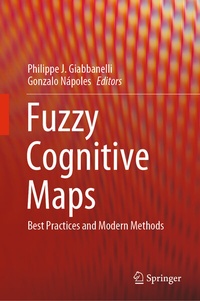
Fuzzy Cognitive Maps
Description

This book starts with the rationale for creating an FCM by contrast to other techniques for participatory modeling, as this rationale is a key element to justify the adoption of techniques in a research paper. Fuzzy cognitive mapping is an active research field with over 20,000 publications devoted to externalizing the qualitative perspectives or "mental models" of individuals and groups. Since the emergence of fuzzy cognitive maps (FCMs) back in the 80s, new algorithms have been developed to reduce bias, facilitate the externalization process, or efficiently utilize quantitative data via machine learning. It covers the development of an FCM with participants through a traditional in-person setting, drawing from the experience of practitioners and highlighting solutions to commonly encountered challenges. The book continues with introducing principles of simulations with FCMs as a tool to perform what-if scenario analysis, while extending those principles to more elaborated simulation scenarios where FCMs and agent-based modeling are combined. Once an FCM model is obtained, the book then details the analytical tools available for practitioners (e.g., to identify the most important factors) and provides examples to aid in the interpretation of results. The discussion concerning relevant extensions is equally pertinent, which are devoted to increasing the expressiveness of the FCM formalism in problems involving uncertainty. The last four chapters focus on building FCM models from historical data. These models are typically needed when facing multi-output prediction or pattern classification problems. In that regard, the book smoothly guides the reader from simple approaches to more elaborated algorithms, symbolizing the noticeable progress of this field in the last 35 years. Problems, recent references, and functional codes are included in each chapter to provide practice and support further learning from practitioners and researchers.
More details
Other editions
Additional editions
Persons
Dr. Gonzalo Nápoles received his B.S. and M.Sc. from the Central University of Las Villas (Cuba) and his Ph.D. from Hasselt University (Belgium) and Maastricht University (the Netherlands). Currently, he is a tenured assistant professor at the Department of Cognitive Science and Artificial Intelligence, Tilburg University (the Netherlands). He has taught fuzzy cognitive maps (FCMs) in several courses, including the First Summer School on Fuzzy Cognitive Mapping held in Volos (Greece). His research focuses on developing learning algorithms for FCM models, understanding their mathematical properties, and exploiting their potentialities in pattern classification and time series forecasting settings. He was a recipient of the Cuban Academy of Science Award for his contributions to the FCM field. More recently, his research efforts have shifted toward developing fair machine learning algorithms that can intrinsically be explained (to a large extent) and methods to mitigate implicit and explicit bias.
