

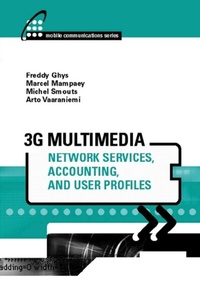
3G Multimedia Network Services, Accounting, and User Profiles
1st Edition
Published on 1. January 2002
342 pages
978-1-58053-645-5 (ISBN)
Description

Here's a cutting-edge book that offers you a comprehensive understanding of 3G multimedia network services and related architectures. This practical resource guides you in developing the services, charges and customer use data that will allow maximum profitability for your company. Covering both mobile and fixed networks, the book thoroughly explains 3G network standards, implementation architectures, charging principles, user profiles, and QoS and security considerations.
More details
Other editions
Additional editions
Freddy Ghys | Marcel Mampaey | Michel Smouts
3G Multimedia Networks Services, Accounting, and User Profiles
Book
09/2003
Artech House Publishers
€104.32
Shipment within 10-20 days
Content
- Intro
- Contents
- Acknowledgments
- Introduction
- 1. Services
- 1.1 World Mobile Standards
- 1.2 Mobile Services
- 1.3 Unifying Fixed and Mobile Services
- 1.4 Multimedia Services
- 1.5 User Profile Management Service
- 1.6 E-commerce, M-commerce, and Micropayments
- 1.7 Entertainment Services
- 1.8 Remote Services
- 1.9 Ambient Intelligence
- 1.10 Communities
- 1.11 Value-added Services Technology Evaluation
- 1.12 Auxiliary Success Factors
- 1.13 Multiplayer Services
- 1.14 Evolving from Previous Technologies
- 1.15 Conclusion
- References
- 2. Service Architecture
- 2.1 Business Model
- 2.2 3G Network Architecture
- 2.3 Service Architecture Challenges
- 2.4 3GPP Standard Triggering Mechanism
- 2.5 The OSA-Parlay Gateway
- 2.6 Additional Thoughts on Business Modeling
- 2.7 NGN Glossary
- 2.8 Conclusion
- References
- 3. Quality of Service in Multimedia Networks
- 3.1 QOS Basics
- 3.2 QOS Implementation in the Network
- 3.3 The UMTS Scenario
- 3.4 A Possible DSL Scenario
- 3.5 QOS-Related Security Considerations
- 3.6 Conclusion
- References
- 4. User Profile Needs and Models
- 4.1 Introduction
- 4.2 Rationale for the UP Concept
- 4.3 Modeling Concepts
- 4.4 User Model
- 4.5 Logical Data Model
- 4.6 Data Description Methods
- 4.7 Ownership of UP Data
- References
- 5. User Profile Architectures and Use
- 5.1 Introduction
- 5.2 Up Access Mechanisms
- 5.3 Use Case
- 5.4 Resilience of UP
- 5.5 Management of UP
- 5.6 Charging
- 5.7 Integration of Different Networks and Their UP
- 5.8 UP Use Case in Services
- 5.9 Conclusion
- References
- 6. The Need for Charging
- 6.1 Consumption-Based vs. Flat Fee
- 6.2 Price Setting
- 6.3 Charging, Accounting, and Division of Revenue
- 6.4 Actors and Money Flows
- 6.5 Mobile Device as Means of Payment
- 6.6 Conclusions
- References
- 7. Charging Methods and Consequences
- 7.1 Resource-Based and Content-Based
- 7.2 Postpaid vs. Prepaid
- 7.3 Charging Influencing Parameters
- 7.4 Charging Components and Correlation
- 7.5 Information to the Customer
- 7.6 Theft of Service
- 7.7 Charged Party
- 7.8 Charging for Network-Integrated Services
- 7.9 Conclusion
- References
- 8. Standardized Charging Models and Protocols
- 8.1 3GPP
- 8.2 IETF
- 8.3 OSA/PARLAY
- 8.4 ETSI-TIPHON
- 8.5 IPDR
- 8.6 Conclusion
- References
- 9. Security
- 9.1 General Threat Analysis
- 9.2 Security Solutions
- 9.3 Deploying Security Solutions
- 9.4 Security Architecture for Multimedia
- 9.5 Signaling Security Issues
- 9.6 Mobile Security Architecture
- 9.7 WLAN Security
- 9.8 Viruses, Trojans, and Worms
- 9.9 Conclusion
- References
- 10. Conclusion
- List of Acronyms and Abbreviantions
- About the Authors
- Index
