

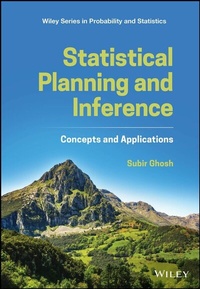
Statistical Planning and Inference
Description

Explore the foundations of, and cutting-edge developments in, statistics
Statistical Planning and Inference: Concepts and Applications delivers a robust introduction to statistical planning and inference, including classical and computer age developments in statistical science. The book examines the challenges faced in statistical planning and inference, exploring the optimum methods identifying limitations and commonly encountered pitfalls.
It addresses linear and non-linear statistical inference and discusses noise-effect reduction, error rates, balanced and unbalanced data, model selection, discrimination and classification, truncated and censored data, and experimental designs.
Each chapter offers readers problems and solutions and illustrative examples to introduce the concepts and methods discussed within.
The book offers:
- Analysis of both classical theory and modern developments in the field of statistical inference and planning
- Expansive discussions of linear and non-linear statistical inference
- Statistical problems and solutions to test the reader's progress through and retention of the material contained within
Aimed at practitioners and researchers in the field of statistics, Statistical Planning and Inference: Concepts and Applications is also a must-read resource for graduate students, professors, and researchers in the life sciences, agriculture, psychology, education and measurement, sociology, computer and engineering sciences, and all other fields that rely on statistical concepts.
More details
Other editions
Additional editions
Person
Subir Ghosh is a Professor of Statistics at the University of California, Riverside, USA. He is known for his research work in Statistical Design and Analysis of Experiments and Modeling. He is an elected fellow of the American Statistical Association, the American Association of the Advancement of Science, and an elected member of the International Statistical Institute. He received the awards at the University of California, Riverside:
2012-2016 Distinguished Teaching Professor and a member of the UCR Academy of Distinguished Teachers.
2003 Graduate Council Dissertation Advisor/Mentoring Award, and 1993 Academic Senate Distinguished Teaching Award.
He also served as the 2000-2003 executive editor of the Journal of Statistical Planning and Inference.
Content
Preface xi
1 Foundation of Experiments 1
1.1 Uncertainties in Evidences 1
1.2 Examples 2
1.2.1 The Louis Pasteur Anthrax Vaccination Experiment 2
1.2.2 The Lanarkshire Milk Experiment: Milk Tests in Lanarkshire Schools 2
1.3 Replication, Randomization, Blocking, and Blinding 4
1.3.1 Replication 4
1.3.2 Randomization 4
1.3.3 Blocking 4
1.3.4 Blinding 4
1.4 Figuring It Out! 4
Questions and Answers 5
Bibliography 6
2 Completely Randomized Design 7
2.1 An Example 7
2.2 Analyses Using R and SAS 9
2.3 Figuring It Out! 12
Bibliography 16
3 Randomized Complete Block Design 17
3.1 Fixed Effects Model 18
3.2 Binomial Model for Signs 20
3.3 Randomization Model 20
3.4 Mixed Effects Model 25
3.5 General Mixed Effects Model 27
3.6 The REML Variance Components Estimates 28
3.7 BLUEs and BLUPs 31
3.7.1 The Conditional Model 32
3.7.2 The Unconditional Model 32
3.7.3 Computation-The Conditional Model 33
3.7.4 Computation-The Unconditional Model 34
3.8 Figuring It Out! 39
Bibliography 40
4 Randomized Incomplete Block Design 41
4.1 Model M1: Fixed-Effects Model 41
4.2 Model M2: Mixed-Effects Model 43
4.3 Research Questions 44
4.4 Figuring It Out! 45
4.5 Definitions 46
Exercises 46
Bibliography 51
5 Error Rates 53
5.1 Definitions of Error Rates 53
5.2 Single-Stage Methods 55
5.3 A Multistage Method 56
5.3.1 Benjamini and Hochberg Method 57
5.4 Figuring It Out 58
Questions 59
Bibliography 62
6 Nutrition Experiment 63
6.1 Figuring It Out! 63
Bibliography 75
7 The Pearson Dependence 77
7.1 Bivariate Normal Distribution 77
7.2 Estimation of Unknown Parameters 79
7.2.1 The Unconditional Model 79
7.2.2 The Conditional Model 81
7.2.3 Test of Significance 83
7.3 A Bayesian Estimation 84
7.4 Exercises 86
Bibliography 87
8 The Multivariate Dependence 89
8.1 The Multivariate Normal Distribution 90
8.2 Inference 91
8.3 Partial Dependence 96
8.4 Exercises 96
Bibliography 98
9 The Conditional Mean Dependence 99
9.1 LS Estimation 100
9.2 Ridge Estimation 101
9.2.1 A Bayesian Estimation 103
9.3 Dependence of Ridge Estimator on the Tuning Parameter 103
9.4 LASSO Estimation 104
9.5 Dependence of LASSO Estimators on the Tuning Parameter 105
Bibliography 116
10 More Parameters Than Observations 119
10.1 Learning by Doing-Exercises 122
Exercises 123
Bibliography 125
11 Eigenvalues, Eigenvectors, and Applications 127
11.1 Eigenvalues and Eigenvectors 127
11.2 Second-Order Response Surface 129
Exercises 132
Bibliography 133
12 Covariance Estimation 135
12.1 Model 1 135
12.1.1 Characterization of the Covariance Matrix and Its Estimators 135
12.1.2 Likelihood Function 136
12.1.3 Properties 137
12.2 Model 2 137
12.2.1 Characterization of the Covariance Matrix and Its Estimators 138
12.3 Model 3 138
12.4 Model 4 139
12.5 Model 5 140
12.6 Exercises 141
Bibliography 142
13 Discriminant Analysis 145
13.1 Learning from the Univariate Data-Two Normal Populations with Equal Variances 145
13.1.1 Discriminant Analysis for the Univariate Data 147
13.1.2 Example-Univariate Discriminant Analysis 148
13.2 Learning from the Univariate Data-Two Normal Populations with Unequal Variances 151
13.2.1 Classification of 25 Versicolor Iris Flowers 153
13.2.2 Classification of 25 Setosa Iris Flowers 154
13.2.3 Test of Homogeneity of Variances 154
13.3 Learning from the Multivariate Data 155
13.3.1 Classification of Versicolor and Setosa 156
13.3.2 Classification of Versicolor and Virginica 158
13.4 Logistic Regression 159
13.5 Exercises 160
Bibliography 162
14 Optimizing the Variance-Bias Trade-Off 163
14.1 Variance-Bias Trade-Off 163
14.1.1 Example 1 164
14.1.2 Example 2 165
14.1.3 Example 3 166
14.2 Information in Data 167
14.3 Information and Design in Presence of a Covariate 169
14.3.1 Information 169
14.3.2 Optimum Design for a Covariate 170
14.4 Information and Design in Presence of Multiple Covariates 171
14.4.1 Information 171
14.4.2 Exponential Model 175
14.4.3 Exponential Regression Model with Multiple Covariates 176
14.4.4 Poisson Log-Linear Model 177
14.4.5 Non-parametric Regression Model 180
14.5 Exercises 183
Bibliography 187
15 Specification, Discrimination, Robustness, and Sensitivity 189
15.1 The Global and Local Optimal Models 189
15.2 The T-Optimal Design 190
15.3 Convex and Concave Functions 192
15.4 The Kullback-Leibler (KL) Divergence 194
15.5 The KL Design Optimality 197
15.6 The Differential Entropy 198
15.7 Lindley Information Measure 200
15.8 Joint Entropy, Conditional Entropy, and Mutual Information 202
15.9 Maximum Entropy Sampling 204
15.10 Search Linear Models and Search Designs 207
15.10.1 Factorial Experiments 209
15.10.2 Search Probability Matrix 210
15.11 Robustness Against Unavailable Data 210
15.12 Influential Sets of Observations 212
15.13 Exercises 213
Bibliography 214
Data Index 217
Subject Index 219
1
Foundation of Experiments
1.1 Uncertainties in Evidences
A research investigation can be exploratory or confirmatory. Exploratory research is generally performed with observational studies or experiments to formulate new hypotheses, tested with a confirmatory investigation [Jaeger and Halliday, 1998]. Confirmatory work by performing experiments involve testing hypotheses generated from an earlier exploratory analysis. The uncertainties in an experiment are controllable in part, but the remaining vast majority remain uncontrollable.
R.A. Fisher wrote in Chapter 1: Introduction, of his book The Design of Experiments [Fisher, 1935]:
"When any scientific conclusions is supposed to be proved on experimental evidence, critics who still refuse to accept the conclusions are accustomed to take one of two lines of attack. They may claim that the interpretation of the experiment is faulty, that the results reported are not in fact those which should have been expected had the conclusion drawn been justified, or that they might equally well have arisen had the conclusion drawn been false. Such criticisms of interpretation are usually treated as falling within the domain of statistics . The other type of criticism to which experimental results are exposed is that the experiment itself was ill designed, or, of course, badly executed. If we suppose that the experimenter what intended to do, both of these points come down to the question of design, or the logical structure of the experiment."
D.R. Cox wrote in Chapter 1: Preliminaries, of his book Planning of Experiments [Cox, 1958]:
"This book is about the planning of experiments in which effects under investigation tend to be masked by fluctuations outside the experimenter's control. Large uncontrolled variations are common in technological experiments and in many types of work in biological sciences, and it is in these fields that the methods to be described are most used."
1.2 Examples
1.2.1 The Louis Pasteur Anthrax Vaccination Experiment
The famous French microbiologist and chemist, Louis Pasteur, performed a dramatic public trial from 5 May to 2 June in 1881, known as "The Anthrax Vaccination Experiment," at the small French village of Pouilly-le-Fort near Melun [Pasteur, 2002/1881]. The goal of his experiment was to demonstrate the efficacy of anthrax vaccination on animals (2002: Translated). Anthrax was a leading cause of the death of a very large number of animals at that time in France and became a major burden on the economy of France.
The 60 animals were divided into two groups:
- Group 1: 24 sheep, 1 goat, and 6 cows, in total 31 animals;
- Group 2: 24 sheep, 1 goat, and 4 cows, in total 29 animals.
On 5 May 1881, all the animals in Group 1 were inoculated with five drops of attenuated anthrax. Attenuation makes anthrax agent harmless or less virulent. On 17 May, all the animals in Group 1 were re-vaccinated by more attenuated anthrax that were more virulent than the anthrax used in the previous vaccination. The Group 1 animals were thus vaccinated on 5 May and 17 May differently, but Group 2 animals were not at all vaccinated up to that point of time. On 31 May, all the animals in both Group 1 and Group 2 were inoculated with the strong virulent anthrax.
On 2 June, 48?hours after the inoculations with the strong virulent anthrax, all the animals in Group 1 were found healthy. Among 29 animals in Group 2, 21 sheep, and 1 goat were found already dead at the time of viewing, 2 sheep died while viewing, and 1 sheep died at the end of the day. In total 25 out of 29 animals in Group 2 were dead on 2 June. All four cows were alive as cows were less prone than sheep and goat to die of anthrax. Louis Pasteur was successful in clearly demonstrating the efficacy of vaccination in his public trial. This was one of the many experiments performed by Louis Pasteur. We are now blessed in having the vaccines available to save all living beings from this deadly disease.
1.2.2 The Lanarkshire Milk Experiment: Milk Tests in Lanarkshire Schools
Pasteurization of milk is the process of heating milk to a very high temperature and cooling it again to kill all pathogenic or disease-causing microbes. Louis Pasteur developed pasteurization in 1864. A very large-scale three-arm nutritional experiment was performed in 1930 for about four months by the Department of Health in Scotland with the investigators Dr Gerald Leighton, Medical Officer (Foods), and Dr Peter L. McKinlay, Medical Officer (Statistics) [Leighton and McKinlay, 1930]. Twenty thousand Lanarkshire (an historic county of Scotland) schoolchildren in seven age groups with ages between 5 to 12 years, and the same number of male and female students in each age group were divided into three experimental groups:
- Group 1: Five thousand children who received a daily ration (three-quarters pint) of Grade A (Tuberculin tested) raw milk;
- Group 2: Five thousand children who received a daily ration (three-quarters pint) of Grade A (Tuberculin tested) pasteurized milk;
- Group 3: Ten thousand children who were control subjects.
The 67 schools were located in the densely populated industrial part of the county with no information on the economic status of the localities chosen. Only one-third of the children had estimated complete or partial unemployment at their homes. Each school provided between 200 and 400 students for the experiment: half of them were assigned to Group 3 and the other half were assigned to one of Groups 1 and 2. Children from a school were assigned to either Groups 1 and 3 or Groups 2 and 3 but not Groups 1, 2, and 3. The weight and height of children were recorded at the beginning and end of the experiment. Complete records were available for only 17?159 children. Children in Groups 1 and 2 were "feeders" and in Group 3 were "controls." The conclusions drawn from the experiment with respect to the rate of growth in weight and height (Student 1931) are the following:
- Children in Groups 1 and 2 demonstrated a definite increase over Children in Group 3;
- No obvious or constant difference found between the genders. Little evidence of definite relation found between the age of the children and the amount of improvement. Younger children showed no higher increase than older children in Groups 1 and 2 not supporting the popular belief that the younger children gain more than the older children;
- Children in Group 1 demonstrated the same with children in Group 2.
R.A. Fisher and S. Bartlett [1931] as well as Student [1931], the pseudonym of W.S. Gosset expressed their concerns about the comparability of students in Group 1 and Group 2 and consequently, about Conclusion 3 drawn on the contrast of the effects of pasteurized vs. raw milk. With 14 groups from 7 age groups and 2 gender groups, Fisher and Bartlett pointed out that pasteurized milk gave a greater increase in height in only 2 groups, the increases were equal in 1 group, and the raw milk gave the greater increase in 11 groups. Student [1931] commented that the same school students were assigned to either Group 1 or Group 2 but not both for administering the experiment conveniently. Student remarked that the teachers presumably assigned more "ill-nourished" students among the "feeders" and too few among the "controls" making the assignment "non-random" and thereby introduced "selection bias" in the experiment. A possible source of "measurement bias" identified by Student was in the difference in winter clothing between "ill-nourished" and "well-fed" students affecting the weight measurements. Student concluded: "I would be very chary of drawing any conclusion from these small biased differences. That is not to say that there is no difference between the effect of raw and pasteurized milk?-?personally I believe that there is and that it is in favour of raw milk?-?but that this experiment, in spite of all the good work which was put into it, just lacked the essential condition of randomness which would have enabled us to prove the fact."
The large-scale Lanarkshire milk experiment was performed to establish the benefit of drinking milk and comparing pasteurized against the raw milk. Two lines of concerns were expressed on Conclusions 1-3: The experiment was not properly "designed" or "planned" and the interpretation of the experiment was "faulty."
1.3 Replication, Randomization, Blocking, and Blinding
1.3.1 Replication
Out of 20?000 schoolchildren in the Lanarkshire milk experiment, 5000 children received raw milk in Group 1, another 5000 children received pasteurized milk in Group 2, and another 10?000 children received no milk in Group 3. The replication in Group 1 is 5000 which is also the replication in Group 2. So the replication in Group 1 and Group 2 together representing children who received milk raw or pasteurized is 10?000 which is also the replication in Group 3 representing children who received no milk. In the Student's proposed milk experiment, the replication of children who...
