

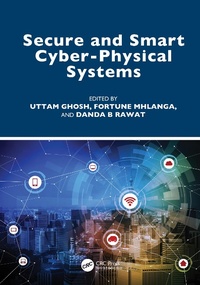
Secure and Smart Cyber-Physical Systems
1st Edition
Published on 26. July 2024
260 pages
978-1-040-01255-0 (ISBN)
Description

Cybersecurity is a paramount concern in both Internet of Things (IoT) and Cyber-Physical Systems (CPSs) due to the interconnected and often critical nature of these systems. The integration of AI/ML into the realm of IoT and CPS security has gained significant attention and momentum in recent years. The success of AI/ML in various domains has sparked interest in leveraging these technologies to enhance the security, resilience, and adaptability of IoT and CPS. Secure and Smart Cyber-Physical Systems provides an extensive exploration of AI/ML-based security applications in the context of IoT and CPS.
Features
Presents cutting-edge topics and research in IoT and CPS
Includes contributions from leading worldwide researchers
Focuses on CPS architectures for secure and smart environments
Explores AI/ML and blockchain approaches for providing security and privacy to CPS including smart grids, smart cities, and smart healthcare
Provides comprehensive guidance into the intricate world of software development for medical devices
Covers a blueprint for the emergence of 6G communications technology in Industry 5.0 and federated-learning-based secure financial services
This book covers state-of-the-art problems, existing solutions, and potential research directions for CPS researchers, scholars, and professionals in both industry and academia.
Features
Presents cutting-edge topics and research in IoT and CPS
Includes contributions from leading worldwide researchers
Focuses on CPS architectures for secure and smart environments
Explores AI/ML and blockchain approaches for providing security and privacy to CPS including smart grids, smart cities, and smart healthcare
Provides comprehensive guidance into the intricate world of software development for medical devices
Covers a blueprint for the emergence of 6G communications technology in Industry 5.0 and federated-learning-based secure financial services
This book covers state-of-the-art problems, existing solutions, and potential research directions for CPS researchers, scholars, and professionals in both industry and academia.
More details
Edition
1. Auflage
Language
English
Place of publication
London
United Kingdom
Publishing group
Taylor & Francis Ltd
Target group
College/higher education
Professional and scholarly
Illustrations
27 Tables, black and white; 73 Line drawings, black and white; 4 Halftones, black and white; 77 Illustrations, black and white
ISBN-13
978-1-040-01255-0 (9781040012550)
Copyright in bibliographic data and cover images is held by Nielsen Book Services Limited or by the publishers or by their respective licensors: all rights reserved.
Schweitzer Classification
Other editions
Additional editions
Uttam Ghosh | Fortune Mhlanga | Danda B. Rawat
Secure and Smart Cyber-Physical Systems
Book
12/2025
1st Edition
CRC Press
€76.30
Shipment within 10-20 days
Uttam Ghosh | Fortune Mhlanga | Danda B. Rawat
Secure and Smart Cyber-Physical Systems
Book
07/2024
1st Edition
CRC Press
€146.30
Shipment within 10-20 days

Uttam Ghosh | Fortune Mhlanga | Danda B. Rawat
Secure and Smart Cyber-Physical Systems
Book
07/2024
CRC Press
Unfortunately, price unknown
Available (delivery time upon request)
Persons
Uttam Ghosh joined Meharry Medical College as an Associate Professor of Cybersecurity in the School of Applied Computational Sciences in January 2022. Earlier, he worked as an Assistant Professor of the Practice in the Department of Computer Science at Vanderbilt University, where he was awarded the 2018 - 2019 Junior Faculty Teaching Fellow (JFTF). Dr. Ghosh obtained his MS and PhD in Electronics and Electrical Communication Engineering from the Indian Institute of Technology (IIT) Kharagpur, India in 2009 and 2013 respectively. He has post-doctoral experiences at the University of Illinois in Urbana-Champaign, Fordham University, and Tennessee State University. He has received research funding from the US National Science Foundation (NSF), US National Security Agency (NSA), National Aeronautics and Space Administration (NASA), and Thurgood Marshall College Fund (TMCF). Dr. Ghosh has published over 120 papers at reputed international journals including IEEE Transactions, Elsevier, Springer, IET, and Wiley, and in top international conferences sponsored by IEEE, ACM, and Springer. He has coedited and published 7 books: Internet of Things and Secure Smart Environments, Machine Intelligence and Data Analytics for Sustainable Future Smart Cities, Intelligent Internet of Things for Healthcare and Industry, Efficient Data Handling for Massive Internet of Medical Things, Deep Learning for Internet of Things Infrastructure, How COVID-19 is Accelerating the Digital Revolution: Challenges and Opportunities, and Security and Risk Analysis for Intelligent Edge Computing. Dr. Ghosh is listed in the Stanford-Elsevier list of the world's most-cited scholars, placing him among the top two percent of cited scientists. He is a senior member of the IEEE and a member of ACM.
Fortune Mhlanga is a proven leader with a strong track record of developing and managing organizations in the academic, private, and public sectors with a specific focus on computing and technology. He joined Meharry Medical College in August 2020 as executive director of the Data Science Institute (DSI). In February 2021 he became the founding dean of the School of Applied Computational Sciences (SACS), the fourth school in Meharry's proud history, after leading the transition of the DSI to the school level. He also serves as founding senior vice president of the Enterprise Data and Analytics (EDA) division whose establishment, in March 2022, posited an advanced technology-driven enterprise data ecosystem that plays a critical role in achieving success in programs and initiatives across the entire Meharry enterprise as it caters for all data storage, harmonization, management, stewardship, and business intelligence in Meharry's clinical, research, academic, and business enterprises. Previously, Mhlanga served as founding dean of the College of Computing and Technology and professor of computer science, data science, and software engineering at Lipscomb University. His tenure at Lipscomb began in August 2011 as director of the then newly-established School of Computing and Informatics. He led the school through a period of growth that resulted in its transformation into the College of Computing and Technology in 2014, offering eleven bachelor's degrees and three master's degrees. Before his appointment at Lipscomb, Mhlanga was a professor of computer science in the School of IT & Computing (SITC) from August 2007 to July 2011. He also served as director of the SITC during his last year at ACU. From 2002-to 2007, he served as associate professor and subsequently professor and founding chair of the computer science department at Faulkner University. Mhlanga was the founding director of the Informatics and Electronics Institute at the Scientific and Industrial Research and Development Centre in Harare, Zimbabwe, from to 1998-2002. He was a senior lecturer in the computer science department at the University of Zimbabwe from 1993 to 1994 and subsequently served as chair of the department until December 1997. Mhlanga has published widely in computing, technology, and computational sciences including modeling and simulation. His experience also includes several domestic and internationally-based academic and research fellowships. In 2017, he received the Carnegie African Diaspora Fellowship through which he provided curriculum co-development and helped train and mentor the research and teaching of graduate students and faculty at Ebonyi State University in Abakaliki, Nigeria. He did similar work in 2010 for the University of Zimbabwe through a fellowship with the International Organization for Migration. In 2000 and 2001, he represented Zimbabwe in a Commonwealth Expert Group on IT which was established at the instance of the Commonwealth High-Level Review Group by Commonwealth Heads of State to examine the constraints preventing the wider adoption of ICT in developing countries and possible ways of overcoming them. Subsequently, he spearheaded Zimbabwe's Knowledge Economy initiative whose overall purpose is to promote and encourage Zimbabwe to invest in its national information infrastructures so that it can participate in knowledge-based development and experience the predicted social and economic benefits. Mhlanga earned his bachelor's degree in computer science from Harding University in 1984, and his master's and Ph.D. degrees in computer science from New Jersey Institute of Technology in 1989 and 1993, respectively. His Ph.D. work focused on database systems and resulted in the conception of a Data Model and Query Algebra for Office Documents.
Danda B. Rawat is the Executive Director, Research Institute for Tactical Autonomy (RITA) - a University Affiliated Research Center (UARC) of the US Department of Defense, Associate Dean for Research & Graduate Studies, a Full Professor in the Department of Electrical Engineering & Computer Science (EECS), Founding Director of the Howard University Data Science & Cybersecurity Center, Founding Director of DoD Center of Excellence in Artificial Intelligence & Machine Learning (CoE-AIML), Director of Cyber-security and Wireless Networking Innovations (CWiNs) Research Lab, Graduate Program Director of Howard CS Graduate Programs and Director of Graduate Cybersecurity Certificate Program at Howard University, Washington, DC, USA. Dr. Rawat is engaged in research and teaching in the areas of cybersecurity, machine learning, big data analytics and wireless networking for emerging networked systems including cyber-physical systems (eHealth, energy, transportation), Internet-of-Things, multi domain operations, smart cities, software defined systems and vehicular networks. He has secured over $110 million as a PI and over $18 million as a Co-PI in research funding from the US National Science Foundation (NSF), US Department of Homeland Security (DHS), US National Security Agency (NSA), US Department of Energy, National Nuclear Security Administration (NNSA), National Institute of Health (NIH), DoD and DoD Research Labs, Industry (Microsoft, Intel, VMware, PayPal, Mastercard, Meta, BAE, Raytheon etc.) and private Foundations. Dr. Rawat is the recipient of NSF CAREER Award in 2016, Department of Homeland Security (DHS) Scientific Leadership Award in 2017, Provost's Distinguished Service Award 2021, Researcher Exemplar Award 2019 and Graduate Faculty Exemplar Award 2019 from Howard University, the US Air Force Research Laboratory (AFRL) Summer Faculty Visiting Fellowship 2017, Outstanding Research Faculty Award (Award for Excellence in Scholarly Activity) at GSU in 2015, the Best Paper Awards (IEEE CCNC, IEEE ICII, IEEE DroneCom and BWCA) and Outstanding PhD Researcher Award in 2009. He has delivered over 50 Keynotes and invited speeches at international conferences and workshops. Dr. Rawat has published over 300 scientific/technical articles and 11 books. He has been serving as an Editor/Guest Editor for over 100 international journals including the Associate Editor of IEEE Transactions on Cognitive Communications and Networking, Associate Editor of IEEE Transactions of Service Computing, Editor of IEEE Internet of Things Journal, Associate Editor of IEEE Transactions of Network Science and Engineering and Technical Editors of IEEE Network. He has been in Organizing Committees for several IEEE flagship conferences such as IEEE INFOCOM, IEEE CNS, IEEE ICC, IEEE GLOBECOM and so on. He served as a technical program committee (TPC) member for several international conferences including IEEE INFOCOM, IEEE GLOBECOM, IEEE CCNC, IEEE GreenCom, IEEE ICC, IEEE WCNC and IEEE VTC conferences. He served as a Vice Chair of the Executive Committee of the IEEE Savannah Section from 2013 to 2017. Dr. Rawat received the Ph.D. degree from Old Dominion University, Norfolk, Virginia. Dr. Rawat is a Senior Member of IEEE and ACM, a member of ASEE and AAAS, and a Fellow of the Institution of Engineering and Technology (IET). He is an ACM Distinguished Speaker (2021- 2023).
Fortune Mhlanga is a proven leader with a strong track record of developing and managing organizations in the academic, private, and public sectors with a specific focus on computing and technology. He joined Meharry Medical College in August 2020 as executive director of the Data Science Institute (DSI). In February 2021 he became the founding dean of the School of Applied Computational Sciences (SACS), the fourth school in Meharry's proud history, after leading the transition of the DSI to the school level. He also serves as founding senior vice president of the Enterprise Data and Analytics (EDA) division whose establishment, in March 2022, posited an advanced technology-driven enterprise data ecosystem that plays a critical role in achieving success in programs and initiatives across the entire Meharry enterprise as it caters for all data storage, harmonization, management, stewardship, and business intelligence in Meharry's clinical, research, academic, and business enterprises. Previously, Mhlanga served as founding dean of the College of Computing and Technology and professor of computer science, data science, and software engineering at Lipscomb University. His tenure at Lipscomb began in August 2011 as director of the then newly-established School of Computing and Informatics. He led the school through a period of growth that resulted in its transformation into the College of Computing and Technology in 2014, offering eleven bachelor's degrees and three master's degrees. Before his appointment at Lipscomb, Mhlanga was a professor of computer science in the School of IT & Computing (SITC) from August 2007 to July 2011. He also served as director of the SITC during his last year at ACU. From 2002-to 2007, he served as associate professor and subsequently professor and founding chair of the computer science department at Faulkner University. Mhlanga was the founding director of the Informatics and Electronics Institute at the Scientific and Industrial Research and Development Centre in Harare, Zimbabwe, from to 1998-2002. He was a senior lecturer in the computer science department at the University of Zimbabwe from 1993 to 1994 and subsequently served as chair of the department until December 1997. Mhlanga has published widely in computing, technology, and computational sciences including modeling and simulation. His experience also includes several domestic and internationally-based academic and research fellowships. In 2017, he received the Carnegie African Diaspora Fellowship through which he provided curriculum co-development and helped train and mentor the research and teaching of graduate students and faculty at Ebonyi State University in Abakaliki, Nigeria. He did similar work in 2010 for the University of Zimbabwe through a fellowship with the International Organization for Migration. In 2000 and 2001, he represented Zimbabwe in a Commonwealth Expert Group on IT which was established at the instance of the Commonwealth High-Level Review Group by Commonwealth Heads of State to examine the constraints preventing the wider adoption of ICT in developing countries and possible ways of overcoming them. Subsequently, he spearheaded Zimbabwe's Knowledge Economy initiative whose overall purpose is to promote and encourage Zimbabwe to invest in its national information infrastructures so that it can participate in knowledge-based development and experience the predicted social and economic benefits. Mhlanga earned his bachelor's degree in computer science from Harding University in 1984, and his master's and Ph.D. degrees in computer science from New Jersey Institute of Technology in 1989 and 1993, respectively. His Ph.D. work focused on database systems and resulted in the conception of a Data Model and Query Algebra for Office Documents.
Danda B. Rawat is the Executive Director, Research Institute for Tactical Autonomy (RITA) - a University Affiliated Research Center (UARC) of the US Department of Defense, Associate Dean for Research & Graduate Studies, a Full Professor in the Department of Electrical Engineering & Computer Science (EECS), Founding Director of the Howard University Data Science & Cybersecurity Center, Founding Director of DoD Center of Excellence in Artificial Intelligence & Machine Learning (CoE-AIML), Director of Cyber-security and Wireless Networking Innovations (CWiNs) Research Lab, Graduate Program Director of Howard CS Graduate Programs and Director of Graduate Cybersecurity Certificate Program at Howard University, Washington, DC, USA. Dr. Rawat is engaged in research and teaching in the areas of cybersecurity, machine learning, big data analytics and wireless networking for emerging networked systems including cyber-physical systems (eHealth, energy, transportation), Internet-of-Things, multi domain operations, smart cities, software defined systems and vehicular networks. He has secured over $110 million as a PI and over $18 million as a Co-PI in research funding from the US National Science Foundation (NSF), US Department of Homeland Security (DHS), US National Security Agency (NSA), US Department of Energy, National Nuclear Security Administration (NNSA), National Institute of Health (NIH), DoD and DoD Research Labs, Industry (Microsoft, Intel, VMware, PayPal, Mastercard, Meta, BAE, Raytheon etc.) and private Foundations. Dr. Rawat is the recipient of NSF CAREER Award in 2016, Department of Homeland Security (DHS) Scientific Leadership Award in 2017, Provost's Distinguished Service Award 2021, Researcher Exemplar Award 2019 and Graduate Faculty Exemplar Award 2019 from Howard University, the US Air Force Research Laboratory (AFRL) Summer Faculty Visiting Fellowship 2017, Outstanding Research Faculty Award (Award for Excellence in Scholarly Activity) at GSU in 2015, the Best Paper Awards (IEEE CCNC, IEEE ICII, IEEE DroneCom and BWCA) and Outstanding PhD Researcher Award in 2009. He has delivered over 50 Keynotes and invited speeches at international conferences and workshops. Dr. Rawat has published over 300 scientific/technical articles and 11 books. He has been serving as an Editor/Guest Editor for over 100 international journals including the Associate Editor of IEEE Transactions on Cognitive Communications and Networking, Associate Editor of IEEE Transactions of Service Computing, Editor of IEEE Internet of Things Journal, Associate Editor of IEEE Transactions of Network Science and Engineering and Technical Editors of IEEE Network. He has been in Organizing Committees for several IEEE flagship conferences such as IEEE INFOCOM, IEEE CNS, IEEE ICC, IEEE GLOBECOM and so on. He served as a technical program committee (TPC) member for several international conferences including IEEE INFOCOM, IEEE GLOBECOM, IEEE CCNC, IEEE GreenCom, IEEE ICC, IEEE WCNC and IEEE VTC conferences. He served as a Vice Chair of the Executive Committee of the IEEE Savannah Section from 2013 to 2017. Dr. Rawat received the Ph.D. degree from Old Dominion University, Norfolk, Virginia. Dr. Rawat is a Senior Member of IEEE and ACM, a member of ASEE and AAAS, and a Fellow of the Institution of Engineering and Technology (IET). He is an ACM Distinguished Speaker (2021- 2023).
Content
Preface. About the Editors. List of Contributors. Acknowledgements. 1: Machine Learning and Deep Learning Approaches in Cyber-Physical Systems. 2: Securing Cyber-Physical Systems using Artificial Intelligence. 3: Towards Fast Reliable Intelligent Industry 5.0 - A Comprehensive Study. 4: Software development for Medical Devices: A Comprehensive Guide. 5: 6G Communication Technology for Industry 5.0: Prospect, Opportunities, Security Issues and Future Directions. 6: Cyber Physical System in AI enabled Smart Healthcare System. 7: Service-Oriented Distributed Architecture for Sustainable Secure Smart City. 8: A Comprehensive Security Risks Analysis of Cliff Edge on Cyber-physical Systems. 9: Securing Financial Services with Federated Learning and Blockchain. 10: A Comprehensive Survey on Blockchain Integrated Smart Grids.
