

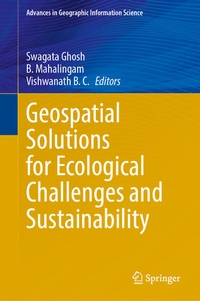
Geospatial Solutions for Ecological Challenges and Sustainability
Description

This contributed volume serves as a comprehensive exploration of how the diverse earth observation data and innovative geospatial tools can unravel the intricate interactions between human society and ecological environment. Human activities are known to have a wide range of impacts on complex ecological systems, and Geospatial Technology can be helpful in evaluating these impacts. To bridge the gap between available information and urgent action needed to achieve the global goals on sustainability by improving the ecological environment, this book brings together leading experts, practitioners, and policymakers to share their insights and experiences for a wide array of pressing ecological concerns. The chapters cover diverse application of geospatial technology in land use land cover change assessment, water resource management, Biodiversity and Wildlife Habitat conservation, Vegetation and Forest Cover monitoring, Coastal and marine pollution control, monitoring climate-related variable leading to climate change etc. - all with the aim of untangling the deep connections between ecology and society through spatial technologies.
More details
Other editions
Additional editions
Content
1. Introduction to Geospatial Technologies in Global Ecological Challenges.- 2. Temperature Extremities Under Current and Future SSP Scenarios for Indian States.- 3. Deciphering Extreme Heavy Rainfall Events in September 2023 over India Using Synoptic Systems, Satellite Observations, and Reanalysis Data.- 4. Evaluation of rainfall-runoff dynamics under landuse and land cover changed conditions in the lower catchment of Palar Basin, Southern India.- 5. Effects of Climate and Land Use/ Land cover Changes on Watershed Hydrology: A Case Study of Yakubu Gowon Dam in Jos, Nigeria.- 6. Geospatial Analysis of Land-Use and Land-Cover Changes in the Sikkim Himalaya, and Insights for Sustainable Future.
