

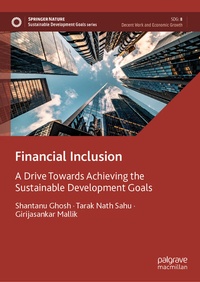
Financial Inclusion
Description

In a world where poverty, hunger, and inequality remain pressing challenges, Financial Inclusion and Sustainable Development reveals how access to finance is more than just banking - it is a catalyst for empowerment, resilience, and growth.
This book explores the transformative role of financial inclusion in eradicating poverty, ensuring food security, advancing gender equality, and fostering decent work and economic growth. Through rigorous analysis, it examines how savings, credit, insurance, and payment mechanisms shape livelihoods, strengthen households, and drive national economies.
Drawing on comparative studies across Indian states, Asian economies, and countries spanning five continents, the book highlights both the shared promise and the striking disparities in financial access worldwide. It sheds light on regulatory frameworks, socio-economic conditions, and infrastructure that determine progress, while underscoring financial inclusion's central place in achieving the Sustainable Development Goals (SDGs).
Rich in evidence and insight, this volume is an indispensable resource for scholars, policymakers, and development practitioners alike. It demonstrates that inclusive finance is not merely an economic tool but a pathway toward dignity, equity, and a sustainable future for all.
More details
Other editions
Additional editions
Persons
Shantanu Ghosh is Assistant Professor and Head in the Department of Commerce at Mugberia Gangadhar Mahavidyalaya, West Bengal, India. His research centers on finance and financial inclusion, with publications in leading journals of Wiley, Springer, and Emerald.
Tarak Nath Sahu is Professor of Commerce and Business Administration at Vidyasagar University, West Bengal, India. A gold medalist and prolific scholar, he has authored or edited twenty books and published over 160 research articles with leading international publishers.
Girijasankar Mallik is Associate Professor at Western Sydney University, Australia. An award-winning teacher and widely published researcher, he has authored over 95 scholarly works, delivered keynote lectures across 34 countries, and supervised more than 15 Ph.D. scholars.
Content
Chapter 1: INTRODUCTION.- Chapter 2: FINANCIAL INCLUSION TRENDS AND PROGRESS.- Chapter 3: SUSTAINABLE DEVELOPMENT ACHIEVEMENTS AND STRATEGIC ROADMAP.- Chapter 4: ASSESSING FINANCIAL INCLUSION FOR INCLUSIVE GROWTH AND DEVELOPMENT.- Chapter 5: COMPARATIVE ANALYSIS OF FINANCIAL INCLUSION ACROSS REGIONS.- Chapter 6: FINANCIAL INCLUSION AND SUSTAINABLE DEVELOPMENT GOALS UNFOLDING THE ASSOCIATION.- Chapter 7: FINANCIAL INCLUSION AND ECONOMIC GROWTH (SDG 8).- Chapter 8: FINANCIAL INCLUSION AND POVERTY ALLEVIATION (SDG 1).- Chapter 9: FINANCIAL INCLUSION AND ZERO HUNGER (SDG 2).- Chapter 10: CONCLUSION AND POLICY RECOMMENDATIONS.
