

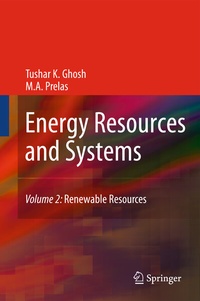
Energy Resources and Systems
Description

This second volume of Energy Resources and Systems is focused on renewable energy resources. Renewable energy mainly comes from wind, solar, hydropower, geothermal, ocean, bioenergy, ethanol and hydrogen. Each of these energy resources is important and growing. For example, high-head hydroelectric energy is a well established energy resource and already contributes about 20% of the world's electricity. Some countries have significant high-head resources and produce the bulk of their electrical power by this method. However, the bulk of the world's high-head hydroelectric resources have not been exploited, particularly by the underdeveloped countries. Low-head hydroelectric is unexploited and has the potential to be a growth area. Wind energy is the fastest growing of the renewable energy resources for the electricity generation. Solar energy is a popular renewable energy resource. Geothermal energy is viable near volcanic areas. Bioenergy and ethanol have grown in recent years primarily due to changes in public policy meant to encourage its usage. Energy policies stimulated the growth of ethanol, for example, with the unintended side effect of rise in food prices. Hydrogen has been pushed as a transportation fuel.
The authors want to provide a comprehensive series of texts on the interlinking of the nature of energy resources, the systems that utilize them, the environmental effects, the socioeconomic impact, the political aspects and governing policies. Volume 1 on Fundamentals and Non Renewable Resources was published in 2009. It blends fundamental concepts with an understanding of the non-renewable resources that dominate today's society. The authors are now working on Volume 3, on nuclear advanced energy resources and nuclear batteries, consists of fusion, space power systems, nuclear energy conversion, nuclear batteries and advanced power, fuel cells and energy storage. Volume 4 will cover environmental effects, remediation and policy.
Solutions to providing long term, stable and economical energy is a complex problem, which links social, economical, technical and environmental issues. It is the goal of the four volume Energy Resources and Systems series to tell the whole story and provide the background required by students of energy to understand the complex nature of the problem and the importance of linking social, economical, technical and environmental issues.
Reviews / Votes
Review of Volume 1:
From the reviews: "This work is the first in a planned three-volume series dealing with energy . . In this first volume, Ghosh and Prelas (both, Univ. of Missouri, Columbia) offer an outstanding consolidation of technical data and knowledge related to conventional energy sources and conversion systems. . This volume is ideally suited for the serious researcher interested in obtaining a thorough overview of conventional energy conversion systems. . Summing Up: Highly recommended. Upper-division undergraduates through professionals." (S. R. Walk, Choice, Vol. 47 (6), February, 2010)
More details
Other editions
Additional editions
Content
11 WIND ENERGY.- 12 SOLAR ENERGY.- 13 HYDROPOWER.- 14 GEOTHERMAL ENERGY.- 15 OCEAN ENERGY.- 16 BIOENERGY.- 17 ETHANOL.- 18 HYDROGEN ENERGY.- APPENDICES.- Appendix XI: Wind Energy.- Appendix XII: Solar Energy.- Appendix XIII: Hydropower.- Appendix XIV: Geothermal Energy.- Appendix XV: Ocean Energy.- Appendix XVI: Bioenergy.- Appendix XVII: Ethanol.- Appendix XVIII: Hydrogen.
