

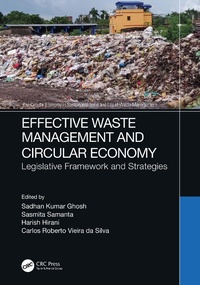
Effective Waste Management and Circular Economy
Legislative Framework and Strategies
1st Edition
Published on 7. September 2022
298 pages
978-1-000-62639-1 (ISBN)
Description

Effective Waste Management and Circular Economy: Legislative Framework and Strategies is an invaluable resource for researchers, policymakers, implementers and PhD, graduate and Under Graduate level students in universities and colleges analysing the legal framework, strategies in waste management, circular economy adoption, use of mathematical and statistical modelling in setting waste management strategies, sanitation and Hygiene in waste management. While huge wastes are wasted by dumping, there is potential of resource circulation by enforcing legislative framework to effective resource utilisation and creating business opportunities. Circularity of resources in waste streams can contribute to a more secure, sustainable, and economically sound future through the followings:
Effective legal framework, strategies and policy instruments,
Adoption of circular economy and recycling technologies,
Support of IoT and appropriate decision making and modelling,
Adoption of alternatives to plastics and other hazardous materials,
Economic feasibility as business case, commercialisation, generating employment.
This book addresses most of the above issues in a lucid manner by experts in the field from different countries, which are helpful for the related stakeholders, edited by experts in the field.
Sadhan Kumar Ghosh, Professor at Jadavpur University, internationally well-known expert working in varied interdisciplinary fields including waste management having research collaboration in 40 countries.
Sasmita Samanta, Pro-Vice Chancellor, KIIT Deemed to be University, Bhubaneswar, Odisha, India having research experience in management & academic administration.
Harish Hirani, Director at CSIR-CMERI, Durgapur, having wider fields of research in IIT Delhi with a number of research collaboration.
Carlos RV Silva Filho, Director, Presidente, ABRELPE, Sao Paulo/SP - Brazil & Presidente, International Solid Waste Association, Netherlands has experience of working in number of international projects
Effective legal framework, strategies and policy instruments,
Adoption of circular economy and recycling technologies,
Support of IoT and appropriate decision making and modelling,
Adoption of alternatives to plastics and other hazardous materials,
Economic feasibility as business case, commercialisation, generating employment.
This book addresses most of the above issues in a lucid manner by experts in the field from different countries, which are helpful for the related stakeholders, edited by experts in the field.
Sadhan Kumar Ghosh, Professor at Jadavpur University, internationally well-known expert working in varied interdisciplinary fields including waste management having research collaboration in 40 countries.
Sasmita Samanta, Pro-Vice Chancellor, KIIT Deemed to be University, Bhubaneswar, Odisha, India having research experience in management & academic administration.
Harish Hirani, Director at CSIR-CMERI, Durgapur, having wider fields of research in IIT Delhi with a number of research collaboration.
Carlos RV Silva Filho, Director, Presidente, ABRELPE, Sao Paulo/SP - Brazil & Presidente, International Solid Waste Association, Netherlands has experience of working in number of international projects
More details
Series
Edition
1. Auflage
Language
English
Place of publication
London
United Kingdom
Publishing group
Taylor & Francis Ltd
Target group
College/higher education
Professional and scholarly
Product notice
Reflowable
Illustrations
81 Tables, black and white; 14 Line drawings, color; 47 Line drawings, black and white; 16 Halftones, color; 12 Halftones, black and white; 30 Illustrations, color; 59 Illustrations, black and white
ISBN-13
978-1-000-62639-1 (9781000626391)
Copyright in bibliographic data and cover images is held by Nielsen Book Services Limited or by the publishers or by their respective licensors: all rights reserved.
Schweitzer Classification
Other editions
Additional editions
Sadhan Kumar Ghosh | Sasmita Samanta | Harish Hirani
Effective Waste Management and Circular Economy
Legislative Framework and Strategies
Book
09/2022
1st Edition
CRC Press
€186.70
Shipment within 10-20 days
Persons
Dr. Sadhan Kumar Ghosh, Professor in Mechanical Engineering since 1998 & Chief Coordinator, Centre for Sustainable Development and Resource Efficiency Management at Jadavpur University, India. He also served as the Dean, Faculty of Engineering and Technology & Head, mechanical engineering. He was the Director, CBWE, Ministry of Labour and Employment, Govt. of India and Larsen & Toubro Ltd. He is a renowned personality in the field on Waste Management, Circular Economy, Green Manufacturing, Supply Chain Management, Sustainable Development, Co-processing of Hazardous & MSW in cement kiln, Plastics Waste & E-waste management & recycling, management system standards (ISO) and TQM having three patents approved. Prof Ghosh is the founder Chairman of the IconSWM; President, International Society of Waste Management, Air and Water (ISWMAW) and the chairman, Consortium of Researchers in International Collaboration (CRIC). He received several awards in India and abroad including the distinguished visiting fellowship by the Royal Academy of Engineering, UK to work on 'Energy Recovery from MSW'. He wrote 9 books, 40 edited volumes, more than 230 national and international articles & book chapters. He is the Associate Editor of Waste Management, Journal, Elsevier and International Journal of Materials Cycle and Waste Management (IJMCWM) and Editor-in-Chief of IconSWM-ISWMAW Secretariat. His significant contribution has been able to place the name of Jadavpur University in the world map of research on waste management. He is consultant & international expert of UNCRD)/DESA, Asian Productivity Organization (APO), Japan, China Productivity Council (CPC), SACEP Sri Lanka, IGES Japan etc. His international research funding includes, European Union Horizon 2020, Erasmus plus, UKIERI, Royal Society-DST, GCRF UK, Royal Academy of Engineering, Georgia Govt. etc. He is the leader of the Collaborative International Research Project on "Global Status of Implementation of Circular Economy (2018-2022)" by ISWMAW involving experts from 44 countries. He was the convener of ISO TC 61 WG2, member in the Indian mirror committee of ISO TC 207 & ISO TC 275. He is expert committee member of government initiatives & was the State Level Advisory Committee Member of Plastics Waste (Management & Handling) Rules 2011, expert committee member for the Preparation of standards for RDF for utilisation set up by the Ministry of Housing and Urban Affairs (MoHUA), govt of India, Chair Elect of 11th IconSWM 2021 to be held in Dec 2021. He is available at: sadhankghosh9@gmail.com & www.sadhankghosh.com.
Prof. Dr. Sasmita Rani Samanta, an insightful academician loaded with high degree of incisiveness and passion for research and schooling which is intermingling with innovative pragmatically approach is the Pro Vice Chancellor, and former Reader and Professor, KIIT Deemed to be university, Odisha, India. Her theoretical knowhow has been mellowing day by day out of shouldering the assigned task for last one and half decades in different capacity of the academic institution. She implements waste management policy of her own institution and implemented energy recovery process from kitchen wastes and garden wastes. Her leadership roles in KIIT ranges from admission process, human resource management, talent acquisition, general administration, to institute governance and competency management and has taken several steps for execution of innovative academic practices in teaching learning methodology, evaluation and connecting the students and faculty to the academia, engaging and retaining people, bringing transparency in system leading to high motivation, ownership and commitment among the employees, increasing their productivity for triumph of organizational goals. Prof. Samanta is a fellow member of Indian Social Science Congress and Royal Society of Arts, UK. She has a number of publications in national and international journals. She was the Co-chairman of the 10th IconSWM-CE (International Conference on Sustainable Waste Management towards Circular Economy) in Nov 2019.
Prof. (Dr.) Harish Hirani, Director, CSIR-CMERI and Professor, Department of Mechanical Engineering, Indian Institute of Technology Delhi is a prominent figure in the fields of Waste Management (MSW, Bio-medical waste, wastewater treatment), Inclusive Innovation, Rural Development & Tribology. Under his leadership CSIR-CMERI has grown as a laboratory for waste management & engineering. He is recoganized for Outstanding Vision, Leadership & Contribution in the Field of Engineering Innovation and R&D Management by The Institute of Engineers (India) in 2019. He was Vice-Chairman of JEE Advanced, 2014-16, Editor of Indian Journal of Tribology (IJT) and Vice-Chairman of Delhi Chapter of Tribology Society of India (TSI). He was awarded BOYSCAST fellowship in 2004 by the DST, Govt. of India to pursue research with Prof. Nam P. Suh at Massachusetts Institute of Technology, USA. Before joining IIT Delhi he served IIT Bombay. He has a number of IPR to his credit. He is the author of the book entitled 'Fundamentals of Engineering Tribology with Applications'. He has guided several Ph.D. and M. Tech. theses and published nearly 70 research papers in peer reviewed journal. Through his innovative thinking he could transform waste to Wealth and could setup a green colony at CSIR-CMERI colony Durgapur with absolutely zero waste. He started effective integrated (mechanized segregation of waste, biomethanation, sludge to briquette, pyrolysis, plasma gasification, ashes to bricks) waste management systems, where each system is designed to complement the others. Using such system of decentralized waste management, he could prove to eliminate Landfills and minimize societal and ecological distress.
Mr. Carlos Roberto Vieira da Silva Filho, Attorney at Law from Sao Bernardo do Campo School of Law, holds a PG title in Administrative and Economic Regulation Law from Mackenzie University. He is fluent in Portuguese, English and Spanish languages. He is the President and CEO of ABRELPE since 2013 and President of ISWA since 2020. He is a non-state partner at the Climate and Clean Air Coalition-CCAC since 2018 with active participation in the development and implementation processes of some Brazilian Federal Laws applied to waste management, such as Law n. 11.079/2004 (Public-Private Partnership); Law n. 11.445/2007 (National Basic Sanitation Law) and Law n. 12.305/2010 (National Solid Waste Law). Carlos is the coordinator of the Panorama of Solid Waste in Brazil, annual reference document about the waste industry in the country and the Principal Director of international projects developed to assist Brazilian municipalities such as Sao Paulo, Santos, Rio de Janeiro and Curitiba. He is member of the Steering Committee for the Global Waste Management Outlook and for the Latin America and Caribbean Regional Waste Outlook, developed by UN Environment in 2015 and 2018 and member of the Technical Research Team for the project "Analysis of Technologies directed to Solid Waste and Treatment and Destination in Brazil, Europe, USA and Japan", hosted by BNDES, and concluded in 2014. He is the Principal coordinator of the project to develop a Manual focusing on Best Practices for Solid Waste Planning and Financing, developed by ISWA. Carlos is the Consultant on PPPs and Waste Financing projects throughout Brazilian municipalities having active participation in drawing, developing and reviewing Solid Waste Master Plans, such as the National Solid Waste Plan in 2011-2012 and its review since 2019. He is the coauthor of books related to Waste Management: Gestao de Residuos Solidos: o que diz a lei" ("Solid Waste Management: what the Law says") "Municipal Waste Management Systems"; "Reverse Logistics and E-Waste"; "New Perspectives for Waste Management in Brazil"; "Legal framework for an adequate management of used pesticide packaging" and author of articles, researches and studies focused on the solid waste industry.
Prof. Dr. Sasmita Rani Samanta, an insightful academician loaded with high degree of incisiveness and passion for research and schooling which is intermingling with innovative pragmatically approach is the Pro Vice Chancellor, and former Reader and Professor, KIIT Deemed to be university, Odisha, India. Her theoretical knowhow has been mellowing day by day out of shouldering the assigned task for last one and half decades in different capacity of the academic institution. She implements waste management policy of her own institution and implemented energy recovery process from kitchen wastes and garden wastes. Her leadership roles in KIIT ranges from admission process, human resource management, talent acquisition, general administration, to institute governance and competency management and has taken several steps for execution of innovative academic practices in teaching learning methodology, evaluation and connecting the students and faculty to the academia, engaging and retaining people, bringing transparency in system leading to high motivation, ownership and commitment among the employees, increasing their productivity for triumph of organizational goals. Prof. Samanta is a fellow member of Indian Social Science Congress and Royal Society of Arts, UK. She has a number of publications in national and international journals. She was the Co-chairman of the 10th IconSWM-CE (International Conference on Sustainable Waste Management towards Circular Economy) in Nov 2019.
Prof. (Dr.) Harish Hirani, Director, CSIR-CMERI and Professor, Department of Mechanical Engineering, Indian Institute of Technology Delhi is a prominent figure in the fields of Waste Management (MSW, Bio-medical waste, wastewater treatment), Inclusive Innovation, Rural Development & Tribology. Under his leadership CSIR-CMERI has grown as a laboratory for waste management & engineering. He is recoganized for Outstanding Vision, Leadership & Contribution in the Field of Engineering Innovation and R&D Management by The Institute of Engineers (India) in 2019. He was Vice-Chairman of JEE Advanced, 2014-16, Editor of Indian Journal of Tribology (IJT) and Vice-Chairman of Delhi Chapter of Tribology Society of India (TSI). He was awarded BOYSCAST fellowship in 2004 by the DST, Govt. of India to pursue research with Prof. Nam P. Suh at Massachusetts Institute of Technology, USA. Before joining IIT Delhi he served IIT Bombay. He has a number of IPR to his credit. He is the author of the book entitled 'Fundamentals of Engineering Tribology with Applications'. He has guided several Ph.D. and M. Tech. theses and published nearly 70 research papers in peer reviewed journal. Through his innovative thinking he could transform waste to Wealth and could setup a green colony at CSIR-CMERI colony Durgapur with absolutely zero waste. He started effective integrated (mechanized segregation of waste, biomethanation, sludge to briquette, pyrolysis, plasma gasification, ashes to bricks) waste management systems, where each system is designed to complement the others. Using such system of decentralized waste management, he could prove to eliminate Landfills and minimize societal and ecological distress.
Mr. Carlos Roberto Vieira da Silva Filho, Attorney at Law from Sao Bernardo do Campo School of Law, holds a PG title in Administrative and Economic Regulation Law from Mackenzie University. He is fluent in Portuguese, English and Spanish languages. He is the President and CEO of ABRELPE since 2013 and President of ISWA since 2020. He is a non-state partner at the Climate and Clean Air Coalition-CCAC since 2018 with active participation in the development and implementation processes of some Brazilian Federal Laws applied to waste management, such as Law n. 11.079/2004 (Public-Private Partnership); Law n. 11.445/2007 (National Basic Sanitation Law) and Law n. 12.305/2010 (National Solid Waste Law). Carlos is the coordinator of the Panorama of Solid Waste in Brazil, annual reference document about the waste industry in the country and the Principal Director of international projects developed to assist Brazilian municipalities such as Sao Paulo, Santos, Rio de Janeiro and Curitiba. He is member of the Steering Committee for the Global Waste Management Outlook and for the Latin America and Caribbean Regional Waste Outlook, developed by UN Environment in 2015 and 2018 and member of the Technical Research Team for the project "Analysis of Technologies directed to Solid Waste and Treatment and Destination in Brazil, Europe, USA and Japan", hosted by BNDES, and concluded in 2014. He is the Principal coordinator of the project to develop a Manual focusing on Best Practices for Solid Waste Planning and Financing, developed by ISWA. Carlos is the Consultant on PPPs and Waste Financing projects throughout Brazilian municipalities having active participation in drawing, developing and reviewing Solid Waste Master Plans, such as the National Solid Waste Plan in 2011-2012 and its review since 2019. He is the coauthor of books related to Waste Management: Gestao de Residuos Solidos: o que diz a lei" ("Solid Waste Management: what the Law says") "Municipal Waste Management Systems"; "Reverse Logistics and E-Waste"; "New Perspectives for Waste Management in Brazil"; "Legal framework for an adequate management of used pesticide packaging" and author of articles, researches and studies focused on the solid waste industry.
Content
Section I : Legal Framework, Strategies in Waste Management & Circular Economy.
1. Pollution-specific appraisal of surface water quality with limited resource approach: A meso-scaled study of the Durgapur Industrial region, West Bengal, India. 2. Emissions from the incineration of municipal solid waste: Effects of legal and technological progress. 3. Legislative support to curb marine littering through wastes coprocessing by promoting Circular Economy. 4. Waste segregation at the source in Germany - A key component of sustainable waste management systems. 5. A study on the legal and administrative support for proper management of world-famous Shri Jagannath Temple at Puri. 6. Gate to gate life cycle assessment of hydrothermal carbonization process for food and yard waste. 7. Waste Monitoring and Management: Strategies, Innovations and Safety Considerations. 8. Waste management strategy of SME sector towards Environmental Sustainability. 9. Trajectory Planning for Autonomous Vehicles and its implementation in effective Waste Management
Section II : Circular Economy adoption in Waste Management
10. Sustainable waste management towards circular economy in Nigerian context: challenges, prospects and way forward. 11. Indonesia main (city level) waste bank for waste management towards circular economy: a case study of Bandung City. 12. Sustainable Methodology for Mechanized Segregation of Legacy Waste and Reclamation of Landfill Area
Section III: Use of Mathematical and Statistical Modelling in setting waste management strategies
13. ANN modelling on the adsorptive removal of phenol using biological and industrial waste materials. 14. Achieving consistency of judgment matrix in Analytical Hierarchy Process. 15. Approach for indexing site selection criteria and its suitability for treatment storage and disposal facility. 16. Using a composite index to form an urban score card for basic infrastructure services. 17. Comparison of linear and nonlinear regression methods for equilibrium modelling of ammonia adsorption by error analysis criteria using cost effective waste camellia sinensis. 18. A Decision Support System for Environment Friendly Sustainable Model of IT Service Sector Industries
Section IV : Case Studies on WM, Sanitation and Hygiene
19. Synergistic Interaction among Supplementary Cementitious Materials (SCMs) for Sustainable Solid Waste Management. 20. Challenges to ensure healthy living through sanitation and hygiene coverage: study on Narail District, Bangladesh. 21. Alternatives of Plastics used in in Food Packaging. 22. Meta-Analysis of Studies on Solid Waste Management in the Philippines. 23. Urban flood induced solid waste management in some metropolitan cities - an overview. 24. Study of some polymeric coagulants using spent tea leaves as a source of natural dye supporting circular economy concepts.
1. Pollution-specific appraisal of surface water quality with limited resource approach: A meso-scaled study of the Durgapur Industrial region, West Bengal, India. 2. Emissions from the incineration of municipal solid waste: Effects of legal and technological progress. 3. Legislative support to curb marine littering through wastes coprocessing by promoting Circular Economy. 4. Waste segregation at the source in Germany - A key component of sustainable waste management systems. 5. A study on the legal and administrative support for proper management of world-famous Shri Jagannath Temple at Puri. 6. Gate to gate life cycle assessment of hydrothermal carbonization process for food and yard waste. 7. Waste Monitoring and Management: Strategies, Innovations and Safety Considerations. 8. Waste management strategy of SME sector towards Environmental Sustainability. 9. Trajectory Planning for Autonomous Vehicles and its implementation in effective Waste Management
Section II : Circular Economy adoption in Waste Management
10. Sustainable waste management towards circular economy in Nigerian context: challenges, prospects and way forward. 11. Indonesia main (city level) waste bank for waste management towards circular economy: a case study of Bandung City. 12. Sustainable Methodology for Mechanized Segregation of Legacy Waste and Reclamation of Landfill Area
Section III: Use of Mathematical and Statistical Modelling in setting waste management strategies
13. ANN modelling on the adsorptive removal of phenol using biological and industrial waste materials. 14. Achieving consistency of judgment matrix in Analytical Hierarchy Process. 15. Approach for indexing site selection criteria and its suitability for treatment storage and disposal facility. 16. Using a composite index to form an urban score card for basic infrastructure services. 17. Comparison of linear and nonlinear regression methods for equilibrium modelling of ammonia adsorption by error analysis criteria using cost effective waste camellia sinensis. 18. A Decision Support System for Environment Friendly Sustainable Model of IT Service Sector Industries
Section IV : Case Studies on WM, Sanitation and Hygiene
19. Synergistic Interaction among Supplementary Cementitious Materials (SCMs) for Sustainable Solid Waste Management. 20. Challenges to ensure healthy living through sanitation and hygiene coverage: study on Narail District, Bangladesh. 21. Alternatives of Plastics used in in Food Packaging. 22. Meta-Analysis of Studies on Solid Waste Management in the Philippines. 23. Urban flood induced solid waste management in some metropolitan cities - an overview. 24. Study of some polymeric coagulants using spent tea leaves as a source of natural dye supporting circular economy concepts.
