

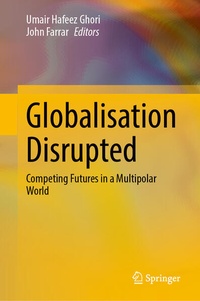
Globalisation Disrupted
Description

This book explores the complexities of globalization, examining its evolving role in a world characterized by increasing interdependence and tension. Globalization has enabled the free flow of people, capital, information, and trade, driving economic prosperity. However, its legitimacy is increasingly questioned, particularly as institutions that underpin the global economy continue to reflect post-World War II structures, favoring Western hegemonic actors while limiting the influence of developing nations. The rise of China and organizations like BRICS has amplified calls for more equitable representation and a rethinking of global economic governance.
The book presents a series of essays, offering diverse perspectives on key issues shaping the future of globalization. Unlike earlier works, this book emphasizes the broadening conception of geopolitical conflict, which now extends beyond the military sphere to include economic legitimacy. The contributions focus on the economic security implications of global developments, touching on themes such as nationalism, technological decoupling, and the shifting balance of power between the West and emerging economies.
Central to the book is the fragmentation of globalization, with discussions on the challenges posed by rising nationalism, protectionism, and the impact of major geopolitical shifts such as Brexit, China's Belt and Road Initiative, and the US-China rivalry. It also delves into the role of emerging economies in reshaping global trade dynamics, the challenges facing global institutions like the WTO, and the implications of technological advancements for global governance. Overall, this book offers a timely and critical analysis of globalization, exploring its stressors and future direction.
More details
Other editions
Additional editions
Persons
Dr. Umair Hafeez Ghori is Associate Professor at Bond University's Faculty of Law. He holds a Ph.D. and an LLM in corporate and commercial laws from the University of New South Wales and an LLB (Hons.) from the University of London. He teaches a variety of subjects including International Investment and Trade Law, International Trade and Business Law, and Public International Law. Dr. Ghori's research focuses on international trade law, export controls, and globalization. He has authored two monographs: "Export Restrictions and Export Controls: From WTO to the Realm of Global Security" (2023) and "Global Textiles and Clothing Trade - Trade Policy Perspectives" (2012). His recent edited volume, "Globalisation in Transition: Human and Economic Perspectives" (2023), reflects his deep engagement with the complexities of globalization. Dr. Ghori has background in commercial and corporate law practice.
Professor John Hynes Farrar is Distinguished Academic and Legal Professional with extensive experience in corporate governance and law. He is Professor of law emeritus at Bond University and Honorary Professor of law, University of Auckland, and University of Waikato. Professor Farrar graduated with an LLB (Hons) from University College, London, followed by an LLM and a LLD from the same institution. He further holds a Ph.D. from the University of Bristol. He has been admitted as Solicitor and Barrister in England, New Zealand, and Australia. Throughout his career, Professor Farrar has held numerous prestigious academic positions, including Professor of law at the University of Canterbury, University College Cardiff, and Victoria University of Wellington. He has also served as Dean of the School of Law at the University of Canterbury, Bond University, and the University of Waikato.
Content
Introduction globalisation disrupted.- Globalisation brexit and the future of the united kingdom.- Globalisation and sovereignty the eus governance dilemma.- Financial stability and the threat of world disorder.- Building a block brick by brics.- Globalisation in a destabilising world how australia will need to adapt in terms of institutional weakness.- The future of the world trade organisation.- China and the strategic evolution of the belt and road initiative.- The geo economic fulcrum us china decoupling and the use of export controls on semiconductors and rare earths.- The clash of economic models and the remaking of world economics china and india.- Global health as the canary in the globalisation coal mine.- conclusion globalisation disrupted or re made.
