

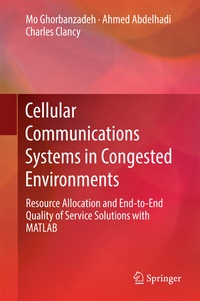
Cellular Communications Systems in Congested Environments
Description

This book presents a mathematical treatment of the radio resource allocation of modern cellular communications systems in contested environments. It focuses on fulfilling the quality of service requirements of the living applications on the user devices, which leverage the cellular system, and with attention to elevating the users' quality of experience. The authors also address the congestion of the spectrum by allowing sharing with the band incumbents while providing with a quality-of-service-minded resource allocation in the network. The content is of particular interest to telecommunications scheduler experts in industry, communications applications academia, and graduate students whose paramount research deals with resource allocation and quality of service.
More details
Other editions
Additional editions
Persons
Dr. Mo Ghorbanzadeh is a Senior Engineer at Federated Wireless, a startup company in Arlington, VA. He works on building a spectrum sharing device for the 3.5 GHz band. His research interests are communications theory, radio propagation, and machine learning.
Dr. Ahmed Abdelhadi is a Research Assistant Professor in the Hume Center for National Security and Technology at Virginia Tech. He leads research programs in the development of advanced communication systems for cellular networks.
Dr. Charles Clancy is an Associate Professor, Bradley Department of Electrical and Computer Engineering, and Virginia Tech. He is also Director, Hume Center for National Security and Technology; Co-Director, NSF Security and Software Engineering Research Center; and L-3 Communications Faculty Fellow in Cybersecurity, College of Engineering.
Content
Quality of Service in Communication Systems.- Utility Functions and Radio Resource Allocation.- Centralized Resource Allocation.- Distributed Resource Allocation.- Resource Allocation Architectures Traffic and Sensitivity Analysis.- Radio Resource Block Allocation.- Spectrum-Shared Resource Allocation.- Delay-Based Backhaul Modeling.- Book Summary.
