

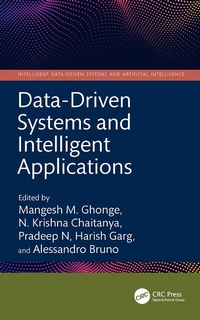
Data-Driven Systems and Intelligent Applications
1st Edition
Published on 9. October 2024
196 pages
978-1-040-12615-8 (ISBN)
Description

This book comprehensively discusses basic data-driven intelligent systems, the methods for processing the data, and cloud computing with artificial intelligence. It presents fundamental and advanced techniques used for handling large user data, and for the data stored in the cloud. It further covers data-driven decision-making for smart logistics and manufacturing systems, network security, and privacy issues in cloud computing.
This book:
Discusses intelligent systems and cloud computing with the help of artificial intelligence and machine learning.
Showcases the importance of machine learning and deep learning in data-driven and cloud-based applications to improve their capabilities and intelligence.
Presents the latest developments in data-driven and cloud applications with respect to their design and architecture.
Covers artificial intelligence methods along with their experimental result analysis through data processing tools.
Presents the advent of machine learning, deep learning, and reinforcement technique for cloud computing to provide cost-effective and efficient services.
The text will be useful for senior undergraduate, graduate students, and academic researchers in diverse fields including electrical engineering, electronics and communications engineering, computer engineering, manufacturing engineering, and production engineering.
This book:
Discusses intelligent systems and cloud computing with the help of artificial intelligence and machine learning.
Showcases the importance of machine learning and deep learning in data-driven and cloud-based applications to improve their capabilities and intelligence.
Presents the latest developments in data-driven and cloud applications with respect to their design and architecture.
Covers artificial intelligence methods along with their experimental result analysis through data processing tools.
Presents the advent of machine learning, deep learning, and reinforcement technique for cloud computing to provide cost-effective and efficient services.
The text will be useful for senior undergraduate, graduate students, and academic researchers in diverse fields including electrical engineering, electronics and communications engineering, computer engineering, manufacturing engineering, and production engineering.
More details
Series
Edition
1. Auflage
Language
English
Place of publication
London
United Kingdom
Publishing group
Taylor & Francis Ltd
Target group
College/higher education
Illustrations
3 Tables, black and white; 21 Line drawings, black and white; 18 Halftones, black and white; 39 Illustrations, black and white
ISBN-13
978-1-040-12615-8 (9781040126158)
Copyright in bibliographic data and cover images is held by Nielsen Book Services Limited or by the publishers or by their respective licensors: all rights reserved.
Schweitzer Classification
Other editions
Additional editions
Mangesh M. Ghonge | N. Krishna Chaitanya | Pradeep N
Data-Driven Systems and Intelligent Applications
Book
approx. 07/2026
1st Edition
CRC Press
€66.00
Not yet published
Mangesh M. Ghonge | N. Krishna Chaitanya | Pradeep N
Data-Driven Systems and Intelligent Applications
Book
10/2024
1st Edition
CRC Press
€121.00
Shipment within 10-20 days

Mangesh M. Ghonge | N. Krishna Chaitanya | Pradeep N
Data-Driven Systems and Intelligent Applications
Book
10/2024
CRC Press
Unfortunately, price unknown
Available (delivery time upon request)
Persons
Mangesh M. Ghonge is currently working as an Associate Professor at Sandip Institute of Technology and Research Center, Nashik, Maharashtra, India. He received his Ph.D. in Computer Science & Engineering from Sant Gadge Baba Amravati University, Amravati, India. He authored/co-authored more than 70 published articles in prestigious journals, book chapters, and conference papers. Besides, Dr. Mangesh Ghonge authored/edited 12 international books published by recognized publishers. He has been invited as a resource person for many workshops/FDP. He has organized and chaired many national/international conferences and conducted various workshops. He is editor-in-chief of International Journal of Research in Advent Technology (IJRAT), E-ISSN 2321-9637. He is also guest editor for SCIE/Scopus indexed journal special issues. His two-patent published and five copyright granted. Dr. Mangesh Ghonge has 12+ years of teaching experience and guided more than 40+ UG projects and 10 PG scholars. His research interest includes security in wireless networks, artificial intelligence, and blockchain technology. He taught subjects like Data Analytics, Machine Learning, Network Security, Software Modeling and Design, Database Management Systems etc. He is a senior member of IEEE and member of CSI, IACSIT, IAENG, IETE, and CSTA.
N. Krishna Chaitanya, currently working as a Professor in ECE at RSR Engineering College, Kavali and he has 20 years of teaching experience. He received his Ph.D degree from JNT University Kakinada, India. He has published more than 65 articles in reputed International Journals, book chapters and international conferences. He authored 4 text books and 2 patent grants. He is a reviewer, Associate Editor and editor for Scopus Journals and SCI journals like Springer, Elsevier, IGI Global, and Wiley. He attended more than 25 workshops/training programs. He is a member in various technical forums like ISTE, IAENG, SCIEI, IACSIT and SDIWC. He guided more than 30 PG and 60 UG projects. His research areas include Computer Networks, Internet of Things, Wireless Communication, Network security and Image Processing. He taught subjects like Software Engineering, Data Security, Computer networks, Wireless communications, Electronic devices and circuits, Electronic circuit analysis etc.
Pradeep N is working as Professor in Computer Science and Engineering, Bapuji Institute of Engineering and Technology, Davangere, Karnataka, India affiliated Visvesvaraya Technological University, Belagavi, Karnataka, India. He is having 18 years of academic experience, which includes teaching and research experience. He has worked at various verticals starting from Lecturer to Associate Professor. He has been appointed as Senior Member, Iranian Neuroscience Society-FARS Chapter (SM-FINSS) for a duration of TWO years (March 1st 2021 to March 2nd 2023). He has honoured with Hon. D.Eng (Honorary Doctrine Engineering) (Honoris Causa), Iranian Neuroscience Society FARS chapter and Dana Brain Health Institute, Shiraz, Iran in 2021. He has completed Short Term Post-PhD Pilot Research Project 2021 at THU DAO MOT university, Vietnam. His research areas of interest include Machine Learning, Pattern Recognition, Medical Image Analysis, Knowledge Discovery Techniques, and Data Analytics. He is presently guiding TWO research scholars on Knowledge Discovery and Medical Image Analysis. He has successfully edited books published by reputed international publishers. He has published more than 20 research articles published in refereed journals and also authored SIX book chapters. He is a reviewer of various International Conferences and few journals which includes Multimedia Tools and Applications, Springer. His one Indian Patent application is published and one Australian Patent is granted and also, he is successful in getting SIX copyright grants for his novel work. He taught subjects like artificial intelligence, Software Engineering, Cloud Computing, Storage Area Networks, Pattern Recognition etc. He is a Professional member in IEEE, ACM, ISTE and IEI. Also, he is a Technical Committee Member for Davangere Smart City, Davangere.
Harish Garg is working as an Associate Professor at Thapar Institute of Engineering & Technology, Deemed University, Patiala, Punjab, India. His research interests include Computational Intelligence, Reliability analysis, Multi-criteria decision making, Evolutionary algorithms, Expert systems and decision support systems, Computing with words and Soft Computing. He has authored more than 358 papers (over 307 are SCI) published in refereed International Journals including Information Sciences, IEEE Transactions on Fuzzy Systems, Applied Intelligence, Expert Systems with Applications, Applied Soft Computing, IEEE Access, International Journal of Intelligent Systems, Computers and Industrial Engineering, Cognitive Computations, Soft Computing, Artificial Intelligence Review, IEEE/CAA Journal of Automatic Sinica, IEEE Transactions on Emerging Topics in Computational Intelligence, Computers & Operations Research, Measurement, Journal of Intelligent & Fuzzy Systems, International Journal of Uncertainty Fuzziness and Knowledge-Based Systems, and many more. He has also authored seven book chapters. His Google citations are over 14330+. He is the recipient of the Top-Cited Paper by India-based Author (2015 - 2019) from Elsevier Publisher. Dr. Garg is the Editor-in-Chief of Journal of Computational and Cognitive Engineering; Annals of Optimization Theory and Practice. He is also the Associate Editors for Soft Computing, Alexandria Engineering Journal, Journal of Intelligent & Fuzzy Systems, Kybernetes, Complex and Intelligent Systems, Journal of Industrial & Management Optimization,Technological and Economic Development of Economy, International Journal of Computational Intelligence Systems, CAAI Transactions on Intelligence Technology, Mathematical Problems in Engineering, Complexity, etc.
Alessandro Bruno is a Lecturer in Computing at Bournemouth University's Department of Computing and Informatics. HE received his Master Degree in Computer Engineering in 2008 with a thesis on Biomedical Imaging. On March 1st of 2009, He started his PhD scholarship in Computer Engineering at DINFO (Computer Engineering Department) at Palermo University. In April 2012, he defended his PhD thesis, which was focused on the analysis of Local Keypoints and Texture for advanced image investigations. From July 2012 up to July 2014, he won a position as a postdoctoral research fellow at Palermo University, focusing on Image Forensics, Object Recognition and Visual Perception. From January 2015 until June 2015, He worked as a Software Engineer at the IZS (Istituto Zooprofilattico Sperimentale della Sicilia) over a project that involved optimising oil and flour tracking from the producer down to the consumer using software engineering techniques. From January 2016 until January 2017, he worked at Palermo University as a postdoctoral research fellow. Alessandro Bruno's main research interests focus on Computer Vision, Artificial Intelligence and Image Analysis. He has mostly dealt with Visual Attention and Visual Saliency, Biomedical Imaging, Crowd Behaviour Analysis, Image and Video Forensics, Remote Sensing and Human-Computer Interaction. He also works on deep learning solutions applied to image generation from different application domains.
N. Krishna Chaitanya, currently working as a Professor in ECE at RSR Engineering College, Kavali and he has 20 years of teaching experience. He received his Ph.D degree from JNT University Kakinada, India. He has published more than 65 articles in reputed International Journals, book chapters and international conferences. He authored 4 text books and 2 patent grants. He is a reviewer, Associate Editor and editor for Scopus Journals and SCI journals like Springer, Elsevier, IGI Global, and Wiley. He attended more than 25 workshops/training programs. He is a member in various technical forums like ISTE, IAENG, SCIEI, IACSIT and SDIWC. He guided more than 30 PG and 60 UG projects. His research areas include Computer Networks, Internet of Things, Wireless Communication, Network security and Image Processing. He taught subjects like Software Engineering, Data Security, Computer networks, Wireless communications, Electronic devices and circuits, Electronic circuit analysis etc.
Pradeep N is working as Professor in Computer Science and Engineering, Bapuji Institute of Engineering and Technology, Davangere, Karnataka, India affiliated Visvesvaraya Technological University, Belagavi, Karnataka, India. He is having 18 years of academic experience, which includes teaching and research experience. He has worked at various verticals starting from Lecturer to Associate Professor. He has been appointed as Senior Member, Iranian Neuroscience Society-FARS Chapter (SM-FINSS) for a duration of TWO years (March 1st 2021 to March 2nd 2023). He has honoured with Hon. D.Eng (Honorary Doctrine Engineering) (Honoris Causa), Iranian Neuroscience Society FARS chapter and Dana Brain Health Institute, Shiraz, Iran in 2021. He has completed Short Term Post-PhD Pilot Research Project 2021 at THU DAO MOT university, Vietnam. His research areas of interest include Machine Learning, Pattern Recognition, Medical Image Analysis, Knowledge Discovery Techniques, and Data Analytics. He is presently guiding TWO research scholars on Knowledge Discovery and Medical Image Analysis. He has successfully edited books published by reputed international publishers. He has published more than 20 research articles published in refereed journals and also authored SIX book chapters. He is a reviewer of various International Conferences and few journals which includes Multimedia Tools and Applications, Springer. His one Indian Patent application is published and one Australian Patent is granted and also, he is successful in getting SIX copyright grants for his novel work. He taught subjects like artificial intelligence, Software Engineering, Cloud Computing, Storage Area Networks, Pattern Recognition etc. He is a Professional member in IEEE, ACM, ISTE and IEI. Also, he is a Technical Committee Member for Davangere Smart City, Davangere.
Harish Garg is working as an Associate Professor at Thapar Institute of Engineering & Technology, Deemed University, Patiala, Punjab, India. His research interests include Computational Intelligence, Reliability analysis, Multi-criteria decision making, Evolutionary algorithms, Expert systems and decision support systems, Computing with words and Soft Computing. He has authored more than 358 papers (over 307 are SCI) published in refereed International Journals including Information Sciences, IEEE Transactions on Fuzzy Systems, Applied Intelligence, Expert Systems with Applications, Applied Soft Computing, IEEE Access, International Journal of Intelligent Systems, Computers and Industrial Engineering, Cognitive Computations, Soft Computing, Artificial Intelligence Review, IEEE/CAA Journal of Automatic Sinica, IEEE Transactions on Emerging Topics in Computational Intelligence, Computers & Operations Research, Measurement, Journal of Intelligent & Fuzzy Systems, International Journal of Uncertainty Fuzziness and Knowledge-Based Systems, and many more. He has also authored seven book chapters. His Google citations are over 14330+. He is the recipient of the Top-Cited Paper by India-based Author (2015 - 2019) from Elsevier Publisher. Dr. Garg is the Editor-in-Chief of Journal of Computational and Cognitive Engineering; Annals of Optimization Theory and Practice. He is also the Associate Editors for Soft Computing, Alexandria Engineering Journal, Journal of Intelligent & Fuzzy Systems, Kybernetes, Complex and Intelligent Systems, Journal of Industrial & Management Optimization,Technological and Economic Development of Economy, International Journal of Computational Intelligence Systems, CAAI Transactions on Intelligence Technology, Mathematical Problems in Engineering, Complexity, etc.
Alessandro Bruno is a Lecturer in Computing at Bournemouth University's Department of Computing and Informatics. HE received his Master Degree in Computer Engineering in 2008 with a thesis on Biomedical Imaging. On March 1st of 2009, He started his PhD scholarship in Computer Engineering at DINFO (Computer Engineering Department) at Palermo University. In April 2012, he defended his PhD thesis, which was focused on the analysis of Local Keypoints and Texture for advanced image investigations. From July 2012 up to July 2014, he won a position as a postdoctoral research fellow at Palermo University, focusing on Image Forensics, Object Recognition and Visual Perception. From January 2015 until June 2015, He worked as a Software Engineer at the IZS (Istituto Zooprofilattico Sperimentale della Sicilia) over a project that involved optimising oil and flour tracking from the producer down to the consumer using software engineering techniques. From January 2016 until January 2017, he worked at Palermo University as a postdoctoral research fellow. Alessandro Bruno's main research interests focus on Computer Vision, Artificial Intelligence and Image Analysis. He has mostly dealt with Visual Attention and Visual Saliency, Biomedical Imaging, Crowd Behaviour Analysis, Image and Video Forensics, Remote Sensing and Human-Computer Interaction. He also works on deep learning solutions applied to image generation from different application domains.
Content
1. Introduction to data driven intelligent systems. 2. Challenges and techniques in data driven systems. 3. Role of Artificial Intelligence in Healthcare Applications using Various Bio-Medical Signals. 4. Machine learning algorithms for data driven intelligent systems. 5. Overview of cloud computing. 6. Overview of Cloud Computing for Data Driven Intelligent Systems with AI Services. 7. Evolution of Artificial Intelligence through Game Playing in Chess: History, Tools and Techniques. 8. Network security enhancement in data driven intelligent architecture based on cloud IoT blockchain cryptanalysis. 9. Geospatial semantic information modeling: Concepts and Research issues.
