

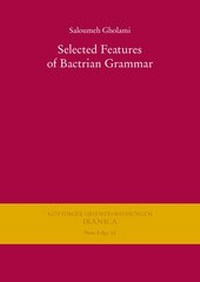
Selected Features of Bactrian Grammar
1st Edition
Published on 2. January 2015
238 pages
978-3-447-19338-2 (ISBN)
Description

Bactrian, the only Iranian language written in the Greek alphabet, was spoken in ancient Bactria in northern Afghanistan. It is an intermediary Middle Iranian language, possessing the characters of both Eastern and Western Iranian groups, and thus playing a very important role in the dialectology of Iranian Languages.
Saloumeh Gholami's study deals with various relatively unknown phonological, morphological and syntactical features of Bactrian and includes the following topics: historical phonology of Bactrian; the syntactical position of different kinds of nouns and their relationship in a sentence; the different types of pronouns and their syntactical properties; the function and syntactical position of prepositions and postpositions; adverbs and their formation; proximate and remote deixis adverbs as well as their different syntactic positions; various kinds of conjunctions and their functions; selected aspects of the verb; word order in clauses with transitive or intransitive verbs, and an investigation of double object constructions; as well as the different types of compounds.
All prices
More details
Other editions
Additional editions
Saloumeh Gholami
Selected Features of Bactrian Grammar
Book
12/2014
1st Edition
Harrassowitz Verlag
€58.00
Shipment within 5-7 days
Content
- Cover
- Title Page
- Copyright
- Table of Contents
- Body
- Abbreviations
- Table of phonetic values
- Acknowledgements
- 1. Chapter One: Introduction
- 1.1 Bactria
- 1.2 Bactrian language and script
- 1.3 Bactrian sources
- 1.3.1 Coins
- 1.3.2 Seals
- 1.3.3 Inscriptions
- Surkh Kotal
- Rabatak
- The other inscriptions
- 1.3.4 Manuscripts
- 1.3.5 Documents
- 1. Legal documents
- 2. Lists and accounts
- 3. Letters
- 4. Buddhist texts
- 5. Fragments of documents of uncertain type
- 1.4 Aims and assumptions
- 2. Chapter Two: Historical phonology of Bactrian
- 2.1 Consonants
- 2.2 Simple consonants
- 2.2.1 PIr. plosives
- 2.2.1.1 PIr. *p, *t, *k
- *# p& p
- *-p- & v and b
- *# t & t
- *t & d,( d?)
- *# k- & k
- *-k- & g
- 2.2.1.2 PIr. *b, *d, *g
- *b & &ß&=[v]
- *d & l
- *g & ?
- 2.2.1.3 PIr. *c, *j
- *c & ?
- 2.2.2 PIr. fricatives and affricates
- 2.2.2.1 PIr. *f, *?, *x
- *f & f
- *? & h
- *x& x
- 2.2.2.2 PIr. *s, *z
- *s & s
- *s & s
- *z & z
- 2.2.2.3 PIr. *s
- *-s- & s
- *-s- & h
- 2.2.2.4 PIr. *h
- *h & h
- 2.2.3 PIr. Sonorants
- 2.2.3.1 PIr. *m, *n
- *m & m
- *-n- & n
- 2.2.3.2 PIr.*r
- *-r- & -r-
- 2.2.3.3 PIr. *w
- *w & w
- 2.2.3.4 PIr. *y
- *y & y
- 2.2.4 Summary of the system of consonants
- 2.3 Consonant clusters
- 2.3.1 Combination with plosives
- 2.3.1.1 Plosive + Plosive
- *gd & ?d
- 2.3.1.2 Plosive + Affricate
- *-tc- & ts &s& and once &??&
- 2.3.1.3 Plosive + Nasal
- *-gn- & ?n
- 2.3.1.4 Plosives + Approximant
- *-dy & l
- 2.3.1.5 Plosives + Trill
- *dr & lr (or dr)
- 2.3.2 Combination with nasals
- 2.3.2.1 Nasal + Plosive
- *-nt- & nd
- *ntc & ndz
- *-nd- & nd
- *-mb- & mv
- *-mp- & mv
- *-mk- & ng
- 2.3.2.2 Nasal + Fricative
- *n? & h
- *-ns- & s
- 2.3.2.3 Nasal + Affricates
- *nc & ndz
- *nj & ndz/nz
- 2.3.3 Combination with fricatives
- 2.3.3.1 Fricative + Plosives
- *ft & vd
- *-xt- & ?d
- *-xt- & ?(?)d
- *st & st
- *sp & sp
- *st & t
- *st & st
- *-zd- & zd
- *-zd- & z
- *sk & sk
- *sk & sk
- 2.3.3.2 Fricative + Fricative
- *-xs- & xs
- *# fs-& f
- *# fs-& x
- *-fs-& fs
- *-fs-& f
- *# xs- & s
- *# xs- & x
- *-xs- & xs
- *-xs- & x
- *#xsn & xn
- *-xst- & xt
- *-xst- & xs
- *-stk- & -sk-
- 2.3.3.3 Fricative + affricate
- *sc & ?
- 2.3.3.4 Fricative + Nasal
- *-xm- & xm
- *sm & hm
- *-sm- & hm
- *hm & hm
- *-zn- & zn
- 2.3.3.5 Fricative + Trill
- *#fr- & fr
- *# fra- & fr(?)
- *#sr & s
- *-str- & s
- *?r- & hr & r
- *?r- & hr
- *?r & r
- *-hr- & r
- *# xr- & xr
- *-xr- & xr
- *# xr- & xir
- 2.3.3.6 Fricative + Approximant
- *?w& lf
- *# dw- & lß
- *# dw& ß
- *xw & xo
- *hw- & xo
- * ?y & i
- *zy & z
- *sy & s
- 2.3.4 Combinations with affricates
- 2.3.4.1 Affricates + Approximant
- *cy & s
- *cy-& s (s)
- *jy & z (?)
- 2.3.5 Combination with Trill
- 2.3.5.1 Trill + Plosives
- *-rt- & rd
- *-rd- & rd
- *-rd- & -rl-
- 2.3.5.2 Trill + Fricative
- *-rs- & s
- *rz & z
- *-rz- & rz
- *rs & rs
- *-rst- & -st-
- 2.3.5.3 Trill + Nasal
- *-rn- & r
- *-rn- & rn
- *rm & rm
- 2.3.6 Combination with approximant
- 2.3.6.1 Approximant + r
- #*wr & r
- 2.4 Phonological processes: Metathesis
- 2.5 Vowels
- *# i & i
- 2.6 Simple vowels
- *# a & a
- *-a- & a
- *#a & a
- *a & a
- *# i & Ø
- *i & i
- *i & a/? (in Greek script a)
- *# u & ? (in Greek script a)
- *# u & u
- *u & u
- *-?- & -ir- (??)
- *-?- & -ur- (??)
- 2.7 Loss of vowels
- 2.7.1 Loss of #V-
- *# a & Ø
- 2.7.2 Loss of -V- (Syncope):
- -Between plosive and sonorant:
- -Between plosive and plosive:
- -Between fricative and plosive:
- -Between fricative and nasal:
- 2.7.3 The treatment of final vowels
- *a # & Ø
- 2.8 Diphthongs
- *au & o
- *ai & e
- *aya & e (& i)
- *aya & a
- *-aya# & i (or sometimes yi)
- *iya & e or i
- *iya & i
- *iya & e
- *awa-& o
- *-awa- & awa
- *-awa- & awa
- *-awa- & awa
- *-awi- & a
- 2.9 Combination of vowel and consonant
- 2.9.1 Combination of w with vowels
- 2.9.1.1 In initial position
- *# wa- & wa & o
- *# wa- & wa
- *# wi-& wi
- 2.9.2 Combination of y with vowels
- 2.9.2.1 In final position
- *arya # & er (??)
- 2.9.3 The combination of other consonants with vowels
- 2.9.3.1 In final position
- *-an # & Ø
- *am # & Ø
- *Vh # & Ø
- 2.10 Palatalization
- * a & i /-.ya, -.i
- *a & e /-.ya
- * a & i /-.s,-.z
- * a & -.i /-.n
- 2.11 Vowel assimilation
- *a & o /-.u
- *i & ?
- 2.12 Dissimilation
- *# wi- & ya
- 2.13 Lowering (?)
- *i & e (?)
- 2.14 Reduced vowel (?):
- Ø & ?/ #-CC
- *a, i & ?
- *-xm- & x?m
- 2.14.1 Suffixal k
- A.1. *-aka- & -??
- A.2. *-aka- after a voiceless consonant & -??
- A.3.*-aka- after ? & -ax?
- B. *-aka- & -a??
- C. *-iyaka- & ??? & ???
- 2.15 Summary
- 3. Chapter Three: Nominal phrases
- 3.1 Number and case
- 3.1.1 Substantive
- 3.1.2 Adjective
- 3.2 Gender
- 3.2.1 Genitive construction
- 3.2.2 Apposition
- Apposition without particle ?
- Apposition with particle ?:
- Apposition containing a group of words
- 3.2.3 Numerals
- 3.2.3.1 Cardinal numbers
- 3.2.3.2 Plural or no plural ending
- 3.2.3.3 Combined numerals
- 3.2.3.4 Ordinal numbers
- 3.3 Adjectives
- 3.3.1 Word formation
- 3.3.2 Nominal phrases consisting of an adjective
- 3.3.3 Ordering of adjectives
- 3.4 Summary
- 4. Chapter Four: Pronouns
- 4.1 Personal pronouns
- 4.1.1 The direct full pronouns
- 4.1.2 The oblique full pronouns
- Possessive function
- 4.1.3 Enclitic pronouns
- The position of enclitic pronouns
- After a conjunction
- After a preposition
- Attached to a verb
- Attached to another enclitic pronoun
- 4.1.4 Ordering of enclitic and full pronouns
- 4.2 Demonstratives
- 4.3 Reflexive forms
- 4.3.1 Reflexive pronouns
- 4.3.2 Reflexive adjectives
- 4.4. Indefinite pronouns
- 4.4.1 With animates
- 4.4.2 With inanimates
- 4.4.3 With both animates and inanimates
- 4.5 Possessive pronouns
- With inanimates
- With animates
- 4.6 Relative pronouns
- 4.6.1 Main relative pronouns
- 4.7 Summary
- Personal pronoun
- Demonstratives
- Reflexive pronoun
- Indefinite pronoun
- Possessive pronoun
- Relative pronoun
- 5. Chapter Five: Prepositions and postpositions
- 5.1 The functions of prepositions and postpositions
- 5.1.1 aß?, aßa-, aß- "to, for, in, etc."
- In an ergative construction:
- In a non-ergative construction:
- A special case
- aß? as object marker or directive?
- 5.1.2 fa??, fa?a-, fa?- "to, for"
- 5.1.3 as? "from, (out) of, by, against, concerning, according to, in respect of, as a result of, than, etc."
- 5.1.4 p?d?, p?d-, p?dd- "in, on, by, with,."
- 5.1.5 p?s?, p?sa-, p?s?a- "to, in the presence of"
- 5.1.6 a??
- 5.1.7 ?aßa?d?, ??ßa?d?
- 5.1.8 p?d??a?? "because of, by the agency of"
- 5.1.9 Prepositions as preverbs
- 5.2 Summary
- 6. Chapter Six: Adverbs
- 6.1 Formation of adverbs by suffixes
- 6.2 Types of adverbs
- 6.3 Deictic adverbs
- 6.3.1 Proximate deixic adverbs
- 6.3.2 Remote deixis adverbs
- 6.4 Syntactical positions of adverbs
- 6.5 Summary
- 7. Chapter Seven: Conjunctions
- 7.1 Coordinating conjunctions
- 7.1.1 Rarely attested coordinating conjunctions
- 7.2 Correlative conjunctions
- 7.3 Subordinating conjunctions
- 7.3.1 Time
- 7.3.2 Cause/Effect
- 7.3.3 Condition
- 7.4 Summary
- 8. Chapter Eight: The verb
- 8.1 Position
- 8.1.1 Two verbs in a construction
- 8.2 Agreement with subject
- 8.3 Passive and ergative constructions
- 8.3.1 Passive in Bactrian
- 8.4. Auxiliary verbs
- Perfect
- Pluperfect
- Past Subjunctive
- 8.4.1 The syntactic position of the auxiliary verb
- 8.5 Summary
- 9. Chapter Nine: Word order
- 9.1 Nominal sentences
- 9.1.1 The presence of a copula
- 9.1.1.1 The position of the copula
- The absence of the copula
- 9.1.2 The nominal sentence of possession
- 9.2 Verbal sentences
- 9.2.1 Intransitive verbs
- 9.3 Transitive verbs
- 9.4 Double object constructions
- 9.5 The order of elements in Bactrian
- 9.6 Summary
- 10. Chapter Ten: Compounds
- 10.1 Bactrian compounds according to the grammatical feautures of elements
- a. Noun
- b. Adjective
- c. Suffix
- d. Adverb
- e. Past participle or past stem
- a. Noun
- b. Adjective
- c. pp or past stem
- a. Noun
- b. Adjective
- c. Adverb
- 10.2 Bactrian compounds according to the syntactical features of elements
- 10.2.1 Exocentric
- 10.2.1.1 Bahuvrihi (possessive compound)
- 10.2.1.2 Verbal governing
- 1. ???-"do, make".
- 2. ßa?- "bring"
- 3. ?a?- "give".
- 4. ?stad? "to put"
- 5. ??s- "come, arrive"
- 6. ???- "to strike"
- 10.2.1.3 Prepositional governing
- 10.2.1.4 Derivative (Ableitung)
- 10.2.2 Endocentric
- 10.2.2.1 Determinative compound
- a. Adjective + substantive or substantive + adjective
- ß. Substantive + substantive
- 10.2.2.2 Copulative (Dvandva)
- 10.3 Tripartite compounds
- 10.4 Seam vowel
- 10.5 Summary
- References
